Choosing an Industrial Piping Contractor: 12 Questions to Ask
Choosing an industrial piping contractor comes down to four things you can verify before you award the job: the piping code the firm builds to, how its welders and procedures are qualified, whether it fabricates in its own shop, and what it has actually done inside a plant that could not stop production. Price sorts bids. Those four sort contractors. Everything else on the list below is a way of confirming one of them.
This is written for plant engineers, maintenance managers, and facility directors in Erie, Huron, Lorain, Ottawa, and Sandusky counties who have to put a piping scope out to bid, defend the award internally, and live with the result through the next shutdown.
Key takeaways
- Ask which piping code governs your system before anything else. A bidder who cannot name ASME B31.3 or ASME B31.1 for your service is quoting labor and material, not a piping system.
- Welder qualification is specific to a procedure, a position, a material, and a thickness range. A general claim of certified welders answers nothing.
- In-house fabrication controls fit-up, purge quality, inspection, and schedule. Subcontracted fabrication adds a handoff at the point where drawings turn into steel.
- Operating-plant experience is the qualification you cannot buy back later. Ask for a specific job with a specific constraint, not a client list.
- Normalize scope before you compare price. Most bid spread comes from code, testing, material specification, and the shop-versus-field split.
What separates an industrial piping contractor from a general mechanical bidder?
Process piping carries product, not people’s drinking water. It is designed for a fluid service, a design pressure, and a design temperature, and it is built and inspected under a piping code rather than the plumbing code. That distinction drives the material, the joint, the examination, and the paperwork you receive at turnover.
A general mechanical bidder may be entirely competent at building systems and still be the wrong firm for a 150 psi caustic line or a 350 F thermal fluid loop. If you are new to the split, our explanation of what process piping is and how it differs from plumbing covers where the line falls.
The practical test is simple. Describe your service out loud to the bidder: the fluid, the pressure, the temperature, the cycles, the cleaning regime. A firm that works in process piping will start asking you questions back within about a minute. A firm that does not will start talking about crew rates.
Which piping code will the work be built to, and can the bidder name it?
This is question one for a reason. Most chemical, paint, plastics, and general manufacturing process piping falls under ASME B31.3 Process Piping. Utility steam, condensate, and boiler external piping generally fall under ASME B31.1 Power Piping, with the boiler proper governed by the ASME Boiler and Pressure Vessel Code.
Hygienic and bioprocess systems bring in ASME BPE, which governs surface finish, drainability, and joint design in ways that a carbon steel shop will not have on its radar. Building services piping inside the envelope may fall under ASME B31.9 instead.
Ask the bidder to state the governing code in writing, on the bid, per system. When two bidders name different codes for the same line, one of them has misread the scope, and you want to find that out before steel is ordered rather than during the pressure test.
How do you verify welding and material quality before the first joint?
Welder and procedure qualification
Certification is not a general credential a company holds. A welder is qualified to a written procedure, in a position, on a base material, within a thickness and diameter range. Ask which procedure specifications cover your work, ask for current qualification records for the people who will actually be on your job, and ask who maintains continuity records. The American Welding Society codes and standards catalog is the reference point for what those documents look like.
Material traceability
For process service, you should be able to trace a spool in your plant back to its material test report. That matters when a corrosion question surfaces three years later, and it matters immediately in food, pharmaceutical, and regulated chemical service. Ask what a completed turnover package contains and ask to see a redacted example from a past job.
Testing, examination, and documentation
Pressure testing, flushing, purging, radiography or other nondestructive examination where the code requires it, and passivation on stainless systems are part of the work. They are not extras. Ask which tests are in the price, what percentage of welds gets examined, who witnesses, and what documentation you receive. A bid that omits testing is not lower. It is incomplete.
Does the contractor fabricate in its own shop, or subcontract it?
This is the most useful single question on the list. A contractor with its own fabrication facility controls fit-up, purge gas, weld inspection, and schedule. A contractor who subcontracts fabrication controls none of those, and has inserted a handoff at the exact point where drawings turn into steel.
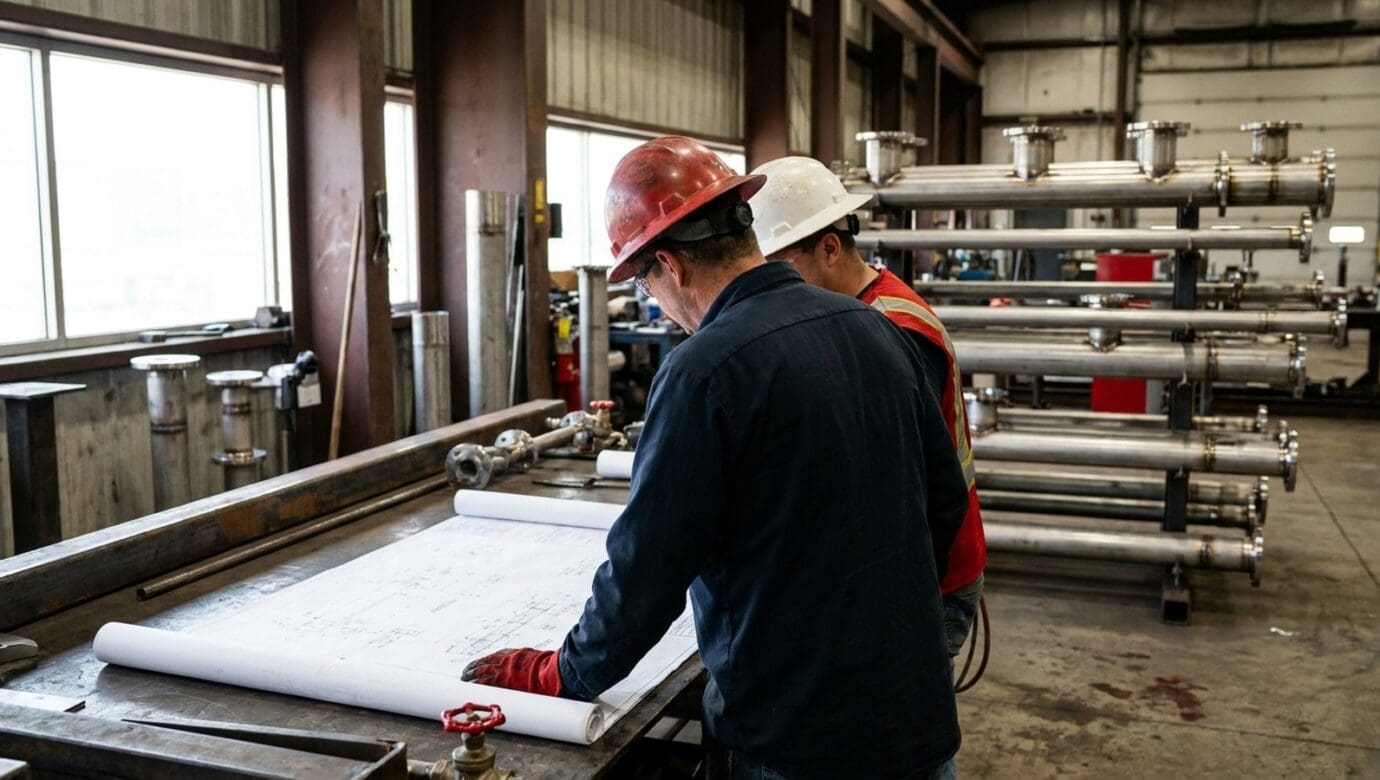
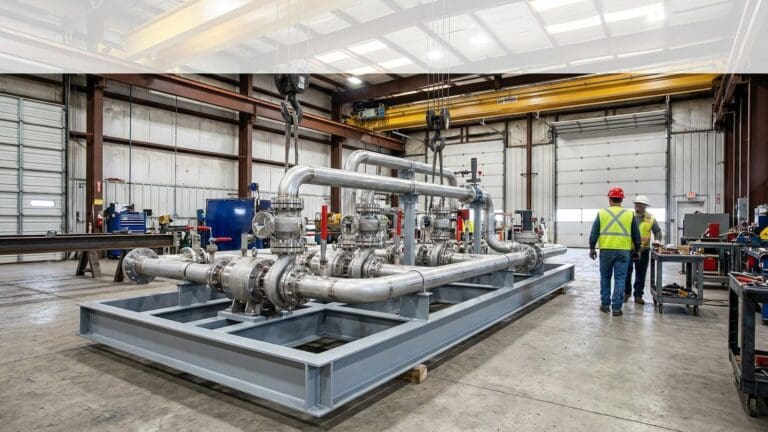
Shop hours are also cheaper, safer, and cleaner than field hours in an operating plant. The more of your job that can be built on a rack under good light and moved to the site as a finished assembly, the fewer hot work permits, confined space entries, and overhead welds you pay for. Wilkes runs its own welding and fabrication operation, including orbital welding and prefabricated piping skids, for that reason.
Two follow-up questions separate a real shop from a rented bay. Ask what percentage of your scope the bidder expects to prefabricate, and ask how spools will be tagged and staged to match the tie-in sequence. Our writeups on prefabricated piping skids and on orbital welding for high-purity lines explain what the shop-built approach changes on the schedule.
Can the crew work safely inside a plant that is still running?
Working around production is a distinct skill, and it is the one most often missing from an otherwise qualified bid. It involves tie-in sequencing, energy isolation, hot work permitting, containment, dust and fume control, and the discipline to stop and give an area back when operations needs it.
Ask how the bidder handles energy isolation under OSHA 29 CFR 1910.147, whose lock goes on the valve, and how the isolation is verified rather than assumed. Ask how hot work is permitted and fire watched, and how they coordinate with your program under the OSHA welding, cutting, and brazing requirements. If the work touches a covered process, ask directly how they participate in your management of change and mechanical integrity program under OSHA 29 CFR 1910.119.
Then ask for one job, by name, with a constraint like yours. At CertainTeed Products Corp., the shingle manufacturing process needed a comprehensive upgrade to existing infrastructure, and the primary challenge was implementing a fume collection system for asphalt storage operations while improving thermal efficiency at the same time. That is the shape of the answer you want: a real constraint, and how the contractor worked around a process that had to keep running.
What this means in Ohio: a fume or emissions scope attached to a piping project can bring in permitting through Ohio EPA air pollution control, and the review clock is usually longer than the fabrication lead time. Ask at bid time who is responsible for the permit narrative and the equipment data, because that answer decides whether your startup date is real.
Who owns the project, and does the firm do engineering as well as installation?
A named project manager
You want a person, not a dispatch queue. Ask who owns schedule, cost, quality, safety, and communication, and ask what the reporting cadence is. If a bidder cannot tell you who will call you on Friday afternoon with a status, nobody will call you on Friday afternoon.
Design capability
Some plants have engineering in house and need a builder. Many do not, and a contractor who only installs will build exactly what the drawing says, including its errors. Decide which model you want before you write the request for quote, because the two are not comparable on price. Our overview of design-build mechanical contracting lays out where the single-team approach cuts change orders, and Wilkes runs that work through custom design-build services.
Material selection for your actual service
Ask how the bidder would choose between stainless, carbon steel, alloy, lined pipe, and thermoplastic for your fluid, temperature, and pressure. A qualified industrial process piping contractor will ask you about chlorides, solids loading, and cleaning chemistry before answering. A contractor who names a material without asking is quoting what sits in the rack. Corrosive service in particular deserves a written basis, and our notes on piping for chemical and paint plants go through the tradeoffs.
How should you compare bids that are not the same?
Send the questions in writing with the bid documents instead of asking them at the walkthrough. Written answers are comparable, and they expose gaps that a confident conversation covers up. Score them on a fixed weighting so the award survives review.
| Question | What a strong answer includes | Weight |
|---|---|---|
| 1. Governing code per system | Names B31.3, B31.1, BPE, or B31.9 by system, in writing | High |
| 2. Welder qualification | Procedure numbers, positions, materials, continuity records | High |
| 3. In-house fabrication | Own shop, prefabrication percentage, spool tagging plan | High |
| 4. Material traceability | Test reports tied to spool numbers at turnover | Medium |
| 5. Testing and examination | Tests priced, examination percentage, witness plan | Medium |
| 6. Operating-plant experience | A named job with a comparable constraint | High |
| 7. Named project manager | One owner of schedule, cost, quality, and safety | Medium |
| 8. Engineering capability | Design in house or a stated partner, split defined | Medium |
| 9. Material selection basis | Questions back about fluid, temperature, and cleaning | Medium |
| 10. Safety program | Written program, site staffing, stop-work authority | High |
| 11. Peak staffing | Where extra pipefitters come from and who vets them | Medium |
| 12. Local response | Where the nearest crew sits after turnover | Medium |
Run the evaluation in a fixed order so late information does not overwrite early findings:
- Issue the twelve questions with the bid documents and require written answers on company letterhead.
- Normalize scope: confirm every bidder priced the same code, the same testing and documentation, the same material specification, and the same shop-versus-field split.
- Score the answers against the weighting above before you open pricing, so the technical read is not colored by the number.
- Open pricing and identify the source of every spread over roughly 10 percent. It usually traces to one of the four scope items in step 2.
- Check two references from plants running a similar process, and ask those references one question: what surprised you after turnover.
- Visit the fabrication shop of the leading bidder. An hour in a shop tells you more about a piping contractor than any proposal.
What matters specifically for plants in Northern Ohio?
Two failure modes sit at opposite ends of the same question. A shop three hours away will not come back for the punch list. A one-truck local outfit cannot staff a shutdown. Ask where the nearest crew actually sits, not where the corporate address is, and ask what a callback looks like the week after turnover.
Winter is the other regional filter. Lake effect snow and long stretches below freezing along the shore from Vermilion to Port Clinton put real load on outdoor process lines, heat trace circuits, safety showers, and makeup air. The National Weather Service Cleveland office forecast area covers this shoreline, and any bidder who has worked here should raise freeze protection before you do. Ask how they route and insulate outdoor lines, and how they test heat trace before the first hard freeze.
Ohio-specific approvals matter too. Building and mechanical work is regulated under rules adopted by the Ohio Board of Building Standards, and boiler installation and inspection run through the Ohio boiler program within the Division of Industrial Compliance. A contractor who works across Ohio regularly will know which plan review applies to your scope and how long it takes. One who does not will find out on your schedule.
Finally, ask about peak staffing. Crew quality is not something you can inspect after the fact, so ask how the bidder scales a shutdown crew, where the additional pipefitters come from, and who vets them. A contractor who cannot scale will either miss the window or bring in labor nobody has checked. You can see the range of work Wilkes has done across these counties on the Wilkes projects page.
Frequently asked questions
What is the difference between an industrial piping contractor and a mechanical contractor?
A mechanical contractor covers building systems: plumbing, heating, ventilation, air conditioning, and the piping that serves a facility. An industrial piping contractor focuses on the process systems that serve production, built to a piping code such as ASME B31.3 rather than the plumbing code. Many firms do both, which helps when one site has domestic water, a steam plant, and a process area that all need coordinating on the same shutdown weekend.
Should I hire separate firms for engineering and installation?
On large capital projects with an engineering firm already engaged, separating the two is often the right structure. On small and mid-size projects, design-build usually cuts schedule risk and change orders, because the team that designed the system is the team that has to install it and gains nothing by leaving a detail unresolved. The tradeoff is that you rely on one firm’s engineering judgment, so vet that judgment before you award.
How do I compare bids that are not scoped the same way?
Normalize scope first. Confirm every bidder priced the same governing code, the same testing and documentation, the same material specification, and the same amount of shop versus field fabrication. Those four items explain most bid spread. When one number sits well below the rest, it is usually missing one of the four, and it is worth requiring the bidder to say in writing which one.
Does an industrial piping contractor need to be local?
Not for fabrication, which travels well on a truck. It matters for field work, tie-in scheduling, and response after turnover. A contractor within reasonable driving distance can staff a shutdown, come back for the punch list, and show up when a line needs attention in February. For Ohio plants, that means asking where the crews are based rather than where the corporate office is.
What should I have ready before I request a piping bid?
Bring the process conditions first: fluid, design pressure, design temperature, flow, and cleaning chemistry. Add a plot plan or existing piping drawings, the tie-in points, your shutdown window, and any plant standards for material, valves, and insulation. If you have a permit or plan review requirement, say so at bid time. That package alone removes most of the guesswork that produces change orders later.
Talk to Wilkes about your project
Bring the process conditions, whatever drawings exist, the tie-in points, and your shutdown window. If all you have is a written description of the problem, that is enough to start. We will give you a straight read on what the work involves, which code governs it, and how much of it can be built in the shop instead of in your plant.
Wilkes Plumbing & Heating has worked out of Huron, Ohio since 1912 and serves plants across Erie, Huron, Lorain, Ottawa, and Sandusky counties and throughout Ohio. Call (419) 433-2325, or request a quote. You are welcome to walk the fabrication shop in Huron before you decide.
Keep reading
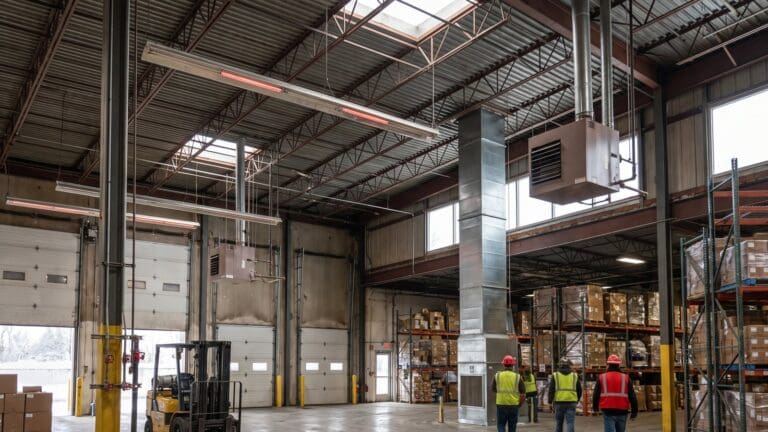
Warehouse Heating in Ohio: Unit Heaters, Infrared and Make-Up Air
A plant engineer's guide to choosing between unit heaters, radiant tube heaters, destratification fans and make-up air, and to balancing exhaust so the building stops fighting its own heat.
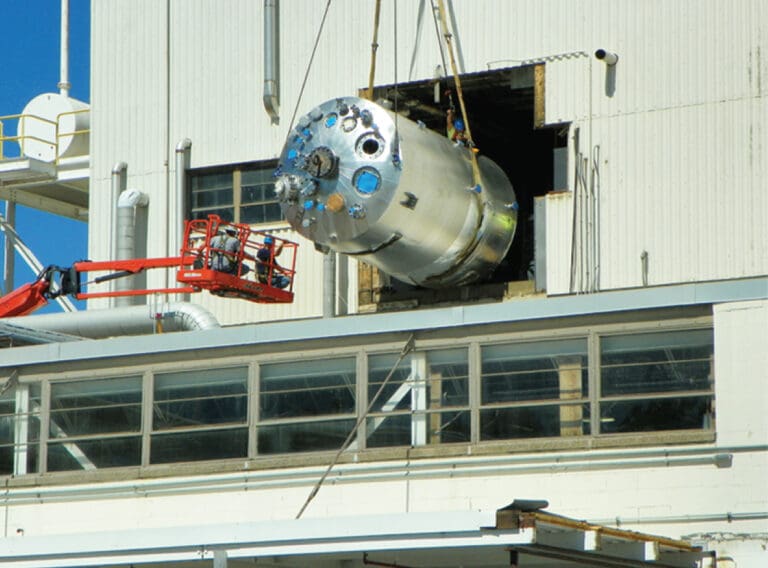
Turnkey Process Piping and a Reactor Install at AkzoNobel
A look inside a turnkey reactor installation and stainless steel process piping scope spread across seven buildings at a Huron, Ohio chemical plant, sequenced so production never stopped.
Prefabricated Piping Skids: Faster Installs, Cleaner Welds
Prefabricated piping skids move the slow, inspection-heavy work off your production floor and into a controlled shop. Here is how Northern Ohio plants scope, test, rig, and tie in a modular process assembly without losing production time.
Need this handled at your facility?
Wilkes engineers, fabricates, and installs process piping, plumbing, and HVAC systems across Ohio.