Commercial Boiler Maintenance: Checklist, Tune-Up and Ohio Rules
Commercial boiler maintenance runs on four clocks: operators read pressure, temperature and water level every day, blow down steam boilers as often as the water treatment program calls for and test the low water cutoff on a fixed schedule, while burner, flame safeguard and relief valve checks follow monthly or quarterly. Once a year, a commercial boiler service opens the fireside and waterside, proves every safety device and ends with a combustion tune-up and a written report. In Ohio, the same program also has to carry the boiler through the inspections required by ORC Chapter 4104.
This guide is for plant engineers, school business officials, hospital facilities directors and building owners in Huron, Sandusky, Norwalk, Port Clinton, Vermilion, Lorain and Fremont who run steam or hot water plants. It sorts the work into what operators can own and what belongs to a service contractor. The plumbing side of the building has its own list in our commercial plumbing maintenance checklist.
Key takeaways
- The low water cutoff, the relief valve and the flame safeguard get tested on a schedule and are never assumed to work.
- A daily boiler log is the cheapest diagnostic tool a plant has.
- A tune-up is a measurement: stack temperature and flue-gas oxygen show whether the burner is wasting fuel.
- Water treatment decides how long the pressure vessel lasts, because hardness builds scale that can cause tube failure.
- Ohio requires a certificate of operation and recurring inspections on intervals set by boiler type.
- The federal tune-up rule for area source boilers covers coal, oil and biomass units, not boilers that burn only gas.
How often does a commercial boiler need maintenance?
Every boiler plant needs a calendar with a name attached to each task. The manufacturer’s manual sets the specifics, and ASME’s Section VI, Recommended Rules for the Care and Operation of Heating Boilers gives operation guidelines for steel and cast iron boilers within the Section IV heating boiler range. The table below is a typical cadence for a commercial program.
| Frequency | Task | Usually owned by |
|---|---|---|
| Daily | Read pressure, temperature and the gage glass; walk the room; fill in the log | Operator |
| Daily (steam) | Blow down the low water cutoff column with the burner firing | Trained operator |
| Daily (steam) | Bottom blowdown on the interval the water treatment program sets | Trained operator |
| Weekly | Check the flame and combustion air openings; record makeup water use | Operator |
| Monthly | Review water tests and the blowdown rate; inspect the relief valve and expansion tank | Operator and water treatment vendor |
| Quarterly | Burner, flame safeguard and gas train checks | Service contractor |
| Twice a year (steam) | Slow drain test of the low water cutoffs | Two technicians |
| Annually | Fireside and waterside inspection, safety device tests, combustion report | Service contractor |
| Per ORC 4104.11 | Required inspection for the boiler type | Owner prepares the boiler and records; inspector performs |
What changes the cadence
Steam boilers need more attention than closed hot water systems, because feedwater solids stay behind as water boils off. A process boiler running around the clock needs readings every shift, while a school boiler idle all summer needs a careful restart, and water quality often decides how tight the schedule must be.
The National Board’s guide to restarting boilers after summer lay-up calls for verifying the water level and testing the low water fuel cutoff as part of the start-up check, and a National Board article on school boiler programs quotes a field staff representative calling the start of the heating season accident season. Book it before the first cold week.
What should operators check every day and every week?
The daily walk-through is where most problems show up first. It takes a few minutes and gives the service contractor a history instead of a guess.
Pressure, temperature and water level
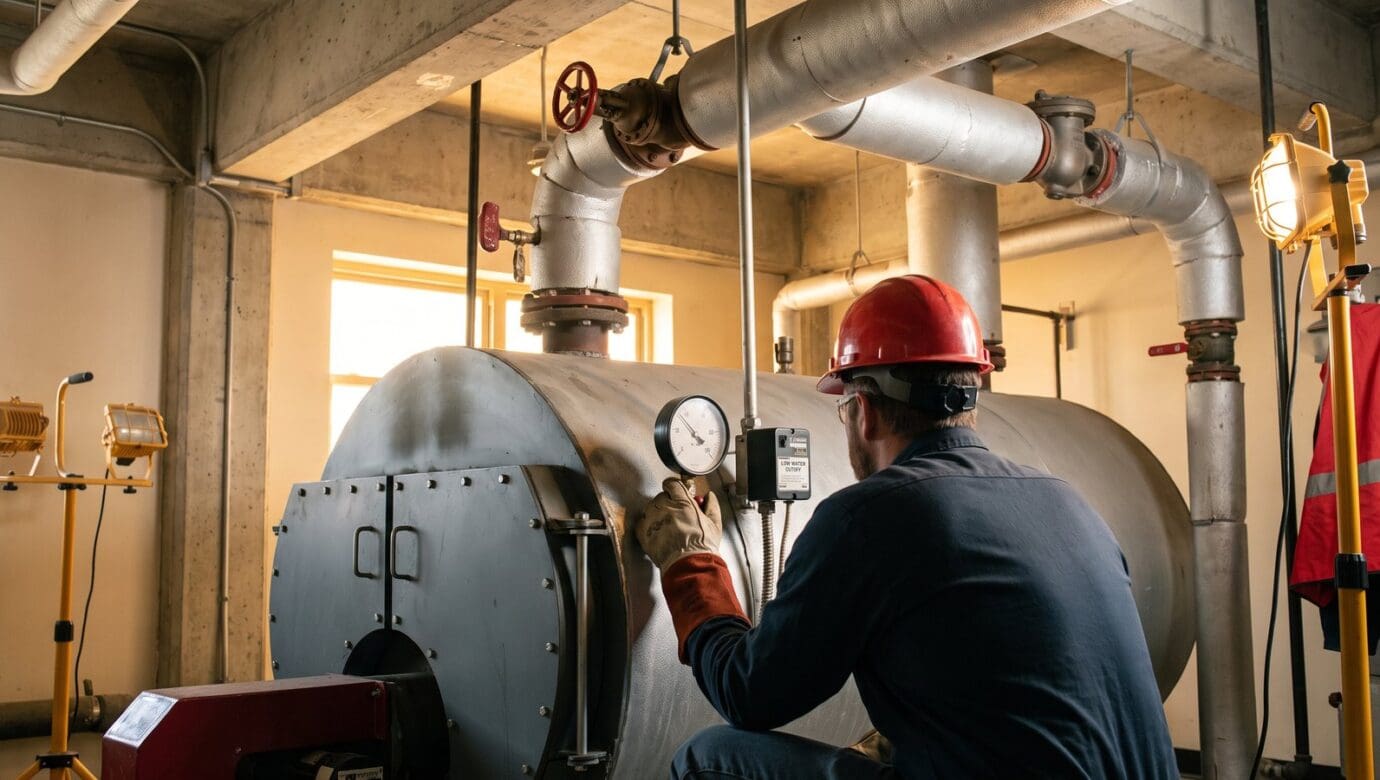
Compare the pressure and temperature gauges with the normal range posted for the boiler, and on a steam boiler check that the water level is visible in the gage glass. A National Board article on low-water fuel cutoffs states that boilers shall not be operated when the water level is not visible in the gage glass. Once a week, look at the flame, clear the combustion air openings and read the makeup water meter.
How to test a low water cutoff safely
The low water cutoff shuts off the burner when the water level drops too low. For steam boilers, ASME CSD-1 recommends a daily test of the low-water fuel cutoff and a semiannual slow drain test, according to the same National Board BULLETIN article, and a cutoff mounted externally in a water column gets a daily blowdown test under load. The article adds two cautions: the Test button on a probe-type control does not prove a shorted or miswired probe works, and the slow drain test normally takes two technicians plus a deliberate check that every jumper is removed afterward. On hot water boilers, follow the manufacturer’s procedure for the cutoff that is installed.
The boiler log
A log sheet or building automation trend should capture pressure, temperature, water level, makeup water, blowdown and cutoff tests, with initials and a time. It shows a slow change, such as stack temperature creeping up, before it becomes a failure.
What belongs on the monthly and quarterly list?
These tasks need tools, more time and sometimes a second set of hands.
Blowdown on steam boilers
Blowdown removes the solids that concentrate as steam boils off, and the blowdown itself is not a monthly task. The DOE tip sheet on minimizing boiler blowdown explains that bottom blowdown is usually a manual procedure done for a few seconds at intervals of several hours to remove suspended solids that settle into a heavy sludge, while surface blowdown, often a continuous process, removes dissolved solids that concentrate near the water surface.
The same sheet puts typical rates at 4 to 8 percent of feedwater flow, up to 10 percent with high-solids makeup water, and warns that too little blowdown leads to carryover and deposits while too much wastes energy, water and chemicals. The monthly job is reviewing the rate against the water tests, because the right rate depends on the boiler type, operating pressure, water treatment and makeup water quality.
Ohio also governs the discharge. Under OAC 4101:4-4-04, a blowoff tank is used where no safe place of discharge is available, and its water may enter a building drain only if it does not exceed 140 degrees Fahrenheit.
Burner, flame safeguard and gas train
Each quarter, check the burner linkage, the flame, the ignition sequence and the gas pressure readings at the train. The same National Board article on school boiler programs is blunt: never bypass controls and limits, and test a suspect flame safeguard on a tester built for the purpose. It also notes that ASME CSD-1 requires controls and safety devices listed by a nationally recognized testing agency and does not allow rebuilt or altered controls, so a replacement part has to meet that rule, not just fit the panel.
Relief valves and expansion tanks
Inspect the relief valve monthly for weeping, corrosion or paint on the spring housing. Ohio requires safety valve discharge to be directed so it does not endanger any person, and an owner or operator who loads a safety valve above the pressure allowed by the certificate of operation is subject to penalty under OAC 4101:4-4-03. On hot water systems, the same restart guide calls for verifying that there is air in the expansion tank and that makeup water is available before start-up.
What happens during the annual boiler service?
The annual service takes the boiler offline, opens it and proves it. It works best in the shoulder season.
Lockout/tagout comes first
Before anyone opens a handhole or pulls a burner, the boiler is isolated and locked out. OSHA’s guidance on controlling hazardous energy warns that the unexpected startup or release of stored energy during servicing can cause serious injury or death, and its examples include a steam valve that turns on automatically and burns workers repairing a downstream connection. The governing standard is 29 CFR 1910.147, and on a boiler, isolation covers the fuel, the electrical supply, the feedwater and the steam or hot water connections.
Fireside and waterside inspection
On the fire side, the technician brushes or vacuums the tubes or flue passages and looks for soot, refractory damage and flame impingement. Heavy soot usually points back to combustion: the DOE tip sheet on boiler combustion efficiency notes that too little excess air produces unburned combustibles such as soot, smoke and carbon monoxide. On the water side, handholes and manways come open so scale, sludge, pitting and corrosion can be seen.
Controls, safety devices and the combustion report
Ohio’s rule in OAC 4101:4-4-03 requires safety devices and controls to be installed and tested as the ASME Boiler and Pressure Vessel Code and the National Board Inspection Code require. It prohibits operating a boiler without them, except with alternate devices on a temporary basis, and requires replacement devices to meet the rules for new ones. The annual service tests the low water cutoffs, operating and high limit controls, flame safeguard, fuel pressure switches and relief valves, and startup, water treatment and combustion reports are on the list of boiler services we provide.
What does a boiler tune-up consist of?
A boiler tune-up adjusts the air-to-fuel ratio so the burner fires completely with as little excess air as it can safely run. It is measured, adjusted and measured again, and the before-and-after readings go in the report.
Stack temperature, oxygen and excess air
The DOE tip sheet on boiler combustion efficiency names stack temperature and flue-gas oxygen, or carbon dioxide, as the primary indicators of combustion efficiency. It calls hand-held analyzers a recommended investment for any boiler system with annual fuel costs above $50,000. It also puts 10 percent excess air within reach on well-designed natural gas systems, and gives a rule of thumb that efficiency rises about 1 percent for each 15 percent reduction in excess air or each 40 degree Fahrenheit drop in stack temperature.
When federal tune-up rules apply
EPA’s area source boiler rule, 40 CFR Part 63 Subpart JJJJJJ, covers boilers at area source facilities that burn coal, oil or biomass, not boilers that burn only gaseous fuels. Most covered units need a tune-up every 2 years or every 5 years, as applicable, according to EPA’s compliance brochure for the rule, while large coal-fired boilers other than limited-use units carry emission limits instead. A gas-only boiler sits outside the rule, but fuel cost and safety still justify its annual tune-up.
Why is boiler water treatment required?
Water treatment decides how long the pressure vessel lasts. The DOE sourcebook Improving Steam System Performance says hardness leads to scale buildup and foaming, which reduce boiler efficiency and can cause tube failure. Softeners remove hardness through ion exchange, and deaerators reduce dissolved oxygen, which the sourcebook calls a significant problem because of its corrosivity at high temperatures. Water treatment and chemical cleaning are part of the boiler and hydronic work we cover.
Closed hydronic loops versus open steam systems
A closed hot water loop should see very little makeup water, so its treatment is mostly about holding inhibitor levels. When the makeup meter moves, something is leaking, and fresh water brings new oxygen and minerals with it. Loops that carry glycol add one more test, covered in our guide to winterizing commercial plumbing and heating.
Steam systems lose water through blowdown and unreturned condensate, so their chemistry needs closer management, and our article on industrial pipe insulation covers the heat lost from steam and condensate piping. A steam to hot water conversion trades steam chemistry for closed-loop care, as in the Oberlin College project, where legacy steam and condensate systems were converted to hydronic heating and chilled water cooling.
How does Ohio’s inspection cycle shape the maintenance plan?
Ohio regulates commercial boilers directly. The Boiler Section of the Ohio Department of Commerce administers and enforces ORC Chapter 4104 and OAC 4101:4, and makes sure equipment is constructed, installed, operated, maintained, altered and repaired according to ASME and NBIC requirements.
Certificates of operation and renewal fees
Under ORC 4104.12, a boiler outside the statutory exemptions is inspected when installed and cannot run until the state issues a certificate of operation. ORC 4104.18 then has the owner or user pay an annual renewal fee scaled to the inspection interval, with a 25 percent late fee on an invoiced fee left unpaid for 45 days.
Inspection intervals by boiler type
ORC 4104.11 sets the maximum intervals:
- Power boilers and high pressure, high temperature water boilers: internal and external inspections under operating conditions at least once a year, unless approved for biennial inspection.
- Low pressure boilers: an external inspection under operating conditions at least once a year and, except for cast iron boilers, an internal inspection at least every three years.
- Process boilers: internal and external inspections at least every three years, unless approved for quinquennial inspection.
Plan the annual service so it lands ahead of the external inspection. When an internal inspection is due, schedule it for the same outage so the boiler is opened only once.
Exemptions and inspection day
ORC 4104.04 exempts some boilers from the inspection and certificate sections, including steam boilers at no more than 15 psig and hot water boilers within 160 psig or 250 degrees Fahrenheit in private residences or apartment houses of fewer than six family units. Even those must carry the safety appliances the board prescribes, and a boiler in a school, hospital, plant or office building does not fit those residential exemptions.
For boilers installed or replaced, Ohio’s clearance rule, OAC 4101:4-4-05 calls for at least three feet of clear space on the control and service sides, with room for inspection and maintenance. On inspection day, have the log, the last inspection report, the water treatment records and the latest combustion report on hand.
What this means in Ohio: The inspector who signs off on a boiler may not work for the state. Under ORC 4104.08, a company authorized to insure boilers in Ohio may designate special inspectors, commissioned by the state, for the boilers its policies cover. Ohio also issues steam engineer and high and low pressure boiler operator licenses, with fees set in ORC 4104.18, and OAC 4101:4-4-03 sends an owner who wants a boiler to run without continuous, manned attendance by a licensed operator to the requirements of OAC 4101:4-10-01.
At South Central High School in Greenwich, our crews replaced the old heating system with a modern, energy-efficient one, including all new piping and pumps, and added a chilled water system for campus air conditioning. A new heating system is the right moment to start a written maintenance program, because the first log entries become the baseline for every later reading. We work with districts and campuses through our education group, and our article on hydronic heating for schools covers the design side.
When does the maintenance log point to replacement?
Maintenance records are also the best evidence for a capital request. When the log shows rising fuel use with no change in the building, repeated findings on the same safety devices, or combustion readings that a tune-up no longer holds, the boiler may cost more to keep than to replace.
ENERGY STAR certified commercial boilers have a thermal efficiency of 94 percent or higher and a turndown ratio of at least 5 to 1, and they use 14 percent less energy than a standard model. The warning signs and the math are laid out in our article on boiler repair or replacement.
How do you turn the checklist into a written program?
A checklist on a clipboard is a start; a written program with frequencies, owners and records keeps the work happening when people change jobs. ANSI/ASHRAE/ACCA Standard 180 is a good model: it establishes minimum HVAC inspection and maintenance requirements that preserve a system’s ability to achieve acceptable thermal comfort, energy efficiency and indoor air quality.
- List every boiler, burner, pump and safety device with its nameplate data and current certificate of operation.
- Give each task in the table above a frequency and an owner.
- Note the inspection due dates under ORC 4104.11 and schedule the annual service ahead of them.
- Write down acceptance limits: normal pressure and temperature ranges, water chemistry targets and the last combustion readings.
- Keep the log, test records, water reports and combustion reports in one place.
- Review the program each spring against the heating season’s records.
Boiler work rarely stands alone. The same outage often covers pumps, piping and controls, which fall under our commercial plumbing and HVAC work.
Frequently asked questions
How often should a commercial boiler be serviced?
A trained operator should check a commercial boiler every day it runs, with weekly, monthly and quarterly tasks on a written schedule and a full contractor service at least once a year. In Ohio, plan that service ahead of the required inspection for your boiler type.
What is included in a boiler service?
A full annual service covers lockout, fireside and waterside inspection, testing of the cutoffs, limits, flame safeguard and relief valves, and a combustion analysis with burner adjustment. It should end with a written report of the readings and any deficiencies.
How do you test a low water cutoff?
On a steam boiler with a cutoff in an external water column, the operator blows down the column while the burner is firing and confirms the burner shuts off. ASME CSD-1 also recommends a semiannual slow drain test, which normally takes two technicians, and the Test button on a probe-type control does not prove the probe itself works.
What is boiler blowdown?
Blowdown is the controlled discharge of boiler water to remove the solids that concentrate as steam is produced. Bottom blowdown is usually a short manual blow every several hours to remove settled sludge, surface blowdown is often continuous and removes dissolved solids near the water surface, and the rate has to balance deposits against wasted energy, water and chemicals.
How often do boilers need to be inspected in Ohio?
Under ORC 4104.11, low pressure boilers get an external inspection at least once a year and, except cast iron boilers, an internal inspection at least every three years. Power boilers and high pressure, high temperature water boilers are inspected inside and out at least yearly, and process boilers at least every three years, unless approved for a longer interval.
Talk to Wilkes about your project
If you want a maintenance program built around your plant, bring the boiler nameplate data, the current certificate of operation, the last inspection report, recent log sheets, water treatment reports and the last combustion report. If the records are thin, the first service visit becomes the baseline. We work on steam and hot water plants across Erie, Huron, Lorain, Ottawa and Sandusky counties from Huron.
Wilkes Plumbing & Heating is at 205 Sprowl Rd, Huron, OH 44839, serving Huron, Sandusky, Norwalk, Port Clinton, Vermilion, Lorain, Fremont, and the surrounding counties. Call (419) 433-2325, or request a quote.
Keep reading
Warehouse Heating in Ohio: Unit Heaters, Infrared and Make-Up Air
A plant engineer's guide to choosing between unit heaters, radiant tube heaters, destratification fans and make-up air, and to balancing exhaust so the building stops fighting its own heat.
Ohio Data Center Cooling: What It Means for Facility Owners
Liquid cooling turned data center heat rejection into a welded piping job, and that competes for the same welders, shop slots, and long-lead equipment your plant, hospital, or school project needs.

Hydronic Heating Systems for Schools: Design and Retrofits
How Northern Ohio schools and campuses should design, budget, and phase a hydronic heating retrofit, from design water temperature and boiler staging to Ohio inspection rules and the fixed summer construction window.
Need this handled at your facility?
Wilkes engineers, fabricates, and installs process piping, plumbing, and HVAC systems across Ohio.