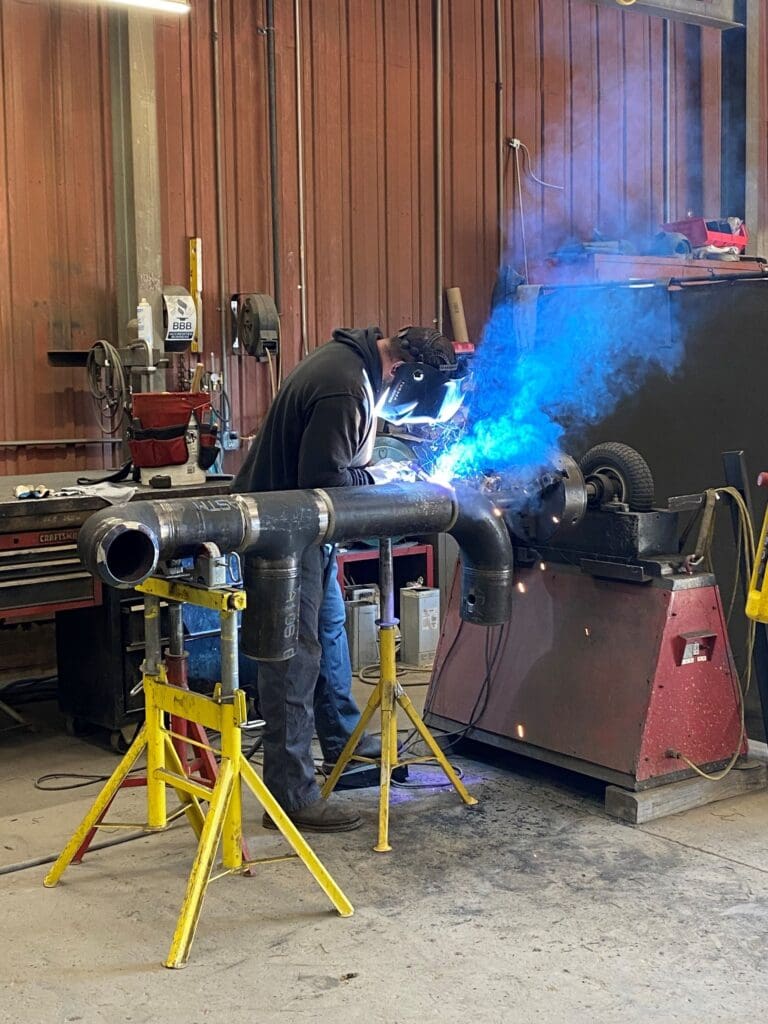
Orbital Welding Services Ohio Manufacturers Depend On
Plant engineers come to us for orbital welding services Ohio quality departments can put in front of an auditor: qualified procedures, welders qualified to those procedures, purge and weld data recorded joint by joint, and a weld map that matches the isometric drawing.
We have worked as a mechanical contractor since 1912, and orbital tube welding sits inside a larger process piping group, so the crew that welds your tube also sets the supports, valves and equipment, tests the system and turns it over.
Why plants specify orbital welds
- Saved, repeatable weld programs
- Full penetration on thin wall tube
- Argon purged, bright interior surface
- Weld data logged per joint
- Shop fabrication, field tie ins
- Procedures qualified to Section IX
Orbital welding systems, materials and methods
Systems we weld
- Sanitary process and product lines
- Clean steam and condensate piping
- Purified water and lab water loops
- CIP and SIP distribution piping
- Chemical transfer and reactor piping
- Compressed air and lab gas lines
Materials and methods
- 304 and 304L stainless steel
- 316 and 316L stainless steel
- Hygienic tube and schedule pipe
- Sanitary fittings, clamps and valves
- Orbital GTAW and manual TIG
- Autogenous and filler added welds
What is orbital welding and where does it beat manual TIG?
Orbital welding is gas tungsten arc welding performed by a machine. A weld head clamps around the tube and carries a tungsten electrode a full 360 degrees around the joint while a controller holds current, travel speed, pulse and rotation to a saved program. On thin wall hygienic tube the weld is normally autogenous, which means the two tube ends are fused without filler metal, so nothing is added to the product contact surface.
The reason plants specify it is repeatability. A skilled hand welder makes a good weld; a qualified program makes the same weld on joint 300 that it made on joint 1, and the controller records what it did on each one. Across a long product rack, that consistency is the difference between a clean turnover and a punch list of cut outs. Our article on orbital welding for high purity lines explains where the method earns its setup time and where a manual root pass is still the better answer.
Who provides orbital welding services Ohio plants can audit?
Anything carrying process fluid falls under a code. ASME B31.3, the process piping code, governs design, fabrication, examination and testing, and it requires that welding procedures and the welders following them be qualified under Section IX of the ASME Boiler and Pressure Vessel Code. For sanitary stainless systems, the American Welding Society publishes D18.1, which covers welding austenitic stainless steel tube and pipe systems in sanitary applications.
As a sanitary welding contractor, that shows up on your job as paper a quality auditor can follow:
- Welding procedure specifications and the qualification records behind them
- Mill test reports and heat numbers for tube, fittings and valves
- Test coupons cut at the start of a shift and after a change to the program, heat lot or gas
- Purge and weld data logged joint by joint against a weld map
- Bore camera checks of the inside face wherever access allows
- Pressure test and turnover records for the finished system
What does high purity stainless steel piping require?
Two things decide whether a sanitary weld passes: what the inside of the joint looks like, and what filled the tube while the arc was running. Oxygen left inside burns the weld root and leaves the dark, sugared surface that traps product and resists cleaning, so the interior is purged with argon and the purge is held until the reading at the outlet is low enough to produce a bright inside face.
ASME BPE, the bioprocessing equipment standard, sets internal surface finish designations and weld acceptance criteria for that work, and 3-A Sanitary Standards covers hygienic design in dairy and food processing. Tube ends are faced square, joints are fit with no more than a hairline gap, and gloves stay on so the product surface reaches the field clean. Where the process calls for it, the system is passivated after fabrication.
Can you prefabricate piping skids and spools in the shop?
Most orbital tube welding belongs at a bench, not on a ladder. Working from your isometrics or ours, we cut, fit and weld spools in the Wilkes fabrication shop, label them to the drawing, and deliver them so the field crew is setting and tying in rather than fabricating. Skid mounted assemblies go further: pumps, valves, instruments and controls are built and tested on a frame before they reach your floor. Our note on prefabricated piping skids covers how that changes a schedule.
Shop work also shortens the part of the job that costs you production. Welding is one piece of our industrial process piping group, so one contractor carries supports, utilities, testing and start up instead of leaving you to referee three trades. Hospitals and labs that need medical gas piping work with the same shop.
What does the work look like at a Northern Ohio plant?
Food and chemical plants near the Lake Erie shore run tight shutdown windows, and most of them land in the holiday weeks or a summer maintenance turn. At Pepperidge Farms in Willard, Ohio we upgraded process piping for the production lines, including seasoning piping, steam and condensate piping, and jacketed piping. At AkzoNobel in Huron, Ohio we handled the turnkey installation of a new reactor, with stainless steel welded process piping across seven buildings.
Welding inside a running plant also means hot work permits and fire watch under NFPA 51B, plus the ventilation and fume control addressed in the OSHA welding, cutting and brazing rules. Winter adds its own list across Erie, Huron, Lorain, Ottawa and Sandusky counties: purge cylinders sitting cold, condensation on tube brought in from a lay down yard, and temporary heat fighting the shielding gas. We plan for it because we work here year round.
How do I request orbital welding from Wilkes?
Send the isometrics, the tube specification and the shutdown window, or simply tell us what the system has to do. Call (419) 433-2325, or request a quote and we will walk the job with you. Our office at 205 Sprowl Rd in Huron, Ohio is open Monday to Friday, 8:00 AM to 4:00 PM.
Frequently asked questions
What is the difference between orbital welding and manual TIG welding?
Both are gas tungsten arc processes. In orbital welding a weld head rotates the electrode around the tube under a saved program that fixes current, travel speed and pulse, so every joint receives the same heat input and the machine records it. Manual TIG depends on the welder holding that consistency by hand, which is the right method for fittings and positions a head cannot reach.
Do you weld stainless tube in the field or only in your shop?
Both. We prefabricate spools and skids at the shop in Huron because bench conditions produce cleaner welds and keep crews out of your production area. Field crews then set the spools and make the tie ins on site, using portable weld heads and power supplies where the joint allows and manual TIG where it does not.
What documentation comes with an orbital welded system?
A turnover package normally includes the welding procedure specifications and welder qualification records, mill test reports and heat numbers for the material, test coupons, purge and weld data tied to a numbered weld map, bore camera results where access allows, and the pressure test and turnover records for the completed system.
Which materials and systems do you weld with orbital equipment?
Mostly austenitic stainless steel, 304, 304L, 316 and 316L, in hygienic tube and in schedule pipe. Typical systems are sanitary product lines, clean steam and condensate, purified water and laboratory water loops, clean in place and steam in place distribution, chemical transfer piping, and compressed air and laboratory gas lines.
How far from Huron will Wilkes travel for orbital tube welding?
We work throughout Erie, Huron, Lorain, Ottawa and Sandusky counties, including Sandusky, Norwalk, Port Clinton, Vermilion, Lorain and Fremont, and we take process piping projects across Ohio. Distance matters less than the shutdown window, so tell us the dates first and we will tell you what the shop can prefabricate before the outage.
Request an orbital welding quote
Orbital welding and sanitary piping
Wilkes Family of Companies