Stainless Steel Process Piping: 304 vs. 316 Specification Guide
Specifying stainless steel process piping comes down to three decisions: which alloy resists the chlorides and chemistry in the line, what surface finish the product or code requires, and how the joints get welded and cleaned up afterward. Get any one of those wrong and you end up with pitting, cracked welds, or a line that fails a sanitary inspection. This guide is written for plant engineers, food and beverage production managers, and facility directors in Northern Ohio who are specifying, reviewing, or troubleshooting a stainless process piping system.
Key takeaways
- 304 and 304L cover most food, water, and general chemical service; 316 and 316L add molybdenum for better resistance to chlorides and many acids.
- Chloride exposure, not just temperature, is the main driver of pitting and stress corrosion cracking in stainless process lines.
- Sanitary and food-contact piping needs a defined surface finish, commonly in the 20 to 32 Ra microinch range, plus orbital welds and drainable geometry.
- ASME B31.3 sets wall thickness and pressure design; the ASME BPE standard adds sanitary geometry and finish requirements for food, dairy, and biopharma lines.
- Passivation after welding and fabrication restores the chromium oxide layer that gives stainless its corrosion resistance.
- Duplex stainless costs more up front but earns its keep in high-chloride, high-pressure service where 316 alone falls short.
What Is the Real Difference Between 304 and 316 Stainless Steel Piping?
304 and 316 are both austenitic stainless alloys built around roughly 18 percent chromium and 8 to 10 percent nickel, which is what gives both grades their corrosion resistance and weldability. The difference that matters in process piping is molybdenum: 316 adds 2 to 3 percent, and that addition is what pushes back pitting and crevice corrosion in chloride-bearing fluids.
304 and 304L handle most potable water, general food contact, mild chemical, and compressed air or utility service without issue. 316 and 316L earn their higher cost in service involving chlorides, brines, many organic acids, and cleaning-in-place chemistry that includes chlorine-based sanitizers.
The “L” suffix on either grade means low carbon, which limits chromium carbide precipitation at the heat-affected zone during welding. Anywhere you are field-welding process piping rather than using pre-fabricated fittings, the L grades are the safer default.
When Does a Line Need 316 Instead of 304?
Chloride concentration, temperature, and how long the fluid or condensate sits in contact with the pipe wall all combine to set pitting and stress corrosion cracking risk. A rule of thumb used across the industry: once dissolved chloride content in a stagnant or slow-moving fluid climbs past roughly 200 parts per million at an elevated temperature, 316 becomes the safer specification over 304.
Northern Ohio plants run into chloride exposure more often than the alloy tables suggest. Road salt tracked into loading dock areas, brine used in some food processing steps, and chlorinated cleaning-in-place cycles all introduce chlorides that a 304 line was never sized to handle. Chemical and paint plant piping is the clearest example: caustic and acid transfer lines, along with any chlorinated solvent service, generally call for 316 from the start.
Steam and clean condensate return lines are usually fine in 304 because chloride carryover is low, but condensate that mixes with cooling tower blowdown or plant wastewater changes that calculus fast.
What Surface Finish and Ra Value Does Sanitary Service Require?
Interior surface finish is measured as Ra, an average roughness value in microinches. Standard mill finish pipe runs 60 to 125 Ra, which is fine for structural or utility service but too rough for anything that needs to stay clean or drain completely.
Food, beverage, and pharmaceutical process lines typically specify a mechanically polished interior in the 20 to 32 Ra range, sometimes tighter for high-purity or biopharma work. 3-A Sanitary Standards and the ASME BPE standard both define finish, crevice-free fitting geometry, and drainability requirements for hygienic piping, and a specification that skips them tends to fail its first sanitation audit.
Our crews have applied this on the Pepperidge Farms Goldfish and cookie production lines, where multiple expansions called for seasoning piping, steam and condensate piping, and jacketed piping built to food-preparation standards. Jacketed lines in particular need a finish and weld profile that will not trap product residue between cleaning cycles.
How Do You Size Wall Thickness and Schedule for Stainless Process Lines?
ASME B31.3, the Process Piping code, sets the pressure design formula that determines minimum wall thickness for any given pipe size, pressure, temperature, and material. Because stainless has a higher allowable stress than carbon steel at most process temperatures, a stainless line frequently qualifies for a lighter schedule, commonly schedule 10S or 40S rather than the schedule 40 or 80 a carbon steel line of the same service would need.
That weight and cost savings only holds if you have accounted for corrosion allowance correctly. Chloride-bearing or high-erosion service still needs the same wall margin stainless would need in carbon steel, and a schedule chosen purely to save weight without checking that allowance is a common way a line under-performs its design life.
Wilkes engineers wall thickness and schedule selection into every stainless process piping package under industrial process piping scope, checking B31.3 pressure design against the actual chemistry, not just the nameplate rating of the fluid.
Ordering Tolerances Matter Too
Stainless tube and pipe come in different dimensional standards. Sanitary tube is ordered to outside diameter with a defined wall, while process pipe follows nominal pipe size schedules. Mixing the two on a project without reconciling fitting compatibility is a common source of field rework.
How Should Stainless Process Piping Be Welded and Purged?
Open-arc hand welding leaves heat tint, oxidation, and inconsistent penetration on the inside diameter of a stainless weld, all of which become corrosion starting points. Orbital GTAW welding runs a preset, repeatable arc around the joint, which is why it is the standard for sanitary, high-purity, and most process stainless piping. Our orbital welding for high-purity process lines article covers the equipment and setup in more depth.
Purging the inside of the pipe with an inert gas during welding is not optional for stainless. Oxygen left inside the joint during welding produces the chromium oxide heat tint that signals a compromised, less corrosion-resistant weld. The general sequence on a Wilkes stainless job looks like this:
- Cap or dam both ends of the joint with purge dams sized to the pipe diameter.
- Purge the isolated section with argon or another inert gas until residual oxygen drops to the target level for the service.
- Verify oxygen content with a calibrated oxygen analyzer before striking the arc.
- Make the orbital weld using parameters set for that pipe size, wall thickness, and material grade.
- Inspect the weld’s interior surface for color, since a straw or blue heat tint means the purge was inadequate.
- Record the weld parameters and inspection result in the project weld log for traceability.
OSHA’s welding, cutting, and brazing standards and American Welding Society codes govern welder qualification and safe practice on top of the purge discipline above, and both apply whether the work happens in our shop or on an active plant floor.
Why Does Passivation Matter After Welding and Fabrication?
Welding, cutting, grinding, and even normal machining smear free iron particles onto the stainless surface and disturb the thin chromium oxide layer that gives the alloy its corrosion resistance. Left alone, that disturbed surface rusts and pits well before the base metal would on its own.
Passivation, typically a citric or nitric acid treatment applied after fabrication, dissolves the free iron and lets a fresh, uniform chromium oxide layer reform. It is a finishing step, not a substitute for choosing the right alloy, and skipping it on a line that will see moisture or chlorides shortens the piping’s service life measurably.
Field-welded stainless, including tie-ins made after initial installation, should get spot passivation on the weld and heat-affected zone even if the rest of the system was passivated in the shop.
Can Insulation Cause Corrosion Under the Jacket?
Insulated stainless steam, condensate, and hot process lines are vulnerable to a specific failure mode called chloride stress corrosion cracking under insulation. Some insulation materials leach chlorides when they get wet, and in the 140 F to 400 F range that combination of moisture, chlorides, and residual stress in a stainless pipe wall can crack the metal from the outside in, often invisibly until the jacket is removed.
This is a real issue for Northern Ohio plants. Lake Erie’s humidity and lake-effect weather push moisture into insulation jacketing at outdoor tie-ins and rooftop runs, and any breach in the vapor barrier during a freeze-thaw winter gives that moisture a way in. Specifying insulation rated chloride-free for stainless service, and keeping jacketing seals intact, matters as much here as the alloy choice itself.
Rule of thumb: Never insulate stainless steel piping with a material you have not confirmed is low in leachable chlorides, and inspect jacket seals at outdoor penetrations every heating season. In a Lake Erie climate, that single check catches most corrosion-under-insulation failures before they reach the pipe wall.
What Does 304 vs. 316 Cost, and When Is Duplex Worth It?
316 stainless typically costs noticeably more than 304 in raw material, largely because of the added molybdenum and nickel content, and that premium carries through fittings, valves, and labor since polished sanitary finishes take longer to produce in either grade. The cost difference is worth paying wherever the chloride and chemistry review above says 304 is marginal.
Duplex stainless grades, which combine austenitic and ferritic structure, cost more again but offer roughly double the yield strength of 316, which can offset some of that premium through a thinner wall schedule. Duplex earns its place in high-chloride, high-pressure transfer lines and in some brine or seawater-adjacent cooling service where 316 alone would need an unreasonably thick wall to hit a reasonable corrosion allowance.
| Material | Typical chloride tolerance | Common process temperature range | Typical use in Ohio plants | Relative material cost |
|---|---|---|---|---|
| 304 / 304L | Low | Ambient to 300 F | Potable water, general food contact, utility and compressed air lines | Baseline |
| 316 / 316L | Moderate to high | Ambient to 400 F | Chemical transfer, CIP chemistry, brine-adjacent food processing, chlorinated cleaning lines | Moderate premium over 304 |
| Duplex 2205 | High | Ambient to 500 F | High-chloride or high-pressure transfer, thinner-wall applications needing extra strength | Highest of the three |
How Do 304, 316, and Duplex Fabricate and Install Differently?
All three grades weld with the same GTAW process and similar purge discipline, but duplex requires tighter heat input control to keep its austenite-to-ferrite ratio balanced, since overheating it during welding can leave the joint more brittle and less corrosion resistant than the base material. That makes welder qualification and procedure control even more important on duplex than on 304 or 316.
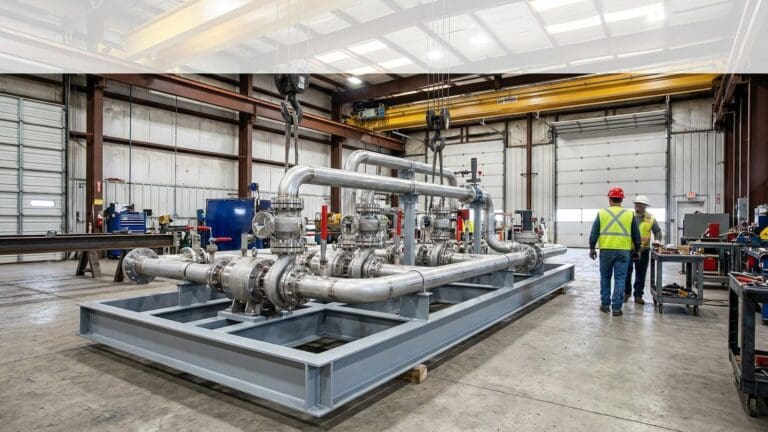
Prefabricating spools in a controlled shop environment, rather than field-welding everything in place, gives more consistent purge quality and finish across all three grades. It is a big part of why industrial piping fabrication work is planned as shop spools wherever a plant’s layout and shutdown schedule allow it.
Talk to Wilkes about your project
Bring your process and instrumentation drawings, the fluid chemistry and temperature range for the line, and any sanitary or code requirements the end product or facility already demands. If you are not sure whether a line needs 304, 316, or duplex, bring what you know about the fluid and we will work through the chloride and temperature review with you before anything gets ordered.
Call Wilkes at (419) 433-2325 to talk through your stainless process piping project, or request a quote to get a scope review started.
Frequently asked questions
Is 316 stainless always better than 304 for process piping?
Not automatically. 316 costs more and is not needed everywhere. For general food contact, potable water, and utility service with low chloride exposure, 304 or 304L performs well and saves money on material and fittings. The decision should follow chloride content, temperature, and cleaning chemistry, not a blanket preference for the higher grade.
What Ra surface finish should I specify for food-contact stainless piping?
Most sanitary food and beverage applications specify an interior finish in the 20 to 32 Ra microinch range, achieved by mechanical polishing after fabrication. Pharmaceutical or high-purity biopharma lines often require a tighter finish. Standard mill finish pipe, at 60 to 125 Ra, is too rough for anything that needs to drain clean or pass a sanitation audit.
Does stainless process piping need to be passivated after welding?
Yes, in almost every case. Welding and fabrication disturb the chromium oxide layer that gives stainless its corrosion resistance and can smear free iron onto the surface. Passivation, usually a citric or nitric acid treatment, removes that contamination and lets a fresh protective layer form, which is what actually delivers the corrosion resistance the alloy is chosen for.
Can insulated stainless piping corrode even though it never sees liquid directly?
Yes. Chloride-bearing insulation that gets wet from a jacket breach can cause stress corrosion cracking on the outside of a stainless pipe wall, particularly in the 140 F to 400 F range. This is a real risk on outdoor and rooftop runs in Northern Ohio’s humid, freeze-thaw climate, so low-chloride insulation and intact jacketing matter as much as the alloy specification.
When does duplex stainless make sense instead of 316?
Duplex earns its higher cost in high-chloride, high-pressure transfer lines where 316 would need an unreasonably thick wall to hold a safe corrosion allowance. Its higher yield strength can also allow a thinner wall schedule, partly offsetting the material premium. For most general chemical, food, and steam service, 316 or 304 remains the more economical and proven choice.
Keep reading
Warehouse Heating in Ohio: Unit Heaters, Infrared and Make-Up Air
A plant engineer's guide to choosing between unit heaters, radiant tube heaters, destratification fans and make-up air, and to balancing exhaust so the building stops fighting its own heat.
Turnkey Process Piping and a Reactor Install at AkzoNobel
A look inside a turnkey reactor installation and stainless steel process piping scope spread across seven buildings at a Huron, Ohio chemical plant, sequenced so production never stopped.
Prefabricated Piping Skids: Faster Installs, Cleaner Welds
Prefabricated piping skids move the slow, inspection-heavy work off your production floor and into a controlled shop. Here is how Northern Ohio plants scope, test, rig, and tie in a modular process assembly without losing production time.
Need this handled at your facility?
Wilkes engineers, fabricates, and installs process piping, plumbing, and HVAC systems across Ohio.