What Is Process Piping? A Plant Manager’s Guide to the Rules
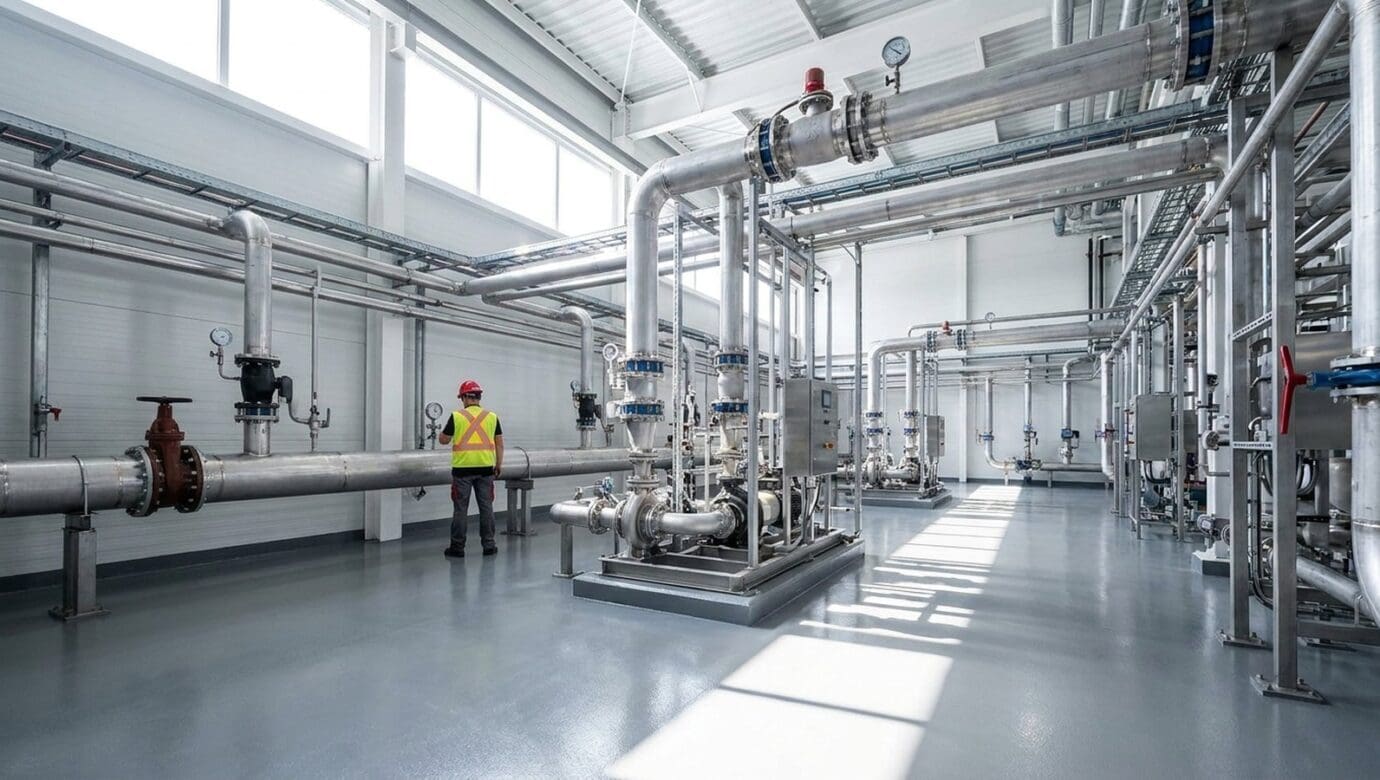
Process piping is the network of pipe, valves, fittings, instruments, and supports that moves raw materials, intermediates, finished product, and process utilities through a plant. It serves production. Plumbing serves the building and the people in it, and that one difference changes the governing code, the joint types, the welder qualifications, the testing, and the closeout package you should expect.
This guide is for plant managers, maintenance leaders, facility directors, and project engineers in Northern Ohio who have to write a scope, compare bids, or decide which trade to call. It covers what counts as process piping, which code applies, how material gets selected, what the project sequence looks like, and what belongs in a turnover package.
Key takeaways
- Process piping serves the product; plumbing serves the building. Sizing follows process conditions, not fixture units.
- Most chemical, paint, plastics, and food process lines fall under ASME B31.3. Utility steam and boiler external piping usually fall under ASME B31.1.
- Write the governing code into the scope. A specification that says “install piping per code” hands the interpretation to whoever bids it.
- Welded joints, material traceability, and documented test records are deliverables on process work, not extras.
- One Ohio plant can contain three regimes at once: plumbing code, power piping, and process piping, inside the same walls.
What counts as process piping in an operating plant?
If the line is part of making the product, it is almost always process piping. In the plants across Erie, Huron, Lorain, and Sandusky counties, that means resin and solvent transfer lines, reactor feed and discharge piping, cooling loops that serve equipment rather than comfort, compressed air and nitrogen headers, steam and condensate on process loads, clean-in-place circuits, and high-purity water distribution.
The test is function, not diameter or material. A 1 in. stainless line carrying catalyst at 150 psi is process piping. A 6 in. cast iron line carrying restroom waste is plumbing. Both may run through the same ceiling.
The scope that gets missed
Equipment vendors quote to their own flanges. A reactor, a filler, or a chiller arrives with connection points and nothing beyond them. Everything from those flanges outward, back to the tank farm, the utility header, or the next unit operation, is process piping, and it is the most common source of schedule slip on a capital project.
Price that interconnect scope early, with a walkthrough rather than a drawing review. Our industrial process piping work is often exactly this: the piping between what was purchased and what already exists.
How is process piping different from plumbing?
Plumbing is governed by the plumbing code and built for building occupants: domestic water, drainage, waste, vent, and in many buildings fuel gas. Sizing follows fixture units, a building department inspects the work, and the failure mode of a mistake is usually a leak, a correction notice, or a cross-connection health risk.
Process piping is governed by the piping code that fits the service, and sizing follows flow, pressure, temperature, and chemical compatibility. The failure mode of a mistake is a release, a contaminated batch, an unplanned outage, or an injury. The two disciplines look similar on a drawing and diverge almost everywhere else.
| Dimension | Commercial plumbing | Process piping |
|---|---|---|
| Governing document | Ohio Plumbing Code (OAC 4101:3) | ASME B31.3, B31.1, or B31.9 by service |
| Sizing basis | Fixture units and demand curves | Process flow, pressure, temperature, viscosity |
| Typical joints | Solder, press, threaded, solvent weld, grooved | Butt weld, socket weld, orbital weld, flanged |
| Personnel qualification | Licensed plumbing trade under state rules | Welders qualified to the specific procedure |
| Testing | Hydrostatic or air test per code, then inspection | Hydrostatic or pneumatic test with documented parameters |
| Examination | Visual inspection by the building department | Visual plus radiography or dye penetrant on a defined percentage |
| Closeout | Inspection sign-off and as-builts | Material test reports, weld maps, welder logs, test records |
Three practical consequences follow.
Welding is the norm, not the exception. Threaded and soldered joints are ordinary in plumbing. In process service, welded joints remove a leak path and a crevice where product can sit. That requires welders qualified to a written procedure, and it means weld quality can be verified instead of assumed. The American Welding Society publishes the qualification framework most process specifications point to.
Documentation is part of the product. Material test reports tie each spool back to a heat number. Weld maps tie each joint to the welder who made it and the procedure used. If a line fails in year four, that record is how you find out why.
Cleanliness has a written specification. A domestic water line gets flushed. A high-purity line gets purged during welding, passivated where the service requires it, and protected from the shop to the tie-in. That craft is covered in our article on orbital welding for high-purity process lines.
Which code governs your system?
Start with the service, not the pipe. ASME B31.3 Process Piping is the usual governing code in chemical plants, paint and coatings plants, plastics processors, and many food and pharmaceutical facilities. It sets design conditions, material requirements, fabrication and examination rules, and leak testing, and it scales the required examination to the fluid service category.
ASME B31.1 Power Piping generally covers boiler external piping and utility steam distribution. ASME B31.9 Building Services Piping covers lower-pressure building service systems sitting between plumbing and heavy industrial work. Hygienic systems in pharmaceutical and biotech work add ASME BPE for surface finish and drainability.
Pressure vessels are a separate question. Reactors, receivers, and heat exchangers fall under the ASME Boiler and Pressure Vessel Code, and in Ohio those installations are administered by the Division of Industrial Compliance. Building permits and inspection authority run through the Ohio Board of Building Standards and the local authority having jurisdiction.
One building, three regimes
A single Ohio plant routinely contains all of it: domestic water and sanitary drainage under the Ohio Plumbing Code, a steam plant under B31.1, and a reactor area under B31.3. Where a process line could contaminate the potable system, cross-connection control becomes its own obligation under Ohio’s backflow rules in Ohio Administrative Code Chapter 3745-95, enforced through the water supplier and Ohio EPA.
A contractor fluent in only one of those regimes will get part of your building right and part wrong. Name the governing code for each system in the scope, in writing, before bid day.
How is the material actually chosen?
Material selection is engineering, not procurement. The inputs are the fluid, its concentration and temperature range, the operating and upset pressures, the cleaning chemistry, and whether the line has to drain, sterilize, or be inspected internally.
Stainless steel is the default for corrosive, sanitary, and high-purity service, and it dominates paint, coatings, and specialty chemical work in this region. Carbon steel is standard for utility air, steam, and non-corrosive service. Higher alloys earn their cost where chlorides, acids, or elevated temperature would eat a 300-series stainless. Thermoplastics and lined pipe handle aggressive chemistry at modest temperature and pressure, where support spacing and thermal expansion become the design problem instead of corrosion.
Two failure patterns repeat. The first is a field substitution made to hold a schedule, where an equivalent-looking material lands in a service it cannot tolerate. The second is a correct material with the wrong joint: a socket weld with a crevice in a line that must drain clean. Both are cheap to prevent at design and expensive to find in production. Our article on piping for chemical and paint plants works through these questions in detail.
What does a process piping project look like, step by step?
The sequence is consistent whether the job is a single tie-in or a full production unit. It breaks down at the boundaries: between engineering and procurement, and between the shop and the shutdown window.
- Define the service. Fluid, concentration, flow, operating and design pressure, temperature range, cleaning method, and the governing code for each line class.
- Engineer the system. Material, wall thickness, joint types, valve selection, support and expansion design, and the examination percentage the code requires for that fluid service.
- Release material early. Alloy pipe, lined pipe, and specialty valves carry the long lead times. Material readiness, not crew size, usually sets the schedule.
- Fabricate in the shop. Build spools where fit-up, purge gas, and inspection are controlled, log each weld, and protect the ends before shipping.
- Plan the tie-in. Confirm isolation points, energy control under OSHA 29 CFR 1910.147, permits for hot work and any confined space entry, and who can stop the job.
- Install and connect. Set spools, make the field welds that could not be shopped, hang and guide the system, and keep open ends closed between shifts.
- Test, clean, and turn over. Pressure test at documented parameters, flush or purge, passivate where required, then hand over the records package.
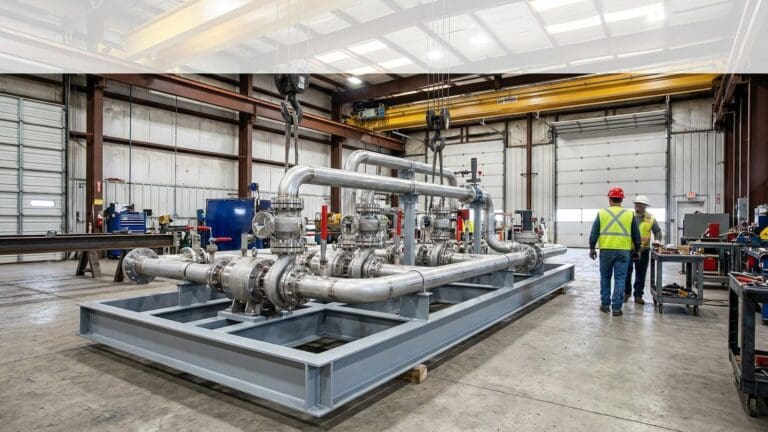
Prefabrication is the strongest lever on the on-site portion of that sequence. Spools and prefabricated piping skids built and tested in a shop cut the hours a crew spends inside an operating plant, which is the expensive part for the owner.
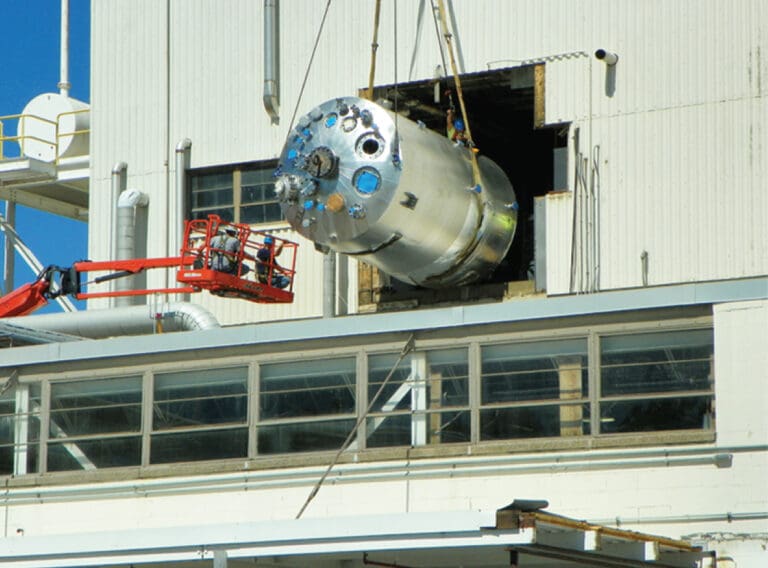
At AkzoNobel, our team delivered a turnkey installation of a new reactor, a core component of their chemical manufacturing process, with stainless steel welded process piping executed across seven separate buildings inside the facility. Work of that shape lives on sequencing: the reactor is one connection point, and the plant around it is the rest of the scope.
What should the turnover package contain?
Ask for the documentation in the bid documents, because it is far harder to reconstruct after demobilization. On a B31.3 job, a reasonable package includes:
- Material test reports tying each pipe, fitting, and weld filler to a heat or lot number
- A weld map or isometric marked with each joint number
- Welder identification and the qualified procedure used for each joint
- Examination records for joints selected for radiography or dye penetrant
- Pressure test records showing medium, pressure, hold time, and witness
- Cleaning, purge, and passivation records where the service calls for them
- As-built isometrics and a valve and instrument list
Where the process handles a covered highly hazardous chemical, that documentation also feeds mechanical integrity obligations under OSHA 29 CFR 1910.119, the process safety management standard. Your inspection program in year five depends on records created in year one.
What does Northern Ohio add to the problem?
Two things: weather and water rules. Lake Erie winters put sustained freezing temperatures on outdoor racks, transfer lines, tank farms, and loading areas from late November into March. The National Weather Service office in Cleveland is the reference for local design conditions, and lake-effect snow loading matters for rack and hanger design as much as the cold.
Freeze protection is a design decision, not a winter maintenance task. Heat trace circuits need power, controls, and a way to prove they work before the first hard night. Drainable low points, slope, and tubing routing are cheaper to get right at layout than to chase with a torch in January.
What this means in Ohio: Cross-connection control is a live compliance obligation, not a formality. Where a process line, a chemical feed, or a cooling loop can reach the potable system, Ohio’s backflow rules in OAC 3745-95 apply, and the assembly generally has to be tested by a certified tester at installation and on a recurring schedule set by your water supplier. Confirm the assembly type and the interval with the supplier before you buy: a device selected for the wrong hazard level is a device you will replace.
The regional industry mix shapes the work too. Chemical and coatings plants, plastics processors, food producers, hospitals, schools, and a growing data center footprint each bring a different code and a different tolerance for downtime. A hospital tie-in is scheduled around clinical operations, a school retrofit around the summer window, a paint plant tie-in around a turnaround that will not move.
When should you call a process piping contractor instead of a plumber?
Call a process piping contractor when the line touches the product, when the service is corrosive, hot, or high pressure, when a weld will be examined, when a code other than the plumbing code governs, or when the work has to happen inside a plant that cannot stop for long. Call a commercial plumbing contractor for the restrooms, the domestic water service, the sanitary drainage, and the fixtures.
Most plants need both, and the argument for one firm covering both is coordination, not convenience. One contractor schedules a domestic water shutdown around a process tie-in instead of two contractors discovering the conflict on the same Saturday morning.
When you are deciding which firms are genuinely qualified to bid, our companion article on how to choose an industrial piping contractor lays out the questions worth asking before the walkthrough.
Frequently asked questions
Is process piping the same as industrial plumbing?
No, although the terms get used interchangeably in requests for quote. Industrial plumbing usually means the potable water, sanitary drainage, and fixture work inside an industrial building, governed by the plumbing code. Process piping means the systems carrying process fluids in support of production, governed by a piping code such as ASME B31.3. Separating the two in the scope keeps bidders pricing the same work.
Does process piping require a licensed plumber?
It requires the right qualification for the work, which is not always the same thing. Welded process piping requires welders qualified to the applicable written procedure, and process work regularly falls under a piping code rather than the plumbing code. Plumbing work inside the same building still follows Ohio plumbing licensing requirements. On a mixed project, expect both qualifications to be present and documented.
What materials are used in process piping?
Stainless steel is the most common choice for corrosive, sanitary, and high-purity service. Carbon steel is standard for utility air, steam, and non-corrosive process service. Higher alloys, lined pipe, and thermoplastics each have a place depending on the chemical, the temperature, and the pressure. Material selection should be documented, because an undocumented substitution is how corrosion failures start.
How long does a process piping project take?
It depends on engineering time, material lead times, and how much work can proceed while the plant runs. The variable that surprises owners most is not installation hours, it is the tie-in window. Shop fabrication is the main lever for shortening the on-site portion, because spools built and tested in a controlled shop cut the hours a crew spends inside your operating plant.
Who inspects process piping in Ohio?
It depends on the system. Building permit and inspection authority runs through the local building department under the Ohio Board of Building Standards. Boiler and pressure vessel installations are administered by the state Division of Industrial Compliance. Code-required weld examination under ASME B31.3 is performed by qualified examiners engaged for the project, and backflow assemblies are tested by a certified tester on the supplier’s schedule.
Talk to Wilkes about your project
Bring what you have to the first conversation, even if it is incomplete. Useful starting material is a process flow diagram or a marked-up plot plan, the fluid and its operating conditions, the equipment already purchased, the shutdown window you are working toward, and any documentation requirement your quality group has set. If you have none of that yet, a walkthrough works. Most scope gaps we find are visible from the floor.
Wilkes Plumbing and Heating has worked out of Huron, Ohio since 1912, handling process piping, welding and fabrication, and commercial mechanical work across Erie, Huron, Lorain, Ottawa, and Sandusky counties and throughout Ohio. Call (419) 433-2325, or request a quote.
Keep reading
Warehouse Heating in Ohio: Unit Heaters, Infrared and Make-Up Air
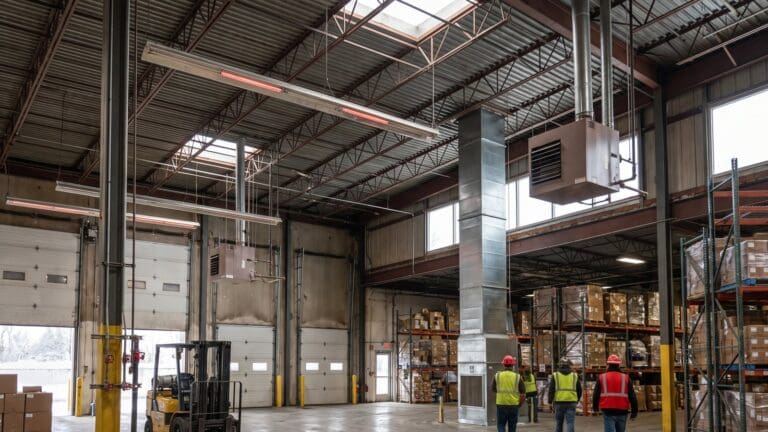
A plant engineer's guide to choosing between unit heaters, radiant tube heaters, destratification fans and make-up air, and to balancing exhaust so the building stops fighting its own heat.
Turnkey Process Piping and a Reactor Install at AkzoNobel
A look inside a turnkey reactor installation and stainless steel process piping scope spread across seven buildings at a Huron, Ohio chemical plant, sequenced so production never stopped.
Prefabricated Piping Skids: Faster Installs, Cleaner Welds
Prefabricated piping skids move the slow, inspection-heavy work off your production floor and into a controlled shop. Here is how Northern Ohio plants scope, test, rig, and tie in a modular process assembly without losing production time.
Need this handled at your facility?
Wilkes engineers, fabricates, and installs process piping, plumbing, and HVAC systems across Ohio.