How to Evaluate Commercial Air Conditioning Companies
A commercial air conditioning company earns your business by proving three things: it can legally handle the refrigerant in your equipment, it can keep that equipment running through an Ohio summer without repeat callbacks, and it can document every visit well enough to survive an insurance audit or a warranty claim. Price and marketing come after those three, not before them. This guide is for facility managers, school business officials, plant engineers, and hospital facilities teams in Northern Ohio comparing commercial air conditioning companies for a service, install, or design-build contract.
Key takeaways
- Every technician who touches refrigerant must hold current EPA Section 608 certification, and a real contractor will show you the card before the truck rolls.
- The HFC phasedown under the AIM Act is raising the price of R-410A refrigerant, and that belongs in any conversation about your existing rooftop units.
- Service-only shops, install-only shops, and full design-build mechanical contractors are three different businesses. Match the capability to the project, not the name on the truck.
- A preventive maintenance plan is only as good as what it makes the technician write down. Ask to see a sample completed visit report before you sign.
- Total cost of ownership includes energy, refrigerant, parts availability, and downtime, not just the installed price on the proposal.
What should you expect from a qualified commercial air conditioning company?
Start with paperwork, not personality. A qualified commercial AC service holds the trade licenses Ohio requires for the work in question, carries certificates of insurance you can actually verify, and can produce EPA 608 cards for the technicians it plans to send. Ohio construction codes are adopted and interpreted through the Ohio Board of Building Standards, and a contractor who does commercial work regularly will already know which permits your project triggers.
Reputation matters, but ask for it in a specific form. A contractor who has serviced schools, hospitals, or manufacturing plants can name the buildings and describe the equipment, not just recite a client count. If they cannot describe a rooftop economizer sequence or a chilled water loop without hesitation, they have not spent much time on buildings like yours.
Work through this sequence before you sign
- Confirm every technician who will touch your site holds current EPA Section 608 certification for the refrigerant types in your equipment.
- Match the company’s stated capability, service, install, or design-build, to what your project actually needs.
- Ask for a sample completed preventive maintenance report, not a blank template.
- Get response time and emergency coverage commitments in writing, not in conversation.
- Request a total cost of ownership breakdown alongside the installed price.
- Check at least one reference on a building with equipment similar to yours.
Service, install, or design-build: which capability does your project need?
These are three different businesses wearing similar uniforms. A service-only shop is built around fast, repeatable maintenance and repair calls. An install-only shop is built around getting new equipment set and started up, usually as a subcontractor to someone else’s design. A full design-build mechanical contractor carries engineering, piping, controls, and construction management under one roof, and can take a project from a failing boiler to a finished chilled water system without handing it to three different companies.
The table below is a starting point, not a rule. Plenty of contractors blend categories, and the right question is always which capability your specific project needs.
| Capability | Good fit for | What it usually cannot do alone | Ask for |
|---|---|---|---|
| Service-only shop | Routine maintenance, repair calls, single-unit replacements | Engineered system redesign, multi-building projects, permitted new construction | Response time commitment and a sample PM report |
| Install-only shop | Executing a design someone else engineered | Solving a design problem or owning schedule risk across trades | References on installs of similar equipment and size |
| Design-build mechanical contractor | System conversions, campus retrofits, new construction, complex piping | Nothing, within its licensed scope, which is the point of the model | In-house engineering, welding, and controls capability |
Our explanation of how design-build mechanical contracting reduces schedule risk and change orders covers this in more depth if your project involves more than a straight equipment swap. At South Central High School, an existing facility with outdated infrastructure needed a comprehensive upgrade to its heating and cooling. Wilkes replaced the old heating system with new piping and pumps and installed a chilled water system that gave the school air conditioning it did not previously have, the kind of scope a service-only or install-only shop is not set up to carry from design through commissioning.
What is EPA Section 608, and why does it matter when you hire a contractor?
EPA Section 608 governs who may purchase, handle, and work on equipment containing regulated refrigerants, and it requires technicians who open a refrigerant circuit to hold certification matched to the equipment type: small appliances, high-pressure systems like most commercial rooftop units, low-pressure chillers, or the universal certification that covers all three. It also sets leak repair requirements and record-keeping obligations for larger systems.
This is not a formality you take on faith. Ask to see the certification card for the specific technician assigned to your site, not a company-wide claim. An uncertified technician working on your refrigerant circuit is a compliance exposure that belongs to your building, not just to the contractor who sent them.
What is the HFC phasedown, and what does it mean for your R-410A rooftop units?
The American Innovation and Manufacturing Act directs a phasedown of hydrofluorocarbon production and consumption, and EPA’s HFC program is the mechanism carrying that phasedown out. R-410A, the refrigerant in most commercial rooftop units installed over the last two decades, is an HFC. As allowances shrink, R-410A becomes scarcer and its price trends upward, and new equipment is moving to lower global-warming-potential refrigerants like R-454B.
None of this means your existing R-410A rooftop units are illegal or need to be replaced on a deadline. It means refrigerant cost is now a real line item in your maintenance budget, and a contractor who cannot explain the phasedown timeline or your equipment’s exposure to it has not thought past this week’s service call.
What this means in Ohio: A large share of the packaged rooftop units on Northern Ohio schools, plants, and commercial buildings installed in the last fifteen years run on R-410A. Budget for rising refrigerant cost on any unit past the midpoint of its service life, and ask your contractor whether a leak repair is worth making versus planning replacement before the next Lake Erie summer.
What should a preventive maintenance plan actually cover?
A real commercial AC service contract is specific about what gets done, not just how often someone shows up. At minimum it should cover coil cleaning, refrigerant charge verification, belt and drive inspection, electrical connection tightening, condensate drain clearing, and economizer and controls calibration. Ventilation and outdoor air performance should be checked against the building’s design intent under ASHRAE standards, since a drifting economizer quietly wastes energy long before it causes a comfort complaint.
Any visit that involves opening an electrical panel or servicing a compressor circuit should follow lockout and tagout procedure under OSHA 29 CFR 1910.147. If a technician skips that step to save time on a routine visit, that habit will eventually show up as an incident report.
What a completed visit report should show
Ask a prospective contractor for a sample report from a real visit, not a blank form. It should list measured readings, refrigerant pressures, amp draws, filter condition, and any deficiency found, with a clear recommendation and cost if repair is needed. Our commercial plumbing preventive maintenance checklist lays out the same documentation standard for the wet side of the building, and the two should look similarly thorough.
How fast should a contractor respond, and what should the contract guarantee?
Response time is a contract term, not a sales pitch. A commercial HVAC service agreement should state a maximum response window for emergency calls, typically measured in hours, and a separate window for routine service requests. It should also say whether after-hours and weekend coverage is included or billed separately, and whether that coverage is answered by the contractor’s own staff or a third-party dispatcher.
In Northern Ohio, cooling failures cluster around the same humid stretches every summer, which means every contractor’s trucks are busiest at the exact moment yours needs one. A written response commitment, checked against real performance from references, tells you more than a promise on a sales call. If a rooftop unit is already near the end of its service life, our framework for deciding between commercial HVAC repair and replacement is a useful companion to this evaluation.
What should a good HVAC proposal include, and what are the red flags?
A proposal worth signing states the scope in plain language: equipment make, model, and capacity, ductwork or piping changes, controls sequence of operation, startup and commissioning, warranty terms on both equipment and labor, and a schedule with named milestones. It should also state clearly who is responsible for permits, electrical work, and structural roof modifications if any of those apply.
Watch for a few consistent red flags. A quote generated without a site visit, unusually vague language around controls or sequence of operation, no stated warranty period separate from the manufacturer’s, and no discussion of how the new equipment interacts with your existing commercial plumbing and HVAC systems are all signs the proposal was built fast rather than built for your building. A contractor with genuine design-build capability, including custom design-build services, will usually walk you through tradeoffs rather than hand you a single option.
How do you calculate total cost of ownership instead of just install price?
Installed price is one line in a much longer calculation. Total cost of ownership adds annual energy use, expected maintenance contract cost, realistic parts and refrigerant availability over the equipment’s life, and the value of downtime if the unit fails during a critical stretch. A packaged rooftop unit commonly runs 15 to 20 years of useful service life with proper maintenance, and the cheapest unit to install is rarely the cheapest one to run for that whole span.
Energy performance is measurable, not a guess. ENERGY STAR for commercial buildings provides benchmarking tools that let you compare your building’s actual energy use against similar buildings, which turns a vague sense that a system is inefficient into a number you can act on. Weigh that against the refrigerant cost trend discussed above and the age of your existing equipment before deciding whether a repair, a like-for-like replacement, or a broader upgrade makes the most financial sense.
Talk to Wilkes about your project
Bring your building’s basics to a first conversation: approximate square footage, the age and type of your existing air conditioning equipment, any recent comfort complaints or breakdowns, and whether you are weighing a service contract, a replacement, or a larger design-build project. If you have utility bills or a recent service report, bring those too. That is usually enough for a first walk-through and a realistic scope.
Call Wilkes at (419) 433-2325 to set up a site visit. You can also request a quote directly through our website and a member of the team will follow up to schedule a time that works for your building.
Frequently asked questions
How often should a commercial rooftop AC unit be serviced?
Most commercial rooftop units benefit from at least two scheduled maintenance visits a year, one before the cooling season and one before heating season if the unit provides both functions. Buildings with heavier use, like hospitals or manufacturing plants, or units running in dusty or corrosive environments, often need quarterly visits. Your contractor should be able to explain why the frequency they recommend fits your specific equipment and building use.
Do I need a certified technician for routine refrigerant checks?
Yes. Any work that involves opening a refrigerant circuit, including checking or adding charge, requires a technician certified under EPA Section 608 for that equipment type. This applies to routine maintenance calls, not only major repairs or installations. Ask your contractor to confirm certification for the specific technician assigned to your building before the first visit.
What is the difference between a service contract and a maintenance plan?
The terms are often used loosely, but a strong agreement spells out exact tasks, visit frequency, response time commitments, and what is included versus billed separately for parts and labor. A weak version just promises “regular visits” without specifics. Ask to see the actual task list and a sample completed report before comparing price between contractors.
Will the HFC phasedown force me to replace working R-410A equipment?
No, the phasedown restricts refrigerant production and import allowances, not the operation of existing equipment. Your current R-410A rooftop units can keep running and being serviced. The practical effect is that refrigerant for repairs and top-offs is trending more expensive over time, which is worth factoring into whether a significant leak repair or a planned replacement makes better financial sense.
Should I choose a design-build contractor even for a single rooftop unit swap?
Not necessarily. A straightforward like-for-like replacement is often handled well by a strong service or install contractor. Design-build capability earns its cost when the project involves engineering decisions, multiple systems, controls integration, or construction coordination, such as converting a building to a new heating and cooling system entirely. Match the contractor’s capability to the actual complexity of your project.
Keep reading
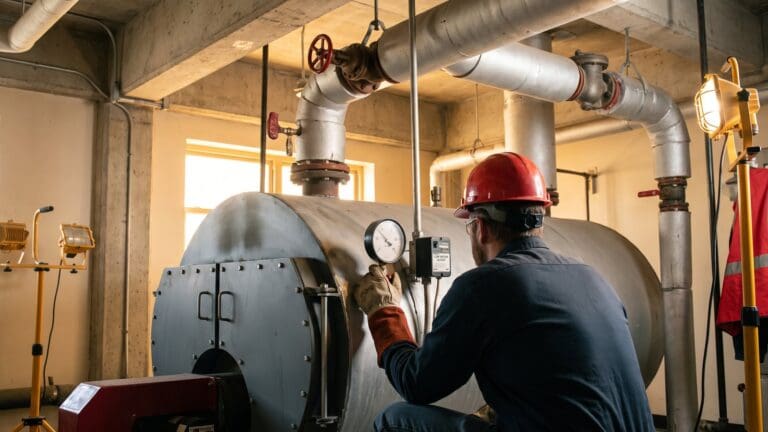
Commercial Boiler Maintenance: Checklist, Tune-Up and Ohio Rules
A frequency-by-frequency maintenance plan for commercial steam and hot water boilers, from the daily log to the annual combustion report, built around Ohio's inspection cycle.
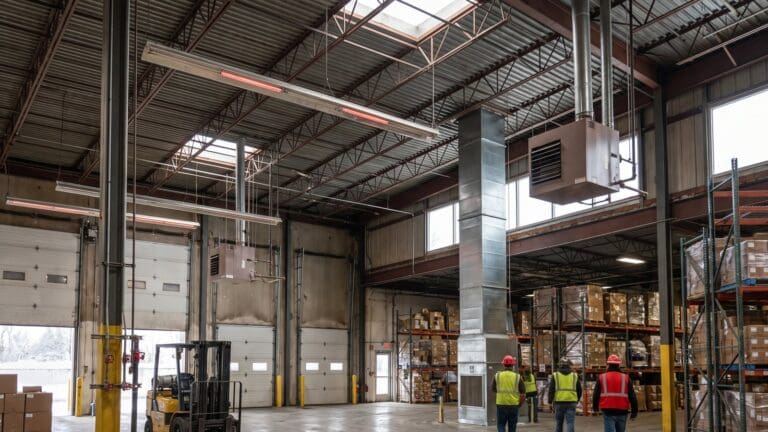
Warehouse Heating in Ohio: Unit Heaters, Infrared and Make-Up Air
A plant engineer's guide to choosing between unit heaters, radiant tube heaters, destratification fans and make-up air, and to balancing exhaust so the building stops fighting its own heat.
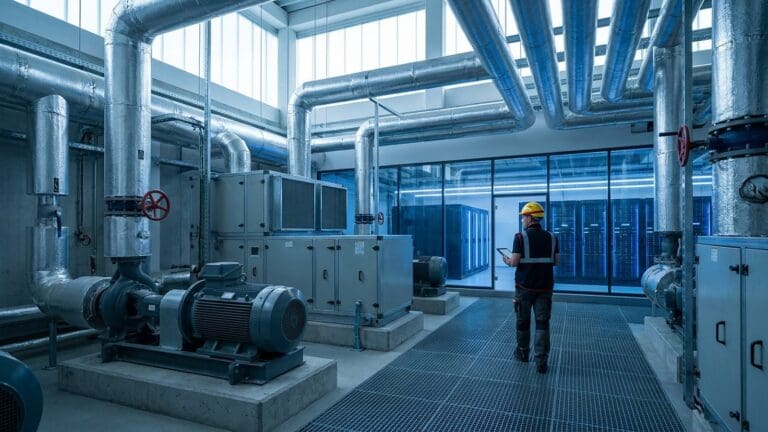
Ohio Data Center Cooling: What It Means for Facility Owners
Liquid cooling turned data center heat rejection into a welded piping job, and that competes for the same welders, shop slots, and long-lead equipment your plant, hospital, or school project needs.
Need this handled at your facility?
Wilkes engineers, fabricates, and installs process piping, plumbing, and HVAC systems across Ohio.