Ohio Data Center Cooling: What It Means for Facility Owners
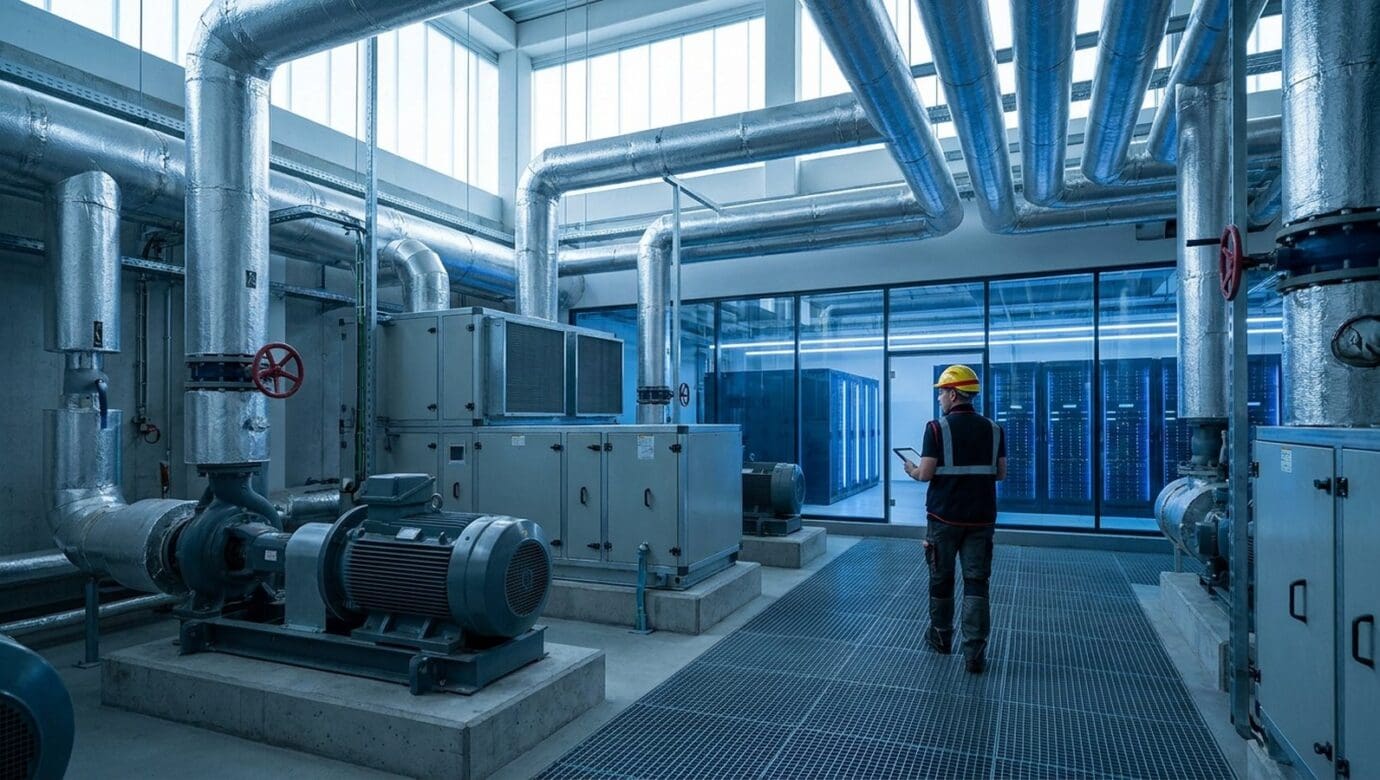
Ohio’s data center buildout has changed what a cooling system physically is. High-density computing moved heat rejection from air to water, which turns what used to be an air handling scope into welded, tested, documented process piping, and that pulls on the same pipefitters, welders, and fabrication shop slots your own capital project needs. For most facility owners in Northern Ohio, the consequence is not the data centers themselves: it is labor availability, equipment lead times, and the delivery method you choose.
This is written for plant managers, facility directors, hospital engineering leads, and school business officials who are planning a mechanically intensive project in the next 12 to 24 months and want to know how a regional construction market under load should change their sequencing.
The short version: engage a mechanical contractor earlier, decide long-lead items sooner, and hold whoever builds your piping to a process standard rather than a comfort-cooling standard.
Key takeaways
- Liquid cooling converts a ducting and air-handling job into a welded piping job governed by process piping codes, not by conventional commercial HVAC practice.
- The real effect on your project is competition for skilled welders, fabrication shop capacity, and long-lead mechanical equipment across the region.
- Northern Ohio winters put freeze protection, glycol selection, and outdoor loop design at the center of any heat rejection scheme.
- Makeup water for evaporative heat rejection brings backflow prevention and Legionella risk management into scope, and Ohio enforces both.
- Design-build or design-assist delivery is the most reliable way to get long-lead decisions made early enough to matter.
Why is data center cooling suddenly a piping problem?
For most of the industry’s history, computing spaces were cooled with air. Air handlers pushed cold air under a raised floor, servers pulled it through, and the mechanical scope looked like a large but ordinary HVAC job with sheet metal, filters, and a chilled water plant in the basement.
Higher-density computing broke that arithmetic. When a single rack draws several times the power a rack drew ten years ago, air stops being a practical carrier, because you would have to move a volume of it that no room can accommodate. Water carries roughly four times the heat per unit mass and is far denser, so the industry moved the working fluid closer to the hardware.
Rear-door heat exchangers, in-row cooling, direct-to-chip cold plates, and immersion tanks all end in the same place: welded distribution piping, manifolds, coolant distribution units, pumps, valves, filtration, and controls. The heat did not go anywhere. It was handed to the pipefitters.
ASHRAE’s technical committee on mission critical facilities publishes the thermal guidelines and the liquid cooling class definitions the industry designs to, collected in the ASHRAE Datacom series. Those classes are why designers can now run warmer supply water and still hold chip temperatures, and warmer water is what makes economizing and heat reuse practical.
What is driving the Ohio buildout, and why does it reach Erie County?
Ohio has drawn large computing investment for reasons that have nothing to do with computing: power capacity, water, transmission access, developable land, and a state economic development apparatus that markets all four. JobsOhio names data infrastructure as a target sector, and Ohio’s energy profile from the U.S. Energy Information Administration shows the generation base those projects sit on.
The construction labor market does not respect county lines. A project in central Ohio absorbing hundreds of pipefitters for 18 months changes what is available in Sandusky, Norwalk, and Lorain, because the qualified welding workforce is regional and mobile. So does the fabrication shop backlog, and so does the queue for chillers, large-diameter valves, and switchgear. You do not need a data center near your building to feel it.
What does liquid cooling demand from a mechanical contractor?
The same things a chemical plant demands, which is why the contractors who succeed at this work look like industrial piping companies rather than comfort HVAC companies.
Weld quality that is documented, not asserted
A leak above an energized rack is a different event from a leak above a warehouse floor. Cooling distribution piping is normally built to a process or power piping standard, most often ASME B31.3 for process piping or ASME B31.1 for power piping, with the choice driven by service and design basis. Building services loops in less critical spaces may fall under ASME B31.9. In all three cases the welders and the welding procedures are qualified under ASME Boiler and Pressure Vessel Code Section IX, and the qualification records are part of the closeout package.
Cleanliness discipline
Liquid cooling loops terminate in narrow channels inside cold plates. Weld slag, mill scale, thread sealant, cutting oil, and construction debris are not cosmetic problems there. They are a plugged channel and a thermal shutdown. The flushing, passivation, filtration, and fill procedure deserves as much specification attention as the pipe schedule.
Material and chemistry judgment
Copper, carbon steel, stainless, and the occasional aluminum cold plate behave differently in a closed loop with treated fluid. Mixing them without accounting for galvanic pairs is a slow failure that surfaces in year three. So is a gasket the coolant chemistry attacks, or a glycol concentration that solves the freeze problem and quietly costs you pump head.
Prefabrication capacity
These jobs are schedule-driven and the site is congested. Skid-mounted pump sets, shop-welded headers, and prefabricated spools cut field hours and produce better welds under controlled conditions. That is the argument for prefabricated piping skids, in a paint plant or a mechanical yard alike.
| Cooling approach | Suits rack density of | Where heat is rejected | What the mechanical scope becomes |
|---|---|---|---|
| Perimeter air handlers, raised floor | Low, roughly under 10 kW per rack | Chilled water or direct expansion coil | Sheet metal, coils, conventional chilled water piping |
| In-row and rear-door heat exchangers | Moderate, roughly 10 to 40 kW per rack | Chilled or condenser water loop | Branch piping and manifolds inside the white space |
| Direct-to-chip cold plates | High, roughly 40 to 150 kW per rack | Facility water loop through a distribution unit | Welded process piping, leak detection, filtration, tight cleanliness spec |
| Immersion | Very high | Facility water loop through a heat exchanger | Dielectric fluid handling plus welded water-side distribution |
How does a Northern Ohio winter change the design?
Heat rejection equipment lives outdoors, and in Erie, Huron, Lorain, Ottawa, and Sandusky counties that means lake-effect events, sustained subfreezing stretches, and wind loading off open water. The National Weather Service office in Cleveland publishes the regional climate record design conditions come from, and duration matters more than the design day: a fluid cooler that survives one cold night is not the same as one that runs 96 hours at 5 F on partial load.
Three decisions carry most of the winter risk. First, freeze protection strategy: glycol throughout, glycol only in the outdoor loop behind a heat exchanger, or a dry system with a controlled drain-down. Second, low-load control, because an economizer that cycles a fluid cooler fan on a mild January day can freeze a tube bundle faster than a cold snap will. Third, protection for makeup lines, drains, and instrument tubing, which is where most actual freeze failures start.
Winter is also the reason economizing pays here. Northern Ohio spends a large share of the year below the wet bulb needed for water-side free cooling, and the energy provisions in ASHRAE Standard 90.1 push designs toward capturing it. Ohio adopts its commercial mechanical requirements through the Ohio Mechanical Code in Ohio Administrative Code 4101:2, promulgated by the Ohio Board of Building Standards, so confirm the applicable edition and any local amendments at design.
What this means in Ohio: a heat rejection scheme that pencils out in a mild climate can fail its first winter here. Confirm the glycol concentration against the actual low-load operating case, not just the design low temperature, and get the freeze protection sequence written into the controls specification before the equipment is released for fabrication.
Refrigerant selection is the other moving target. The HFC phasedown under the AIM Act is changing what chillers ship with, and EPA’s HFC program is the authority to check before committing to a machine you expect to service for 20 years.
What does makeup water bring into scope?
Any evaporative heat rejection, and most large chilled water plants, need a makeup water connection. That is a cross-connection to the potable system, and Ohio treats it as one. Backflow prevention requirements sit in Ohio Administrative Code 3745-95, administered through Ohio EPA’s backflow prevention program, and most Ohio public water systems require annual testing by a certified tester. Our walkthrough of backflow testing in Ohio covers who is on the hook.
Open cooling towers also put you in Legionella territory. ANSI/ASHRAE Standard 188 sets out the water management program framework, and the CDC’s Legionella guidance explains the control logic behind it. For a hospital this is part of how the building gets surveyed. Closed loops carry far less of this risk, which is one more argument for an indirect scheme where the site allows it.
Does industrial piping experience transfer to a critical facility?
More directly than most owners expect, because the constraints are the same constraints wearing different clothes: live operations you cannot interrupt, congested space, legacy systems you have to tie into rather than replace, and quality documentation that does not bend for the calendar.
Our work at the NASA Glenn Research Center remodel is a fair example of the second and third of those. We installed domestic water piping, sanitary piping, plumbing fixtures, and associated systems as part of bathroom remodels across four office buildings that are primarily used as testing laboratories, and the scope included sub-pumps on the lower levels along with steam and condensate work. Cutting into steam and condensate inside occupied research buildings is an exercise in isolation, sequencing, and energy control, which is exactly the discipline OSHA 29 CFR 1910.147 exists to enforce and exactly what a live tie-in on a critical cooling loop requires.
Availability expectations are the one genuinely new variable. Owners frame them through the Uptime Institute tier system, and the tier target drives real piping decisions: whether you build two distribution paths, where isolation valves go, and whether any single joint can take the load down. Ask what tier the design assumes before you review a layout, because you cannot retrofit concurrent maintainability into a header that was never valved for it.
How should you sequence a mechanical project in this market?
None of this is a reason to delay a project. It is a reason to sequence one differently. The order below is what we would run for a plant, hospital, or school project competing for the same trades.
- Set the load and availability basis first. Peak load, redundancy, and acceptable downtime drive every downstream decision. Guessing here causes redesign.
- Bring the mechanical contractor in during schematic design. Constructability, shop capacity, and lead times are cheapest to absorb before drawings harden. This is the case for design-build mechanical contracting.
- Identify long-lead items and set an order-by date for each. Chillers, large valves, pumps, switchgear, and heat exchangers all move on quoted lead times that stretch when demand concentrates. A design that commits to a long-lead item without an ordering plan will sit and wait.
- Reserve fabrication shop capacity. Prefabrication only saves schedule if there is a slot when you need one. That is a calendar conversation, not a bid conversation.
- Write the cleanliness, flushing, and treatment plan into the specification. Decide who owns the fill, what the filtration criteria are, and when in the sequence it happens.
- Plan tie-ins and shutdowns with operations in the room. Every outage hour moved to a scheduled window is an hour you do not lose to a surprise.
- Define commissioning and closeout deliverables up front. Pressure test records, weld maps, welder qualifications, control point verification, and load testing are a sequence, not a punch list.
What should you ask a mechanical contractor before you sign?
Ask these in an early meeting, not in a bid clarification. A contractor who has done critical work answers them quickly and specifically. Vague answers now become change orders later.
- What code are you building this to, and who signs the documentation package?
- What are your qualified welding procedures for this service, and who are the qualified welders you will actually send?
- What is your flushing, cleaning, and water treatment plan, and where does it sit in the schedule?
- What can be prefabricated, and does your shop have capacity in our window?
- What are the long-lead items in this design, and what is the order-by date for each?
- How do you keep our operations running while you work, and what shutdowns do you genuinely need?
- What is the freeze protection strategy, and what happens at 20 percent load in January?
- Who commissions the system, and what documentation do we hold at the end?
Our industrial process piping group does welded and fabricated work across Ohio, and our custom design-build services group is usually where the early sequencing conversation starts. Wilkes has been a mechanical contractor in Huron since 1912.
Frequently asked questions
Why are data centers moving from air cooling to liquid cooling?
High-density computing hardware produces more heat per rack than air can practically remove. Water carries far more heat per unit of volume, so moving heat with liquid takes less energy and less space. The tradeoff is that it converts the cooling system into a piping system with process-grade requirements for weld quality, cleanliness, material compatibility, and commissioning documentation.
Does a data center cooling loop need code-quality welding?
Cooling distribution piping is generally built to a process or power piping standard, most often ASME B31.3 or ASME B31.1 depending on service and design basis, with procedures and welders qualified under ASME Boiler and Pressure Vessel Code Section IX. The governing code, test pressures, and examination requirements come from the engineer of record, so confirm them during design rather than assuming a default.
Will the Ohio data center boom affect my building project?
Indirectly, through labor and lead times. Skilled pipefitters, certified welders, fabrication shop slots, and long-lead mechanical equipment are shared regional resources, and concentrated demand lengthens the wait for all four. The practical response is to engage a mechanical contractor earlier in design so long-lead items get ordered on time and shop capacity gets reserved before you need it.
What freeze protection does a Northern Ohio cooling loop need?
It depends on whether the outdoor loop is glycol-filled, isolated behind a heat exchanger, or drained. The decision should be checked against sustained cold and low-load operation, not just the design day temperature, because most freeze failures start in makeup lines, drains, and instrument tubing during long mild-load stretches rather than during a single cold night.
Do cooling towers trigger backflow and Legionella requirements in Ohio?
Yes. A makeup water connection is a cross-connection to the potable system, and Ohio addresses backflow prevention in Ohio Administrative Code 3745-95 through Ohio EPA, with most water systems requiring annual testing by a certified tester. Open evaporative equipment also falls within the water management program framework in ANSI/ASHRAE Standard 188.
Talk to Wilkes about your project
Bring three things to a first conversation: the load and redundancy you need, the outage windows your operation can tolerate, and the date the system has to run. Drawings help, but a plain scope description and those three constraints are enough for us to tell you what is realistic, what is long-lead, and where the schedule risk sits.
Call (419) 433-2325, or use our contact page to request a quote.
Keep reading
Commercial Boiler Maintenance: Checklist, Tune-Up and Ohio Rules
A frequency-by-frequency maintenance plan for commercial steam and hot water boilers, from the daily log to the annual combustion report, built around Ohio's inspection cycle.
Warehouse Heating in Ohio: Unit Heaters, Infrared and Make-Up Air
A plant engineer's guide to choosing between unit heaters, radiant tube heaters, destratification fans and make-up air, and to balancing exhaust so the building stops fighting its own heat.
Hydronic Heating Systems for Schools: Design and Retrofits
How Northern Ohio schools and campuses should design, budget, and phase a hydronic heating retrofit, from design water temperature and boiler staging to Ohio inspection rules and the fixed summer construction window.
Need this handled at your facility?
Wilkes engineers, fabricates, and installs process piping, plumbing, and HVAC systems across Ohio.