
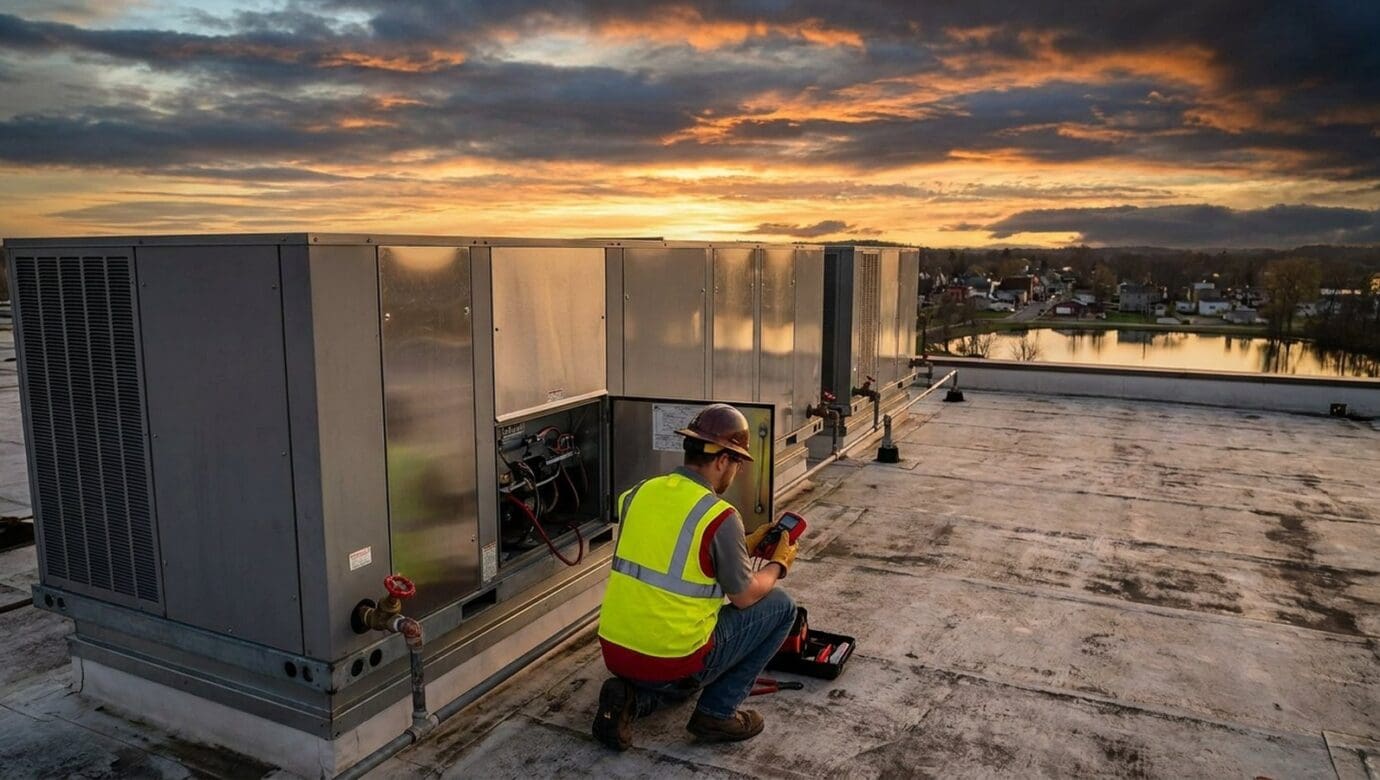
Commercial HVAC Repair or Replacement: A Decision Framework
Repair the unit when it is still inside its service life, the failure is a component rather than the core of the machine, the repair costs a small fraction of replacement, and the system still meets the load and the ventilation requirement. Replace it when the compressor or heat exchanger has failed on aging equipment, when repairs have turned routine, when the refrigerant is obsolete, or when the building’s use has changed enough that the system no longer fits.
Most of these calls are not close once the numbers are on paper. The trouble is that the decision usually arrives in July, with a technician standing on the roof waiting for an answer. This framework is for plant managers, facility directors, school business officials, and hospital facilities teams in Northern Ohio who have to defend the call to a finance committee. Work it through in February instead.
Key takeaways
- Quote the repair in writing and get a credible installed replacement budget for the same position before deciding.
- The failed part matters more than the age: a contactor is a service call, a cracked heat exchanger is a capital conversation.
- Refrigerant often settles the question. A significant leak on R-22 equipment is usually the moment to replace.
- Verify the load before you buy. The load calculation behind the original unit may not describe the building you operate now.
- Keep an equipment inventory and a capital plan so the decision lands on your calendar, not on the hottest day of the year.
What does a commercial HVAC repair actually cost you?
Start with a number, not a feeling. Get the repair quoted in writing, then get a replacement budget for the same position: not a full design, just a credible installed cost covering curb adapter, rigging, electrical, controls, permits, and disposal. Then read three figures together.
The repair as a percentage of replacement
A small percentage on a young unit is an easy yes. A large percentage on an old unit rarely is: you are buying a partial rebuild of a machine that will present its next failure shortly. Past about a third of installed replacement cost on equipment beyond mid life, replacement usually wins on total cost of ownership before any energy savings are counted.
Where the unit sits in its service life
Rooftop units, split systems, chillers, and boilers age differently, and environment drives the spread. A unit on a paint plant roof in Sandusky pulling process exhaust across its coils will not last as long as the same unit on a clean office campus. Service records beat nameplate years.
How many times you have already been here
One repair is an event. Three repairs in two cooling seasons is a pattern, and the pattern is the data point. Teams underweight cumulative spend because it arrives in small invoices across two budget years. Add them up before the meeting, and track energy use alongside them: the federal ENERGY STAR Portfolio Manager benchmarking tool turns a complaint about an old unit into a number a finance committee can act on.
Which failures are worth repairing and which are not?
Sort failures into two buckets before pricing anything.
Generally repairable, even on older equipment: contactors, capacitors, fan and blower motors, belts, bearings, control boards, sensors, economizer actuators, and condensate pumps. These are consumables, and replacing one tells you little about the rest of the machine.
Serious enough to open the replacement conversation: a failed compressor, a cracked heat exchanger, a leaking evaporator or condenser coil, a refrigerant leak the technician cannot isolate after a second visit, and a rusted through cabinet or base rail. These are the expensive core of the unit. When one fails in the back half of a machine’s life, the money is better spent new.
A cracked heat exchanger is its own category. It is a combustion safety problem, not an efficiency problem, and the appliance comes out of service now, not next quarter. Venting and installation rules for fuel gas appliances come from NFPA 54, the National Fuel Gas Code, which Ohio adopts in its mechanical and fuel gas provisions.
| What you are looking at | Points toward repair | Points toward replacement |
|---|---|---|
| Repair cost vs. installed replacement | Under about 20 percent | Over about 30 to 35 percent |
| Position in service life | First half, records are clean | Back half, or unknown history |
| Failed component | Motor, board, actuator, belt, sensor | Compressor, heat exchanger, coil, cabinet |
| Repair frequency | First real failure in years | Third call in two seasons |
| Refrigerant | Current, readily available charge | R-22 or another phased out charge |
| Capacity fit | Sized to the current load | Oversized, short cycling, poor humidity control |
| Controls | Integrates with the existing system | Obsolete protocol, no parts, no vendor support |
Read the table for direction, not a verdict. Two rows pointing at replacement on a 6 year old unit is worth a second opinion. Five rows on a 20 year old unit is a decision.
How much is the old system costing you in energy?
Efficiency is where an aging system quietly outspends its own replacement. Older equipment was built to a lower efficiency floor, and by the back half of its life it has drifted below even that. Dirty coils, worn belts, a stuck economizer, and a failed discharge air sensor each cost a few percent. Together they cost real money.
Minimum efficiency requirements trace back to ANSI/ASHRAE/IES Standard 90.1, Energy Standard for Sites and Buildings Except Low-Rise Residential Buildings, the basis for the commercial energy provisions Ohio enforces. That floor has moved several times over the life of a typical rooftop unit, so a like for like swap is rarely a like for like machine. Settle two questions before specifying anything.
Is the equipment even the right size?
Oversized equipment short cycles, controls humidity poorly, and wears out its own compressor. Buildings get re-tenanted, lighting goes to LED, and cooling loads drop. A load calculation run to the commercial procedures published by the Air Conditioning Contractors of America costs a fraction of a rooftop unit and often finds a size smaller is right.
Are you moving the right amount of outside air?
Ventilation rates follow ANSI/ASHRAE Standard 62.1, Ventilation and Acceptable Indoor Air Quality, and occupancy changes move the requirement both directions. A warehouse bay now used for assembly needs more outside air than the original design assumed. A classroom wing at half enrollment may be conditioning air nobody breathes.
Ohio energy price trends published by the U.S. Energy Information Administration are the right input for a payback calculation, and your own bills are better still.
Does the refrigerant change the answer?
Often it decides the question outright, and it is the factor facility teams miss most.
Production and import of R-22 ended in the United States, and equipment still running on it depends on reclaimed and stockpiled supply. That makes a significant leak on an R-22 machine a budget event rather than a service call. Handling, recovery, leak repair, and technician certification rules come from EPA Section 608 of the Clean Air Act, old equipment and new alike.
The separate phasedown of hydrofluorocarbon refrigerants under the American Innovation and Manufacturing Act, administered by the EPA hydrofluorocarbons program, is changing what new equipment ships with. That shapes capital planning more than a single repair, but ask two questions before ordering: what refrigerant does the replacement use, and is your service provider equipped for it.
What this means in Ohio: A rooftop unit that limps through August will still have to start on the coldest morning of the year. Conditions along the lake shore, tracked by the National Weather Service office in Cleveland, put sustained subfreezing stretches and lake effect snow on the same roof as your economizer dampers and condensate traps. Before approving a summer repair on marginal equipment, confirm the heating side and freeze protection hold in January.
What do Ohio code and inspection requirements add?
A repair rarely triggers a permit. A replacement usually does, and that moves the schedule more than owners expect.
Ohio’s building and mechanical codes are adopted by the Ohio Board of Building Standards and enforced locally by certified building departments. A like for like rooftop change out is usually a straightforward mechanical permit. Anything that moves ductwork, changes ventilation rates, alters structural support, or adds electrical service pulls in more review, and review takes calendar time you have to budget.
In a K-12 district, the funding and approval path can run through the Ohio Facilities Construction Commission, which adds its own documentation and scheduling requirements. School work is the least forgiving on timing, because the building has to be back in service in August regardless.
If the replacement touches a heating boiler, Ohio boiler law under Ohio Revised Code Chapter 4104 governs inspection and operating certificates, and the state boiler program handles inspections. Build that into the schedule rather than discovering it during startup week.
What about central plants rather than packaged units?
Central plant equipment is a different conversation. Boilers, chillers, pumps, and the distribution between them have longer lives, larger capital costs, and more disruptive replacements, so the horizon is years, not weeks. We treat the heating plant side separately in our guide to boiler repair or replacement.
Sometimes the right answer is not a one for one swap at all. At South Central High School, an existing facility with outdated infrastructure required a comprehensive upgrade to its heating and cooling systems. We replaced the old heating system with a modern, energy efficient solution, including all new piping and pumps, and installed a chilled water system that gave the school air conditioning it did not have before.
That is a replacement decision made at the system level rather than the unit level. Ask whether your building is at that point, especially if you are facing a third rooftop failure in a building whose piping is the same age. Our overview of hydronic heating for schools and institutions walks through that scope, and our education and institutional work covers how these projects get staged around an academic calendar.
How do you run the replacement without losing a season?
When replacement is the answer, the install is a project, not a purchase. This sequence keeps a change out inside its shutdown window.
- Confirm the load. Run a current load calculation before selecting equipment. Match the building you have, not the nameplate you inherited.
- Verify the structure and curb. Check roof framing capacity and curb dimensions early. A curb adapter is cheap. Finding out in July that you need structural reinforcement is not.
- Check electrical capacity. Confirm capacity, disconnect location, and conductor sizing against NFPA 70, the National Electrical Code, as adopted in Ohio. New equipment often has a different minimum circuit ampacity than what it replaces.
- Settle the controls. Decide how the new unit talks to the building automation system before the order goes in. Controls integration is the most common cause of a slipped startup.
- Pull the permit and book the inspection. Submit early, and put the inspection date on the schedule next to the crane date.
- Plan the lift. Crane placement, ground bearing, swing path, and rigging need a walk through. Lifting falls under the OSHA crane and derrick standards, and a lift plan costs less than a bad Saturday.
- Lock out and recover. Isolate power and gas under a written procedure meeting OSHA 29 CFR 1910.147, the control of hazardous energy, and recover the refrigerant charge before the old unit leaves the curb.
- Commission and document. Verify airflow, charge, economizer operation, and outside air against design, then hand over a startup report, a controls point list, and warranty paperwork.
Order long lead equipment as early as the budget allows. The summer window is short, and every district in the county wants it.
How do you keep from making this decision under pressure?
Three unglamorous habits separate a facility team that plans from one that reacts.
Keep an equipment inventory with a real condition rating
Tag, location, install year, refrigerant, capacity, last major repair, and a one to five condition score you revisit yearly. Half the difficulty in these decisions is that nobody can find the information fast enough.
Put replacements on a capital plan
If you know which four units are in the last quarter of their life, you can budget two next year and stop being surprised. Annual benchmarking gives the plan a defensible basis, and the tools on the ENERGY STAR commercial buildings program pages are free.
Maintain what you have decided to keep
Coil cleaning, belt and bearing service, economizer verification, filter discipline, and control checks are the cheapest money in the building. They also make an honest condition score possible: an uncleaned unit looks like a failing one.
When the answer is replacement, the mechanical work, the piping, and the controls land together. That is why we run this scope through our commercial plumbing and HVAC group and our design-build team as one effort rather than two.
Frequently asked questions
How long should a commercial HVAC unit last?
Service life varies by equipment type, installation quality, environment, and maintenance history, so a single number misleads. A rooftop unit on a clean office building serviced twice a year will outlast an identical unit on a plant roof pulling process exhaust. Rising repair frequency, rising repair cost, and falling capacity on design days locate a machine in its life better than its age does.
Can I replace one rooftop unit without touching the others?
Usually yes, and staged replacement is sound strategy when capital is limited. Verify three things first: structural support and curb dimensions, available electrical capacity at the panel, and controls compatibility, since a new unit may not speak the same protocol as a legacy building automation system. Size the replacement to the current load rather than the old nameplate.
Is a commercial HVAC repair worth it when the unit is low on refrigerant?
A system low on refrigerant has a leak, because refrigerant is not consumed in normal operation. Topping it off without finding the leak is a deferral, not a repair, and it is expensive on phased out refrigerants. Have the leak located and quoted. If it is in a coil on aging equipment, replace the unit.
When is the best time of year to replace commercial HVAC equipment?
Shoulder seasons, spring and fall, are easiest because the building tolerates downtime and lead times are less compressed. For schools, summer break is the natural window, and it has to be planned months ahead because the entire regional market wants the same weeks. Plan a summer replacement the prior fall.
Does a rooftop unit replacement require a permit in Ohio?
In most jurisdictions a commercial equipment change out requires a mechanical permit from the local certified building department, working under codes adopted by the Ohio Board of Building Standards. A like for like swap is typically straightforward. Work that changes ductwork, ventilation rates, structural support, or electrical service draws more review, so confirm requirements early.
Talk to Wilkes about your project
Send us the unit tags, nameplate photos, and your last two years of service invoices. We will give you a straight answer on repair versus replacement with a budget number for each, including when the honest answer is to keep what you have. If the question is system level, send drawings or a scope.
Call (419) 433-2325, or request a quote online. Wilkes Plumbing & Heating has worked out of Huron, Ohio since 1912, serving commercial, industrial, and institutional facilities across Huron, Sandusky, Norwalk, Port Clinton, Vermilion, Lorain, Fremont, and the surrounding counties.
Keep reading
Commercial Boiler Maintenance: Checklist, Tune-Up and Ohio Rules
A frequency-by-frequency maintenance plan for commercial steam and hot water boilers, from the daily log to the annual combustion report, built around Ohio's inspection cycle.
Warehouse Heating in Ohio: Unit Heaters, Infrared and Make-Up Air
A plant engineer's guide to choosing between unit heaters, radiant tube heaters, destratification fans and make-up air, and to balancing exhaust so the building stops fighting its own heat.
Ohio Data Center Cooling: What It Means for Facility Owners
Liquid cooling turned data center heat rejection into a welded piping job, and that competes for the same welders, shop slots, and long-lead equipment your plant, hospital, or school project needs.
Need this handled at your facility?
Wilkes engineers, fabricates, and installs process piping, plumbing, and HVAC systems across Ohio.