
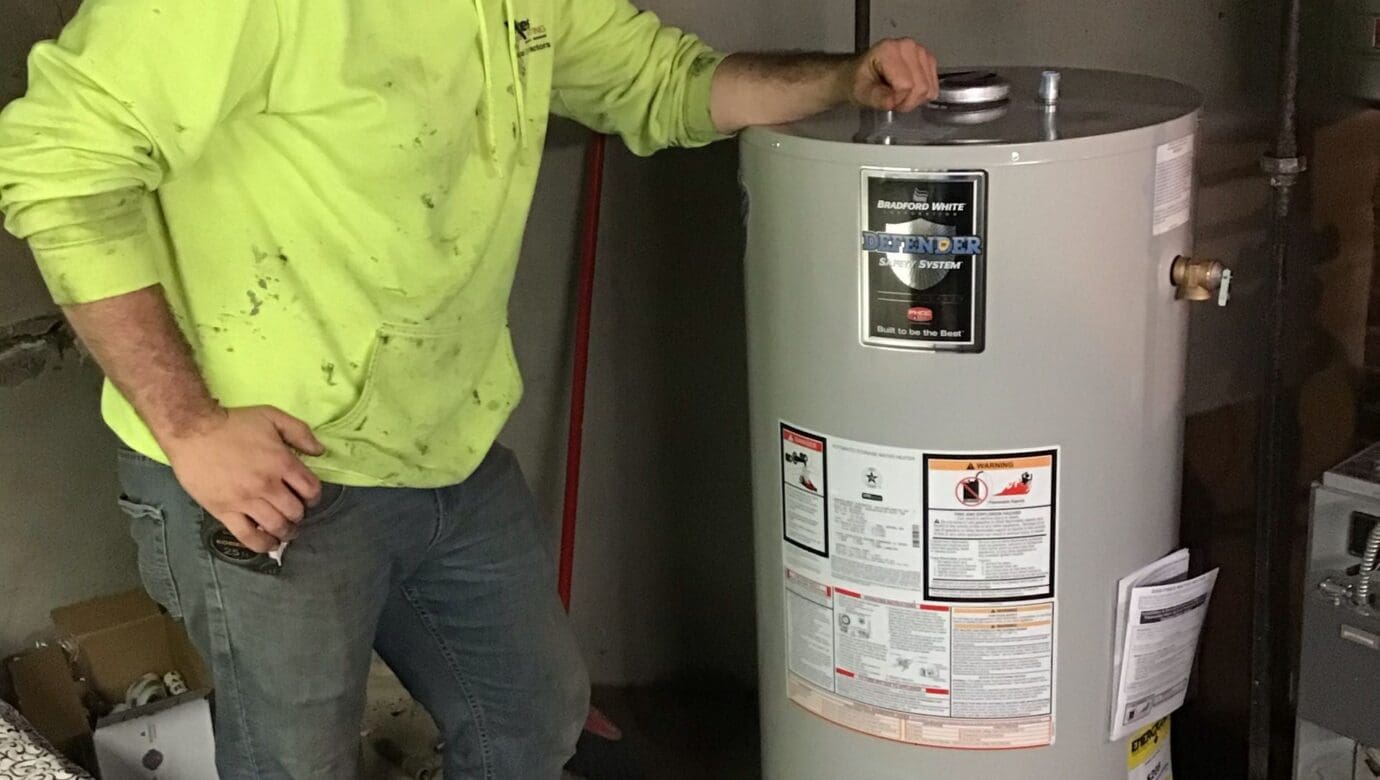
Commercial Water Heater Replacement: Sizing and Code Guide
A commercial water heater replacement comes down to four decisions: sizing the new unit to actual peak demand and recovery, picking a fuel and equipment type that fits your mechanical room and utility service, meeting Ohio’s plumbing and mechanical code steps, and phasing the swap so the building never runs out of hot water. Get those four right and the project is routine.
This guide is for facility managers, plant engineers, school business officials, and hospital facilities teams in Northern Ohio who are budgeting a water heater replacement or watching an aging unit for signs of failure.
Key takeaways
- Replace on recovery failure and corrosion, not just age. Most gas storage water heaters run 10 to 15 years; heat pump and electric storage units often reach 15 to 20 years.
- Size by first hour rating and recovery rate at your actual incoming water temperature, not by the nameplate gallon capacity alone.
- Storage, tankless, and heat pump water heaters solve different load profiles. Match the equipment to your demand curve and mechanical room, not the lowest quote.
- Store hot water at 140 F or higher to control Legionella, then temper to 120 F or lower at fixtures with a mixing valve to prevent scalding.
- A closed system after backflow prevention needs a thermal expansion tank. Ohio’s plumbing and mechanical codes both touch this project, so pull permits before demolition starts.
When does a commercial water heater need replacing, not repair?
Three signs mean it is time to plan a replacement rather than another service call: recovery that can no longer keep up with morning or shift-change demand, visible rust or scale at the tank seams and fittings, and repeat control or element failures on a unit that has already had one major repair. A leaking tank is not repairable; a leaking gasket or a failed thermostat usually is, at least once.
Age is a secondary signal, not the trigger. Most gas and electric storage water heaters run 10 to 15 years before the tank itself starts to fail from internal corrosion. Heat pump water heaters and well-maintained electric storage units often reach 15 to 20 years. Tankless units run longer on the heat exchanger but depend on scale control, which matters more on the harder water found in parts of Erie, Huron, and Sandusky counties.
How do you size a replacement by peak demand and recovery?
Start with fixture count and the peak hour, not the total gallons a building uses in a day. Count showers, kitchen equipment, laundry, and hand sinks that run at the same time during your worst hour, whether that is a school cafeteria rush, a hospital shift change, or a plant’s first-break washup. That peak hour demand, in gallons, is the number the new heater has to cover.
Two figures matter once you know peak demand: first hour rating for storage equipment, and recovery rate in gallons per hour at a given temperature rise for any fuel-fired unit. The American Society of Plumbing Engineers publishes sizing methods used across the industry for exactly this kind of load calculation, and following that method rather than a rule-of-thumb multiplier is worth the extra hour of work on a building with real peak loads.
Northern Ohio incoming water runs colder in winter than the national average used in many rule-of-thumb sizing tables. A heater sized for a 70 degree F temperature rise in a warm climate may only be handling a 90 degree F rise here in January, which cuts effective recovery. Size to your coldest expected incoming water temperature, not an average.
Storage tank, tankless, or heat pump: which fits your building?
Each type solves a different demand curve. Storage tanks buffer a sharp peak with stored volume and a modest recovery rate, which suits a school with a short morning and lunch peak. Tankless units deliver continuous recovery at a steady rate and skip standby losses, which suits a building with long, steady draws rather than one sharp spike. Heat pump and hybrid water heaters trade some recovery speed for lower operating cost and qualify for utility incentives in many Ohio service territories, which suits a building with room for the equipment and a load that is not all peak.
| Type | Best fit | Fuel options | Main limitation |
|---|---|---|---|
| Storage tank | Sharp, short peaks: schools, offices, small clinics | Gas or electric | Standby loss; recovery limited by burner or element size |
| Tankless (on-demand) | Steady, spread-out draws: multi-unit residential, some hospitals | Gas (usually), electric for small loads | High peak gas input; scale sensitivity on hard water |
| Heat pump / hybrid | Buildings with moderate peaks and room to spare | Electric | Slower recovery in cold mechanical rooms; needs air volume |
| Point-of-use electric | Remote sinks far from the central plant | Electric | Small capacity; supplements, does not replace, central supply |
Energy Star publishes efficiency criteria for commercial water heaters across all four categories, and it is a fair starting point for comparing models once you know which type fits the building.
Gas or electric: what changes in your mechanical room?
Gas equipment needs a vent, combustion air, and a gas line sized for the new unit’s input, which on a tankless replacement is often two to three times the old storage heater’s burner. Electric equipment needs panel capacity and, on a heat pump unit, a mechanical room warm enough and large enough to draw the air volume the heat pump needs, which is a real constraint in an unheated Northern Ohio equipment room in January.
Fuel choice also depends on what is already at the building. Ohio’s natural gas infrastructure is well developed across the northern part of the state, and the U.S. Energy Information Administration tracks in-state supply and pricing that most facility budgets already reference for utility planning. A building already on a gas boiler or gas domestic hot water system usually stays on gas for the replacement; a building converting away from gas needs an electrical study before equipment selection, not after.
What do venting and combustion air require on a gas replacement?
Any gas-fired water heater replacement has to be vented and supplied with combustion air according to the National Fuel Gas Code, NFPA 54, which sets the sizing rules for vent connectors, vent termination clearances, and the combustion air openings a mechanical room needs. A higher-input tankless or condensing unit almost always needs a different vent material and diameter than the storage tank it replaces, even in the same mechanical room.
What this means in Ohio: A mechanical room built tight for energy efficiency, common in newer Northern Ohio construction, may not have enough free combustion air for a larger replacement unit without adding louvers or ducted outside air. Check this before ordering equipment, not during startup.
Condensing gas equipment also needs a condensate drain and, in many cases, a neutralizer before that condensate reaches a floor drain or sanitary line. Skipping the neutralizer is a common punch-list item on inspections.
How do you control scald risk and Legionella growth at the same time?
These two requirements pull in opposite directions, and a commercial system has to satisfy both. ANSI/ASHRAE Standard 188 addresses Legionellosis risk management for building water systems and is the reference most healthcare and institutional owners now use to justify storage temperature: hold stored water at 140 F or higher, where Legionella bacteria cannot multiply.
Water that hot at a fixture is a scald hazard, so a thermostatic mixing valve tempers the water down before it reaches showers, handwashing sinks, and tubs. ASSE International publishes the device standards, commonly cited as ASSE 1017 for master mixing valves and ASSE 1070 for point-of-use valves, that plumbing inspectors and specifiers reference for this equipment. On the Firelands Regional Medical Center project in Sandusky, Wilkes designed and installed the plumbing and medical gas systems for a new five-story building where storage temperature, tempering, and infection-control requirements all had to work together across exam rooms, surgical suites, and ICU rooms. Hospital domestic hot water systems carry additional infection-control considerations beyond a standard commercial building, covered in our healthcare plumbing and medical gas guide.
A hospital or school kitchen is not the only place this matters. Any building with a large, low-turnover hot water loop, such as an underused wing or a seasonal building, is a Legionella risk if storage temperature drifts down to save energy without a compensating tempering strategy.
What permits and Ohio code steps apply to a water heater replacement?
Most Ohio jurisdictions treat a commercial water heater replacement as permitted work under the Ohio Plumbing Code, Ohio Administrative Code Chapter 4101:3-1, especially when the fuel type, venting, or piping configuration changes from what is already installed. The state’s Board of Building Standards sets the code adoption and enforcement structure that local building departments and the Ohio Division of Industrial Compliance apply, so check with the local plumbing inspector on permit scope before demolition starts, not after.
A closed system, meaning a water heater downstream of a backflow preventer or check valve, needs a thermal expansion tank to absorb the volume increase as water heats, a requirement most Ohio water systems now enforce as part of Ohio EPA cross-connection control. If your building already has an annual backflow testing program, as most commercial buildings in Ohio’s backflow prevention requirements call for, that same assembly is almost certainly why an expansion tank belongs on the new heater.
How do you swap the water heater without losing hot water in an occupied building?
An occupied hospital, school, or manufacturing plant cannot go a shift without hot water, so the sequence matters as much as the equipment choice. A phased changeover keeps the old unit in service until the new one is tested and ready to take the full load.
- Confirm peak-hour demand and equipment selection before the old unit is scheduled to be shut down.
- Stage the new water heater and pre-run piping, venting, and electrical connections while the existing unit still runs.
- Lock out and tag the gas or electrical supply to the old unit only at the moment of cutover, following OSHA’s control of hazardous energy standard, 29 CFR 1910.147, so no trade works on a live fuel or power source.
- Schedule the actual cutover for the lowest-demand window: overnight or a weekend for most schools and offices, and a coordinated low-census window for a hospital wing.
- Purge air and sediment, set storage and mixing valve temperatures, and run the new unit through a full recovery cycle before declaring it in service.
- Document temperatures, valve settings, and code items for the inspector and for the building’s own maintenance log, then decommission the old tank.
Buildings that cannot tolerate any interruption, such as a hospital central plant, sometimes justify a temporary rental heater staged on-site during the changeover. It adds cost, but it removes the downtime risk entirely, and it is worth pricing against the cost of even a few hours without hot water in a clinical building.
Talk to Wilkes about your project
Bring your building’s fixture count, the peak hours you already know are tight, your current fuel type and mechanical room constraints, and any code or health department requirements specific to your facility to a first conversation. That is enough for an initial sizing and equipment recommendation before a site visit narrows it further.
Call Wilkes at (419) 433-2325, or request a quote to start planning a commercial water heater replacement for your Northern Ohio facility. Our commercial plumbing and HVAC team handles sizing, permitting, and the phased changeover from first call to final inspection, and works from the same preventive maintenance approach covered in our commercial plumbing maintenance checklist once the new unit is in service.
Frequently asked questions
How long does a commercial water heater last?
Most gas and electric storage water heaters run 10 to 15 years before internal tank corrosion causes a leak. Heat pump and well-maintained electric storage units often reach 15 to 20 years, and tankless heat exchangers can run longer if scale is controlled. Recovery failure and visible corrosion are better replacement signals than age alone.
What temperature should a commercial water heater be set to for Legionella control?
Store hot water at 140 F or higher, the threshold referenced in ANSI/ASHRAE Standard 188, since Legionella bacteria cannot multiply at that temperature. Because 140 F water is a scald hazard at a fixture, a thermostatic mixing valve tempers it down to 120 F or lower before it reaches showers and handwashing sinks.
Do I need a permit to replace a commercial water heater in Ohio?
Most Ohio jurisdictions require a permit for commercial water heater replacement under the Ohio Plumbing Code, particularly when fuel type, venting, or piping configuration changes. Confirm scope with your local building department before demolition, since requirements vary slightly by jurisdiction even within the same county.
Is a tankless water heater a good fit for a hospital or school?
It depends on the demand curve more than the building type. Tankless units suit steady, spread-out draws well, but a hospital wing or school with a sharp morning peak may be better served by storage capacity that buffers the spike, or a combination of storage and tankless equipment sized to the actual peak hour.
How much downtime does a water heater replacement cause?
A well-sequenced phased changeover, where the new unit is staged and tested before the old one is shut down, typically limits actual hot water interruption to a few hours during a scheduled low-demand window. Buildings that cannot tolerate any gap sometimes stage a temporary rental unit during the cutover.
Keep reading
Medical Gas Piping: What Hospitals Need From a Contractor
Medical gas is a life safety system, not a utility. Here is what NFPA 99 verification, ASSE 6010 certification, and occupied-hospital work actually require from a mechanical contractor in Northern Ohio.

Legionella Water Management Plans: ASHRAE 188 in Ohio
ASHRAE 188 sets the framework for a Legionella water management plan in hospitals and large buildings. Here is what Ohio facility teams need to know to build and maintain one.
Backflow Testing in Ohio: Who Needs It and How Often
What Ohio building owners need to know about backflow testing: which connections need a testable assembly, how hazard class picks the device, how often testing is required, and what happens when a report is late.
Need this handled at your facility?
Wilkes engineers, fabricates, and installs process piping, plumbing, and HVAC systems across Ohio.