Mechanical Contractor in Huron, Ohio: What to Expect
A mechanical contractor in Huron, Ohio handles the plumbing, HVAC, industrial process piping, and welding work that keeps a plant, hospital, school, or commercial building running: the pipe, boilers, rooftop units, and backflow assemblies that most people never think about until one of them fails. In Erie, Huron, Ottawa, Sandusky, and Lorain counties, that work is done by a short list of firms, and the right one for your building depends on scope, response time, and whether the crew has actually built what you need before.
This guide is for plant managers, facility directors, school business officials, hospital facilities teams, and building owners across Huron, Sandusky, Norwalk, Port Clinton, Vermilion, Lorain, and Fremont who are choosing a contractor for the first time or replacing one that has not kept up. It lays out what a qualified local mechanical contractor should provide, how to check their credentials in Ohio, and what to ask before you sign a contract.
Key takeaways
- A true mechanical contractor covers plumbing, HVAC, process piping, and fabrication, not just one trade.
- Response time matters: a shop based in Huron or Sandusky can reach most of Erie, Huron, and Ottawa counties faster than a crew traveling from Cleveland or Toledo.
- Verify license status through the Ohio Construction Industry Licensing Board and ask for current certificates of insurance before work starts.
- Lake Erie winters raise the stakes on freeze protection, boiler reliability, and rooftop equipment access.
- A contractor with its own fabrication shop can prebuild piping skids off site, which shortens the time your building is out of service.
Type mechanical contractor Huron Ohio into a search bar and you will see the same handful of local names surface again, and one of them has been doing this work in Huron since 1912. That kind of tenure matters less as a marketing point and more as a practical one: a firm that has served the Sandusky Bay region for over a century has already dealt with the local inspectors, the local water authority, and the specific freeze and thaw cycles that define construction here.
Why Does Northern Ohio’s Industrial Base Need a Local Mechanical Contractor?
The Sandusky Bay corridor is more industrial than most people from outside the region expect. Chemical, paint, plastics, and food manufacturers run process lines that depend on properly sized and welded piping, not off-the-shelf plumbing. A poorly executed weld or an undersized line does not just leak, it can shut down a production run or trigger a safety incident.
NASA Glenn’s Armstrong Test Facility in Sandusky is one of the more visible examples of the kind of technical work this area supports, alongside food processors, glass and building products manufacturers, and a healthcare and higher education base that includes hospitals, clinics, and colleges across Erie and Lorain counties. Add a tourism economy built around the Lake Erie islands and Cedar Point, and you have a region where commercial kitchens, hotel boiler plants, and public restrooms all need reliable service on a tight seasonal calendar.
That mix is why the work is best handled by a contractor who understands both sides of the business: industrial process piping built to ASME B31.3 for a manufacturer, and commercial plumbing and HVAC for the school, clinic, or office building down the road. Wilkes has built process piping and reactor systems for manufacturers and completed mechanical work at NASA’s Sandusky test facility, alongside plumbing and HVAC work for schools, hospitals, and commercial buildings across the same counties.
What Should a Mechanical Contractor in Sandusky and Huron, Ohio Provide?
A capable local mechanical contractor brings more than a truck and a toolbox. Four things separate a contractor that can actually support an Erie County facility from one that is simply willing to take the call.
Emergency response distance
When a boiler fails at a hospital or a process line goes down at a plant, the distance between the contractor’s shop and your facility determines how long you are down. A contractor based in Huron or Sandusky can reach most of Erie, Huron, and Ottawa counties, and much of Sandusky and Lorain counties, well inside the response window that a Cleveland or Toledo based firm cannot consistently match, especially in winter weather.
An in-house fabrication shop
Custom piping runs and skid-mounted equipment packages are faster and cleaner when they are built in a controlled shop environment instead of stick-built on site. A contractor with its own fabrication capability, including orbital welding for high-purity lines, can prebuild sections off site to American Welding Society practices and standards referenced in codes like ASME B31.3, then install them in a fraction of the field hours a purely on-site build would take.
Working knowledge of local jurisdictions
Ohio’s building and plumbing codes are administered through local building departments that answer to the Ohio Board of Building Standards, and each jurisdiction has its own inspectors, permitting quirks, and preferred documentation. A contractor who already has a working relationship with Huron, Sandusky, Norwalk, or Erie County inspectors moves permits and inspections faster than one seeing that office for the first time.
Established utility relationships
Backflow testing, gas service coordination, and water main tie-ins all run through the local utility, and a contractor who already knows the water department’s paperwork and the gas utility’s scheduling avoids the delays that come from learning a new process mid-project.
How Do You Check a Mechanical Contractor’s License and Insurance in Ohio?
Ohio does not require a single statewide plumbing or HVAC license the way some states do, so verification is a multi-step process rather than one database lookup. Start with the Ohio Construction Industry Licensing Board, which handles licensing for hydronics, refrigeration, and other regulated specialty trades in the jurisdictions that require it, then confirm the contractor carries current general liability and workers’ compensation coverage through the Ohio Bureau of Workers’ Compensation. A certificate of insurance should list your project and be current, not expired from a prior job.
References matter as much as paperwork. Ask for two or three recent projects similar in scope to yours, and ask each reference the same question: would you hire this contractor again for a similar job. A safety program is the fourth check, since a contractor’s safety record affects your own liability exposure and your insurance carrier’s view of the project.
| Question to ask | What a strong answer sounds like | Why it matters |
|---|---|---|
| Are you licensed for this scope of work in this jurisdiction? | A specific answer naming the license type and jurisdiction, not a general “we’re licensed” | Confirms the contractor has cleared the applicable Ohio requirement, not just a business registration |
| Can I see a current certificate of insurance? | One is produced within a day or two, naming your project | Protects your facility if there is an accident or property damage on site |
| Do you have your own fabrication shop? | A direct yes, with examples of prefabricated piping skids or process piping built there | Shop-built work is typically higher quality and faster to install than field-built work |
| How far is your crew from my facility? | A specific travel time, not “we cover the whole state” | Determines real emergency response time, not marketing coverage claims |
| Can you provide two or three references for similar work? | References offered without hesitation, ideally in a similar market segment | Past performance on comparable work predicts your outcome better than a sales pitch |
| What is your safety program, and what is your experience modification rate? | A described program with a specific rate figure, not a vague assurance | A weak safety record raises your own liability and insurance costs on the project |
How Do Lake Erie Winters Change Plumbing and HVAC Work in Huron and Sandusky?
Winters along the Lake Erie shore bring lake-effect snow, sustained freezing temperatures, and rapid swings that stress buildings harder than the statewide averages suggest. Freeze protection on exposed piping, backflow assemblies, and rooftop equipment is not optional here, and a contractor unfamiliar with the local climate can underestimate what a building needs.
Boiler reliability becomes a life-safety issue in winter for hospitals, schools, and senior living facilities, which is one reason preventive maintenance schedules matter more in this region than in milder climates. Rooftop HVAC access also gets harder once snow accumulates, so scheduling major HVAC work, including many summer retrofit projects at schools, around the calendar rather than waiting for a failure saves both money and downtime.
What this means in Ohio: Any exposed pipe, hose bib, or backflow assembly within reach of outside air along the Lake Erie shore should be insulated, heat traced, or drained before the first hard freeze, typically by early November in a normal year. A single overnight cold snap can freeze and split a line that was fine the day before.
This is also where an HVAC contractor Sandusky facility managers already trust earns that trust: knowing which rooftop units in this climate need extra attention before the first lake-effect system rolls through, and which boiler rooms need a pre-season check rather than a mid-January emergency call.
What Questions Should You Ask Before Hiring a Plumber or Mechanical Contractor in Huron or Sandusky, Ohio?
Search plumber Huron Ohio or commercial plumber Sandusky Ohio and you will get a list of options, but narrowing that list takes a consistent process. Use the same steps whether you are hiring for a single repair or a multi-year facility relationship.
- Define the scope in writing: repair, maintenance, or a design-build project, and whether it touches process piping, plumbing, HVAC, or all three.
- Ask each candidate for license type, jurisdiction, and current insurance certificates before any site visit.
- Confirm typical response time to your specific address, not a general service area map.
- Request two or three references for work of similar scope and actually call them.
- Ask whether the contractor fabricates piping in house or subcontracts that work.
- Walk the site together and get a written scope of work, not just a verbal estimate.
- Confirm who pulls permits and coordinates inspections with the local building department.
- Put the maintenance or warranty terms in writing before work begins.
Contractors who cover this ground with you, and who can point to completed local projects and explain their own approach to industrial piping without prompting, are typically the ones worth calling back for a proposal.
What Does a Wilkes Project in the Huron and Sandusky Area Look Like?
Wilkes’ work at CertainTeed Products Corp. is a useful example of what a mechanical contractor is actually hired to solve. The shingle manufacturing process at that plant needed a comprehensive upgrade to existing infrastructure, centered on implementing a robust fume collection system for the asphalt storage operations while also improving thermal efficiency across the process.
That kind of project rarely stays inside one trade. It touches process piping sized and welded to ASME B31.3, thermal system design, and coordination with the plant’s own operations schedule so the upgrade does not stop production any longer than necessary. It is the same reason manufacturers along the Lake Erie shore look for a mechanical contractor who can plan, fabricate, and install as one team instead of managing three separate subcontractors.
What Should a First Conversation With a Local Mechanical Contractor Cover?
Before you call, get clear on three things: the exact problem or project, any deadline that is driving the schedule, and who at your organization needs to sign off on the scope and cost. A contractor who asks good questions back, about your building’s age, prior work, and operating hours, is usually the one paying attention.
Ask directly about commercial plumbing and HVAC capacity if that is your need, or industrial process piping capacity if it is a plant project. A contractor who tries to be everything to everyone without the shop, crew, or code knowledge to back it up is a bigger risk than one who is upfront about what they do and do not handle.
Frequently asked questions
What does a mechanical contractor in Huron, Ohio actually cover that a general plumber does not?
A mechanical contractor typically covers plumbing, HVAC, industrial process piping, boiler and hydronic systems, and welding and fabrication under one roof, while a general plumber usually focuses on plumbing alone. For manufacturers and larger institutional buildings, that broader scope means one team can plan and execute a project instead of coordinating several separate trades.
How do I verify a plumber or HVAC contractor is properly licensed in Ohio?
Check with the Ohio Construction Industry Licensing Board for the specific trade and jurisdiction involved, since Ohio licensing runs through a mix of state and local requirements rather than one universal license. Also ask for a current certificate of insurance and confirm workers’ compensation coverage through the Ohio Bureau of Workers’ Compensation before work begins.
Why does response time matter so much for a commercial plumber in Sandusky, Ohio?
A failed boiler, a burst line, or a backed-up sewer does not wait for a convenient time, and every hour of delay usually means more water damage, more downtime, or a bigger repair bill. A contractor based in or near Sandusky reaches most local facilities faster than a crew traveling from a distant metro area, particularly once winter weather slows travel along the Lake Erie shore.
How does Lake Erie weather affect plumbing and HVAC systems in this region?
Lake-effect snow and sustained freezing temperatures raise the risk of frozen and split pipes, strain boiler systems that carry more of the heating load, and make rooftop HVAC access harder once snow accumulates. Facilities in Erie, Huron, Ottawa, Sandusky, and Lorain counties generally need more deliberate freeze protection and pre-season equipment checks than buildings further south.
What should I bring to a first meeting with a mechanical contractor?
Bring a clear description of the problem or project, any deadline driving the schedule, recent maintenance or inspection records if you have them, and building or system drawings if they exist. The more specific you can be about scope and history, the faster a contractor can give you an accurate proposal instead of a rough guess.
Talk to Wilkes about your project
Before you call, jot down what is happening, how long it has been an issue, and any deadline you are working against, whether that is a production schedule, a school break, or a health inspection. If you have drawings, prior service records, or photos of the equipment involved, have them ready. It shortens the first conversation and gets you a more accurate scope faster.
Reach the team at (419) 433-2325, or request a quote and someone from Wilkes will follow up to talk through your project.
Keep reading
Design-Build Mechanical Contractor: Fewer Change Orders
Design-build puts engineering and construction under one mechanical contract. This guide covers where the schedule savings come from, why change orders drop, who owns code compliance, and when a hard bid still wins.
What Does a Mechanical Contractor Do? Scope and Trades
A plain guide to what a mechanical contractor covers, how the role differs from a general contractor, plumber, or HVAC service company, and when a Northern Ohio facility needs one.
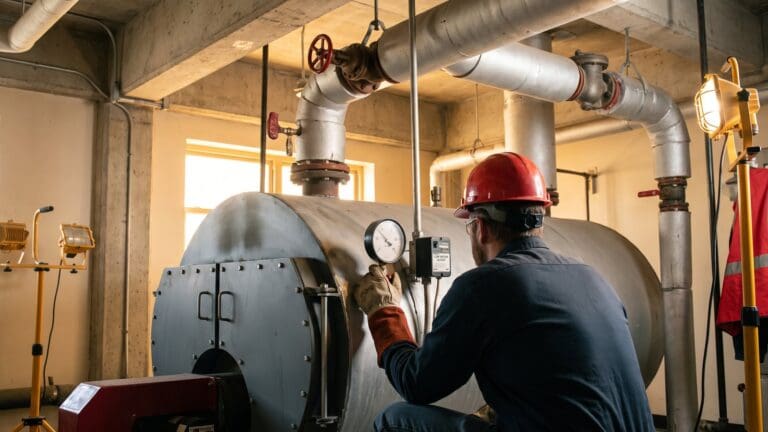
Commercial Boiler Maintenance: Checklist, Tune-Up and Ohio Rules
A frequency-by-frequency maintenance plan for commercial steam and hot water boilers, from the daily log to the annual combustion report, built around Ohio's inspection cycle.
Need this handled at your facility?
Wilkes engineers, fabricates, and installs process piping, plumbing, and HVAC systems across Ohio.