Backflow Testing in Ohio: Who Needs It and How Often
If your building has a backflow prevention assembly on its water service, that assembly has to be tested by a certified tester on a recurring schedule, and the public water system that serves you enforces it. Most Ohio purveyors require a passing test report every year, filed with them and not simply kept in your binder. Miss the deadline and the purveyor can order correction and, in the end, shut off water until the assembly is repaired and retested.
This guide is for plant managers, facility directors, school business officials, and hospital facilities teams in Erie, Huron, Lorain, Ottawa, and Sandusky counties who own the piping on their side of the meter.
Key takeaways
- Ohio’s cross-connection control rules sit in Ohio Administrative Code Chapter 3745-95, and your local water purveyor administers them and accepts the reports.
- Annual testing is the common interval across Ohio water systems. The interval that governs your building is the one your water department puts in writing.
- Hazard class drives the device: high hazard generally takes a reduced pressure principle assembly, low hazard may take a double check.
- A test performed and never submitted counts as a missed test. The report has to reach the purveyor.
- A reduced pressure assembly in an unheated Northern Ohio space will freeze its relief port open.
- Access decides your annual cost. An assembly a tester cannot stand in front of costs money forever.
What is backflow, and why do water suppliers care so much?
Backflow is water moving the wrong direction through a piping system, out of your building and back into the public main. It happens two ways, and the distinction determines which device protects a connection.
Backsiphonage occurs when pressure in the distribution main drops below the pressure in your building. A main break, a large fire flow, or an open hydrant is enough, and the drop pulls water backward out of the building. Backpressure occurs when a system inside the building pushes harder than the incoming supply: a boiler loop, a pressurized process line, a booster pump, or an elevated tank.
Either way, whatever is in your water can end up in the neighborhood’s water. The federal framework comes from the Safe Drinking Water Act, administered through EPA’s drinking water program, which obligates public water systems to protect the main from contamination originating on customer premises.
In Ohio that obligation lands in Ohio Administrative Code Chapter 3745-95, the Ohio EPA cross-connection control rules. Ohio EPA’s backflow prevention program sets the framework, and your city or county water department carries it out: it maintains the register, sends notices, recognizes testers, and accepts reports.
The Ohio Plumbing Code, adopted by the Ohio Board of Building Standards, governs where protection is required inside the building and how it is installed. The two work together: the plumbing code says a connection needs protection, and the cross-connection rules say it has to be proved working on a schedule.
Who needs backflow testing?
Far more properties need it than realize it. A testable assembly is required anywhere the building’s potable water can contact something you would not want to drink, which on most commercial sites is several places.
The connections that almost always require protection
- Boiler and hydronic makeup water lines, especially any loop carrying glycol or chemical treatment
- Cooling towers and closed loop chilled water systems
- Fire suppression systems, particularly those with antifreeze or a fire department connection
- Irrigation and lawn systems, including quick couplers
- Commercial kitchens: dishwashers, pot fillers, pre-rinse assemblies, and carbonators
- Chemical mixing stations, janitor sinks, and hose bibbs used with hose-end chemicals
- Process water in manufacturing, plating, paint, and food production
- Laboratory, imaging, dental, dialysis, and sterilizer connections
Two get missed constantly. Fire lines are cross-connections even when nobody thinks of them that way, because a sprinkler system holds standing water and often carries corrosion inhibitor. NFPA 13 governs the sprinkler system, but the assembly on the fire service belongs to the purveyor’s schedule. Kitchens are the other: the FDA Food Code treats backflow protection as a food safety item, so a health inspector and a water department can write you up for the same missing device.
If you manage a commercial, institutional, or industrial building, assume you have at least one assembly and that the water department has you in its file. We routinely walk buildings whose owners believed they had none and find three.
Which assembly does your hazard class require?
Water purveyors sort connections into hazard classes. A high hazard, sometimes called a health hazard, is one where backflow could carry something capable of causing illness or death. A low hazard is objectionable but not dangerous, such as a clean closed loop. The class drives the device, and getting it wrong is expensive because the fix is usually a repipe, not a swap.
Assembly performance standards come from the ASSE International series, and most cross-connection programs work from the AWWA manual. The short version for a facility owner:
| Assembly type | Protects against | Typical Ohio applications | Installation constraints |
|---|---|---|---|
| Reduced pressure principle (RP) | High hazard, backpressure and backsiphonage | Boiler and chiller makeup, process water, chemical feed, medical equipment | Never in a pit. Needs a heated space and an air gap to an adequate drain. |
| Double check valve assembly (DC) | Low hazard, backpressure and backsiphonage | Clean closed loops, some fire lines, non-chemical makeup | Allowed in a vault where the purveyor permits it. Still needs test cock access. |
| Pressure vacuum breaker (PVB) | Backsiphonage only, high or low hazard | Irrigation zones with no chemical injection | Sits at least 12 in. above the highest downstream outlet. Not valid under backpressure. |
| Atmospheric vacuum breaker (AVB) | Backsiphonage only | Janitor sink faucets, single fixture uses | Not testable, no valve downstream, not acceptable under continuous pressure. |
The RP, the DC, and the PVB are the testable assemblies, along with the detector variants used on fire service. Non-testable devices such as hose bibb vacuum breakers still matter, but they are inspected and replaced rather than gauged.
What this means in Ohio: A reduced pressure assembly relieves water to atmosphere when a check fouls, so it cannot live outdoors or in an unheated vestibule through a Lake Erie winter. Freeze splits the body or holds the relief port open, and the first sign is usually water across a floor in January. If an RP has to serve an exterior connection, put it in a heated enclosure with a drain and a reachable shutoff.
How often does a backflow preventer have to be tested?
Testable assemblies are tested at installation, after any repair, rebuild, or relocation, and then on a recurring interval the water purveyor sets. Annual testing is the common interval across Ohio water systems, and some purveyors shorten it for high hazard connections or for assemblies serving hospitals and schools. Because the interval and the form are set locally, the only reliable answer for your building is the one your water department gives you in writing.
Three scheduling details that trip people up
First, the anniversary usually runs from the last passing test rather than the calendar year, so testing early moves your due date earlier and permanently. Second, a failed test does not reset the clock; the repair and the passing retest do. Third, the report has to reach the purveyor. A test performed, signed, and left in a facility file is a missed test as far as the register is concerned, and that is the most common way a diligent building ends up in violation.
What happens during a certified backflow test?
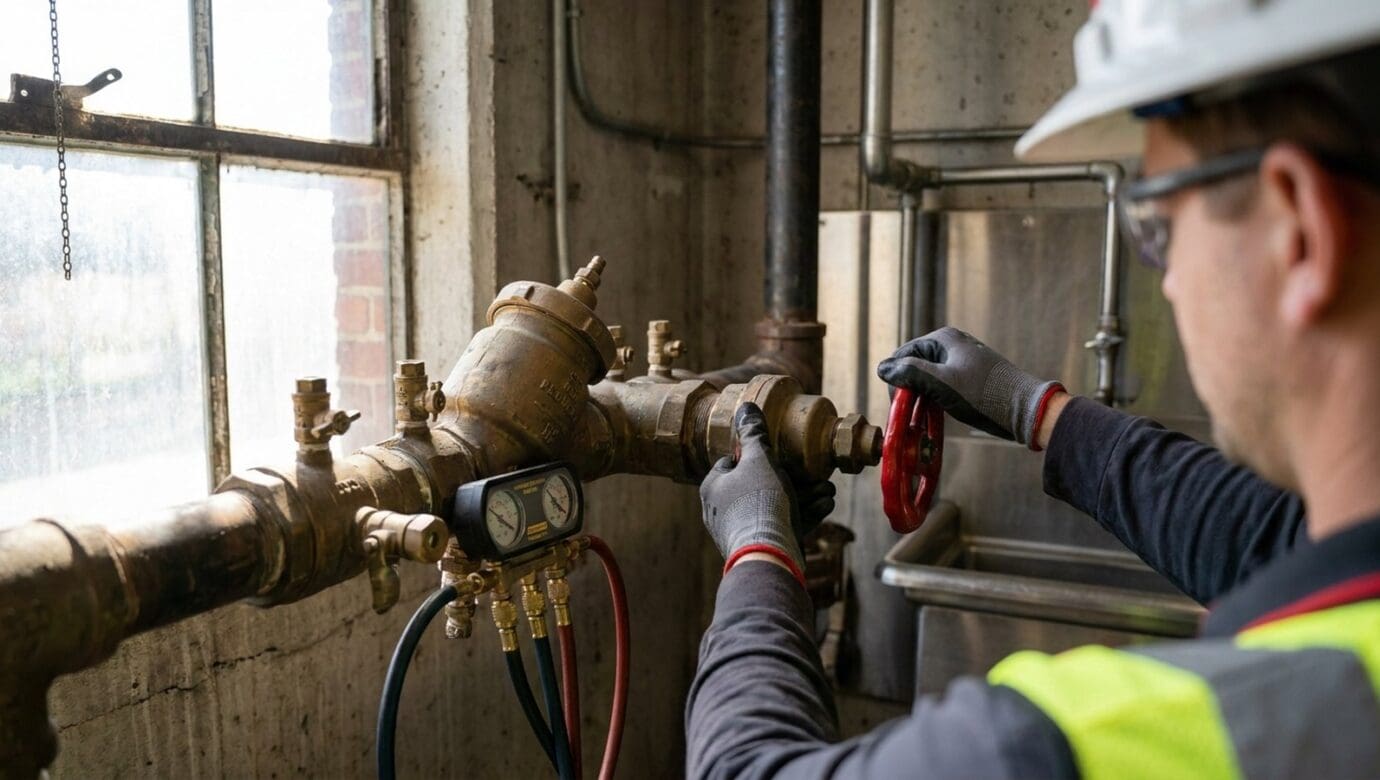
A certified tester connects a calibrated differential pressure gauge to the test cocks and verifies each internal component. On a reduced pressure assembly, that means confirming both check valves hold against reverse flow and that the relief valve opens at the required differential. On a double check, it means proving both checks hold tight. The readings, the make, model, size, serial number, and the result go on the report.
The mechanical part takes minutes on an accessible assembly. Everything around it takes planning:
- Confirm the tester and the gauge. The tester must hold a current certification the purveyor recognizes, with a gauge calibrated inside the period the purveyor accepts. Ask for both before scheduling, not after a report is rejected.
- Identify what the assembly feeds. Isolating a device serving a sterilizer, a process line, or a fire pump is a coordination problem, not a plumbing problem.
- Notify occupants and set the window. Schools, hospitals, and plants get a written outage window, which on a production line means a shift change or a planned shutdown.
- Isolate and test. Close the downstream shutoff, connect the gauge to the test cocks in sequence, and record the differential for each check and the relief valve opening point.
- Repair on the spot where possible. Most failures are wear items: seats, discs, springs, O-rings, or debris holding a check off its seat. A rebuild kit and a same-day retest is the normal outcome.
- Restore, flush, and document. Reopen slowly to avoid a surge, flush the fixtures, file the report with the purveyor, and update your register with the new due date.
Replacement beats a rebuild when the body is corroded through, when the assembly is undersized for current demand, or when the device was never the right class for the hazard. That last case is common in buildings that changed use, where a double check installed for a clean loop now sits in front of chemical feed.
What happens if you skip backflow testing?
Nothing, right up until it matters. Then several things happen at once.
The water purveyor issues a notice with a correction window. If the assembly is not tested or corrected inside it, the purveyor can discontinue water service until the cross-connection is protected. For a plant, a school, or a medical building, losing domestic water is not a paperwork problem. It is a shutdown, and in a licensed facility it can force a closure.
The second consequence is liability. If a contamination event is traced to an unprotected connection on your side of the meter, the exposure sits with the property owner, not the water department, and insurers ask for test records after the fact.
The third is the quiet one, and it costs most buildings the most money. An untested assembly is an unmaintained assembly. A fouled check restricts flow and generates pressure complaints nobody traces to the real cause, and a weeping relief valve runs water into a mechanical room continuously. Stagnant building water is also the condition CDC’s Legionella guidance and ASHRAE Standard 188 target, which is why hospitals fold backflow records into a water management plan.
How do you run a backflow program across a campus or portfolio?
Build a register and work it. List every assembly with its building, room, and elevation, plus size, make, model, serial number, hazard class, the equipment it protects, and the due date. The register is the deliverable; everything else is scheduling against it.
Test in batches, not one at a time
Testing every assembly on one visit costs a fraction of testing them as notices arrive, because mobilization, isolation, and occupant notification are the expensive parts. Pair the visit with the rest of your preventive work so the water goes down once. Our commercial plumbing preventive maintenance checklist covers how to sequence that across a year. Facilities running hydronic heating in schools and institutions usually have makeup assemblies sitting next to equipment that needs seasonal attention anyway.
Fix access once and stop paying for it annually
Access is what people underestimate. An assembly above a hard ceiling, behind stored inventory, or over live production equipment costs more every year, forever, and it is why a routine test turns into a lift rental. When we install or relocate assemblies, we set them where a tester can stand in front of the test cocks and the relief port discharges straight to a drain.
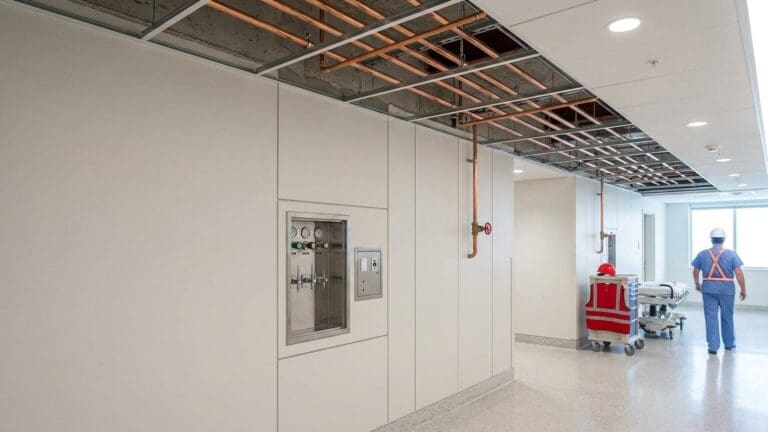
Complex facilities are where the discipline pays off. On the Firelands Regional Medical Center project in Sandusky, our team designed and installed the entire plumbing and medical gas systems for a new five story building covering exam rooms, surgical suites, and ICU rooms. Protected connections in a building like that get documented as they are installed, because tracing them later in an occupied hospital is far harder. The same holds for any healthcare plumbing and medical gas scope, where the equipment list changes faster than the drawings.
Backflow testing, repair, and reporting sit within our commercial plumbing and HVAC work, and on industrial sites the same crews handle the industrial process piping the assemblies protect. Wilkes has worked in Northern Ohio buildings since 1912, so we have seen what happens to an assembly nobody looked at for a decade.
Frequently asked questions
Who is allowed to test a backflow preventer in Ohio?
Testing must be performed by a tester holding a current backflow prevention assembly tester certification, using a differential pressure gauge calibrated within the period your water purveyor accepts. The purveyor keeps a list of testers it recognizes and will reject a report from someone not on that list or whose certification has lapsed. Ask for the certification and the gauge calibration date before scheduling the work.
Do I need a backflow preventer on my fire sprinkler system?
In most cases yes, because a sprinkler system holds standing water and often contains antifreeze or corrosion inhibitor, which makes it a cross-connection. The assembly class depends on what is in the system and on your purveyor’s requirements. Fire service assemblies are sized for fire flow rather than domestic demand, so they are large and have to be planned into the room, and testing briefly takes the system out of service.
What is the difference between a reduced pressure assembly and a double check?
A double check valve assembly uses two independent check valves in series and protects low hazard connections. A reduced pressure principle assembly adds a relief valve between the two checks that dumps water to atmosphere if either check fails, so contaminated water reaches the floor drain instead of the supply. That is why reduced pressure assemblies are used on high hazard connections and cannot be installed in a pit.
Can you test our assemblies without shutting the building down?
Not entirely, because the test requires isolating each assembly, but the outage is short and can almost always be scheduled around your operation. We regularly do this work on evenings, weekends, and planned shutdowns for schools, medical buildings, and manufacturers. Send the register and your constraints, and we sequence the visit so each area goes down once, briefly, at a time you pick.
How much does annual backflow testing cost?
The test itself is a small, predictable line item per assembly, and the real variables are quantity, access, and condition. Assemblies in a row in a heated mechanical room test quickly. One above a hard ceiling or over production equipment costs more every year because of the lift and the coordination. Repairs are quoted separately, and most failures are rebuild kits rather than replacements.
Talk to Wilkes about your project
If you are not sure how many assemblies you have, when they were last tested, or whether the reports reached the water department, we can walk the property and build the register. Bring what you have: a device list, mechanical drawings, last year’s reports, a recent purveyor notice, and the systems you cannot take offline during business hours.
Wilkes Plumbing & Heating is at 205 Sprowl Rd, Huron, OH 44839, serving Huron, Sandusky, Norwalk, Port Clinton, Vermilion, Lorain, Fremont, and the surrounding counties. Call (419) 433-2325, or request a quote and we will get a tester on your calendar.
Keep reading
Medical Gas Piping: What Hospitals Need From a Contractor
Medical gas is a life safety system, not a utility. Here is what NFPA 99 verification, ASSE 6010 certification, and occupied-hospital work actually require from a mechanical contractor in Northern Ohio.

Legionella Water Management Plans: ASHRAE 188 in Ohio
ASHRAE 188 sets the framework for a Legionella water management plan in hospitals and large buildings. Here is what Ohio facility teams need to know to build and maintain one.
Commercial Water Heater Replacement: Sizing and Code Guide
A practical field guide to sizing, fuel selection, venting, Legionella control, code steps, and phasing a commercial water heater replacement for Ohio schools, hospitals, and plants.
Need this handled at your facility?
Wilkes engineers, fabricates, and installs process piping, plumbing, and HVAC systems across Ohio.