
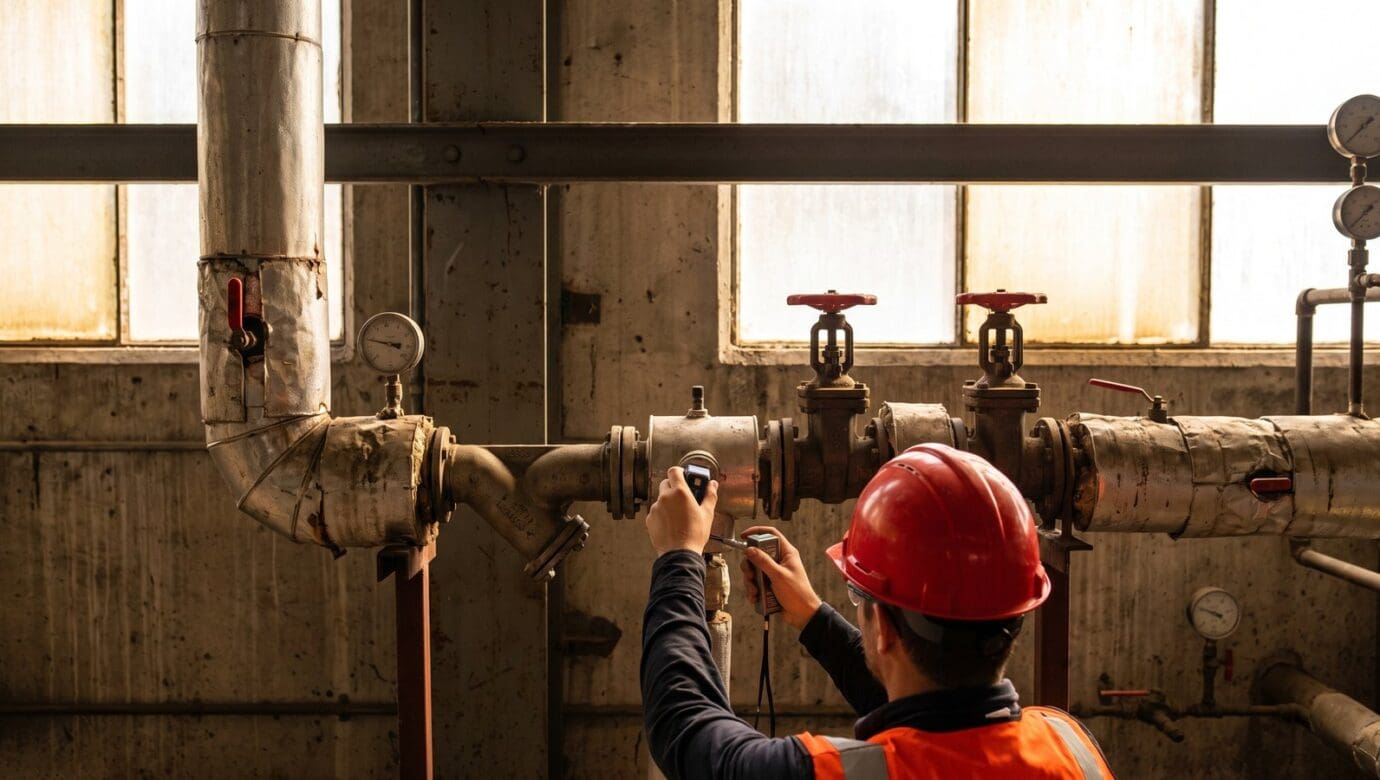
Steam Trap Testing: How Traps Fail and What a Survey Finds
A steam trap is an automatic valve that drains condensate, air and other noncondensable gases from a steam system while holding the steam in. Traps fail in one of two ways: open, which blows live steam into the condensate return, or closed, which backs condensate into coils, mains and heat exchangers. Finding the failures reliably calls for at least two test methods per trap, usually ultrasonic sound plus surface temperature, on a regular schedule. Our team works on traps, condensate return and the piping around them as part of our boiler and hydronic heating service.
This guide is for plant engineers, maintenance leads, school business officials and hospital facilities directors in Huron, Sandusky, Norwalk and Lorain County who still run steam. Many older schools, churches and plants in Erie and Huron counties heat with steam, and there much of the savings comes from trap surveys and condensate recovery rather than new equipment. The principles apply across industrial, healthcare and education plants.
Key takeaways
- A steam trap passes condensate, air and noncondensable gases while stopping live steam, and each trap family senses the difference in its own way.
- A trap that fails open wastes steam, water and treatment chemicals, while a trap that fails closed cuts heating capacity and can set up water hammer.
- Federal guidance recommends at least two test methods per trap to improve the odds of a correct diagnosis, and temperature alone cannot tell saturated steam from condensate at the same temperature.
- Testing intervals scale with pressure, from weekly or monthly on high-pressure traps to annually on low-pressure heating systems.
- A survey is only as useful as its log, which should hold the location, type, condition, test result and repair date for every trap.
- Repiping a poor trap station with isolation valves, a strainer and test points often matters as much as the trap itself.
How does a steam trap work?
Steam gives up its heat in a coil, a jacket or a heat exchanger and turns back into water. The Federal Energy Management Program’s steam trap assessment guide describes steam traps as automatic valves used in every steam system to remove condensate, air and other noncondensable gases while preventing or minimizing the passing of steam. If condensate collects, it reduces the flow capacity of steam lines and the thermal capacity of heat transfer equipment, and excess condensate can lead to water hammer.
Air and gases matter too. The same guide notes that air left after startup reduces steam pressure and temperature, that noncondensable gases such as oxygen and carbon dioxide cause corrosion, and that steam passing through a trap provides no heating at all.
Traps sit at the bottom of drip legs along the mains and at the outlet of each unit heater, coil, heat exchanger and jacketed line. The U.S. Department of Energy’s steam system sourcebook puts the stakes plainly: if the traps do not function properly, excess steam flows through the end-use device or the condensate backs up into it.
What are the main steam trap types, and where does each fit?
The DOE sourcebook groups traps into three families. Thermostatic traps respond to temperature, mechanical traps to the density difference between condensate and steam, and thermodynamic traps to the difference in velocity between condensate and live steam. The table draws operating principles from that sourcebook and the FEMP guide, and failure modes from the American Society for Health Care Engineering’s steam trap measure sheet, except the bellows row, which comes from the sourcebook. The sourcebook also notes that bimetallic traps can fail in either the open or closed position, where ASHE lists them as failing open.
| Trap type | What moves the valve | Air at startup | Typical failure mode |
|---|---|---|---|
| Inverted bucket | Steam caught under a bucket floats it up to close the valve | Vents air through a small hole in the top of the bucket | Open or closed |
| Float and thermostatic | A float rides the condensate level, and a separate thermostatic element vents air | Thermostatic element discharges air at startup and in operation | Closed |
| Bimetallic thermostatic | A strip of two dissimilar metals bends as it nears steam temperature | Open when cold, so air and condensate pass freely | Open |
| Bellows thermostatic | A fluid-filled bellows expands as it nears steam temperature | Open when cold, so air escapes | Open or closed |
| Thermodynamic disc | The velocity difference between condensate and steam moves a flat disc | Poor air removal unless fitted with added components | Open |
| Piston or impulse | The velocity difference between condensate and steam moves a piston valve | Discharges air and condensate continuously | Open |
The sourcebook adds that inverted bucket traps are not recommended for superheated steam service unless special installation conditions are met, because they can lose their condensate seal and discharge live steam continuously. The practical rule is to match the trap to the load: a modulating coil, a drip leg and a jacketed process line each ask for something different.
How do steam traps fail, and what does a failure cost?
FEMP frames every trap test around two questions: is the trap working, and if not, did it fail open or closed? A trap that fails open loses steam and its energy, and where condensate is not returned, the water goes with it. A trap that fails closed wastes no steam but can significantly reduce heating capacity or damage the equipment it serves.
The open failures add up quietly. DOE’s Steam Tip Sheet #1 reports that in steam systems not maintained for 3 to 5 years, between 15% and 30% of the installed traps may have failed, while systems with a regularly scheduled maintenance program should hold leaking traps under 5% of the trap population. FEMP estimates that approximately 20% of the steam leaving a central boiler plant is lost through leaking traps in typical space heating systems without proactive assessment programs.
Loss scales with orifice size and line pressure. The tip sheet’s table, credited to the Boiler Efficiency Institute, puts a trap stuck open with a 1/8-inch orifice at 13.7 pounds of steam per hour at 15 psig and 75.8 pounds per hour at 150 psig, and a 1/4-inch orifice at 150 psig at 303 pounds per hour. Its worked example values steam at $10.00 per thousand pounds and puts that single 1/8-inch, 150 psig failure at $6,640 a year.
The steam is not the whole cost. FEMP notes that where condensate is not returned, leaking traps raise make-up water and treatment costs and increase blowdown. ASHE adds that live steam migrating into the condensate system overheats condensate piping and escapes through atmospheric vents.
How do you test a steam trap?
DOE’s tip sheet lists four ways to test steam traps: temperature, sound, visual and electronic. FEMP ranks the classic three, sight, sound and temperature, by reliability and advises using at least two of them. On a survey, that usually means an ultrasonic reading and a temperature reading at every trap, plus a sight check where the piping allows it.
Sound: ultrasonic and contact listening
FEMP describes listening tools ranging from a simple mechanic’s stethoscope to electronic instruments that compare the measured sound with that of working and failed traps. On types that discharge intermittently, such as inverted bucket and disc traps, the tester listens for the expected open and close cycle rather than continuous flow.
Temperature: infrared and contact readings
FEMP calls temperature the least reliable method, because saturated steam and condensate exist at the same temperature. Still, a trap well below the expected steam temperature is flooded, assuming it is in service and not in startup. Downstream, temperature should drop off quickly past a working trap and stay nearly constant when steam is getting through, unless other traps on the line affect the reading.
Sight: test valves and flash steam
Where a trap discharges to atmosphere or has a test valve, the tester watches the discharge. FEMP describes flash steam as a relatively lazy, billowy plume, while live steam from a failed-open trap forms a much sharper, higher velocity plume.
How often should steam traps be tested?
Pressure drives the schedule. DOE’s tip sheet recommends testing high-pressure traps (150 psig and above) weekly to monthly, medium-pressure traps (30 to 150 psig) monthly to quarterly, and low-pressure traps (below 30 psig) annually. ASHE repeats the annual check for low-pressure systems below 30 psig.
Program depth matters as much as frequency. FEMP compares a simple program using rudimentary portable equipment once a year, an intermediate program using better portable equipment twice a year, and permanently installed continuous monitoring. By its estimate, the simple program can cut trap losses in half, the intermediate program can cut them in half again, and the best programs can reduce losses to less than 1%.
Continuous monitoring earns its cost on the traps that matter most. DOE suggests online monitoring of the most important traps, and the sourcebook points to wireless sensors that monitor and alarm for leakage. FEMP notes that conductivity systems cost the most to install but fit best where large loads mean large traps, and that conductivity must be paired with temperature, because an air-filled trap reads like steam but sits near ambient temperature.
What does a steam trap survey involve, and what can it find?
Federal guidance is direct about the opportunity: DOE’s tip sheet says that if your steam distribution system includes more than 500 traps, a survey will probably reveal significant steam losses. On the plant floor, one participating company’s ENERGY STAR Energy Treasure Hunt listing names addressing steam trap failures among its top operations and maintenance savings opportunities. A good survey turns findings like that into a ranked repair list instead of a pile of tags.
A sound survey starts from ASHE’s walk-through, log and repair steps, then adds FEMP’s two-method test and DOE’s loss table:
- Walk the facility and log every trap: its location and ease of access, its type, whether monitoring equipment is installed, and visible condition such as corrosion, steam leaks or other leaks.
- Tag each trap with a number that matches the log and the piping drawings.
- Test each trap in service with at least two methods, typically ultrasonic sound and temperature.
- Classify the result as working, leaking, blowing, cold or flooded, and note whether a failed trap failed open or closed.
- Estimate the steam loss on each failed-open trap from its orifice size and line pressure, using a table such as DOE’s.
- Rank the repairs by steam loss, safety and process impact, then clean, rebuild or replace.
- Record every test and repair in the trap log, the reporting mechanism DOE recommends for documenting energy and dollar savings.
The log is what turns a one-time survey into a program. Read across several years, it shows which trap types and locations fail most often in your plant.
Why does trap maintenance matter for safety, not just fuel?
Water hammer is where failed traps turn dangerous. A DOE operating experience summary on water hammer in a steam system reports that condensate-induced water hammer is the most frequently reported type at DOE facilities. It lists failure to properly maintain steam traps, drains and blowdown valves in an operable condition among the common causes, and notes that, although rare, water hammer events have resulted in fatalities at DOE facilities.
The same summary’s prevention list reads like a trap program: warm cold steam piping slowly with trap blowdown valves open, verify that traps are operating properly before opening steam line valves, inspect traps frequently, and install traps at low points or repair sagging piping. The sourcebook adds that condensate backup promotes poor performance and may lead to water hammer.
Trap work carries its own hazards. OSHA’s control of hazardous energy page lists thermal energy among the sources that can injure workers, with the example of a steam valve turned on while workers repair a downstream connection. That means isolating and locking out the station under 29 CFR 1910.147 and relieving pressure before anyone opens a trap.
When should you repair, replace or repipe a trap station?
Repair when the trap body is sound and the problem is internal, such as a worn seat, a stuck mechanism or a fouled strainer. ASHE’s method is to clean and repair the malfunctioning parts and document the work in the trap log. Replace when the trap is the wrong type for the load, keeps failing the same way, or can no longer be rebuilt.
Repipe when the station itself is the problem. FEMP describes three-way valves on either side of a trap as a test station that makes it easy to test traps and check back pressure, and the sourcebook cautions that several trap types are highly sensitive to correct installation arrangement and even insulation quantity. Welding an assembly in our Huron shop instead of in an occupied building cuts site hours and hot work.
The piping around the trap is code piping. ASME B31.1 sets minimum requirements, from design through operation and maintenance, for piping in industrial and institutional plants and in central and district heating systems. Inside buildings, ASME B31.9 covers building services piping in industrial, institutional, commercial and public buildings that does not need the range of sizes, pressures and temperatures covered in B31.1. Ohio law, as the callout below shows, counts steam and condensate piping that serves a building as building services piping. On plant work, trap station repiping can be scheduled in the same outage as industrial process piping work.
What this means in Ohio: Ohio law sorts steam piping by service. ORC 4104.41 counts steam and steam condensate piping that serves a building as building services piping, and counts plant and process steam distributed at boiler pressures greater than 15 psig, along with power boiler steam condensate piping, as power piping. Under ORC 4104.42, the owner of a power piping system must ensure that its inspection program complies with the applicable ASME B31 standards and must keep five years of records, including piping alterations and examination and inspection records. A trap log with test results and repair dates fits naturally inside that record set.
Sometimes the bigger question is the steam system itself. At Oberlin College, the scope was a complete conversion of legacy steam and condensate systems to hydronic heating and chilled water cooling. When the boiler plant is the real issue, our guide to boiler repair or replacement walks through that decision.
How does condensate return fit into a steam trap program?
Every trap that works sends hot water back toward the boiler, and every trap that blows sends steam there instead. DOE’s Steam Tip Sheet #8 notes that most returned condensate is relatively hot, 130 F to 225 F, compared with cold make-up water at 50 F to 60 F, and that the energy in condensate can be more than 10% of the total steam energy content of a typical system. Returning it also reduces make-up water, chemical treatment and sewer disposal costs, and it cuts energy losses from boiler blowdown.
The tip sheet’s suggested actions are practical. If a condensate return system is absent, estimate the cost of one and install it if it is economically justified, monitor and repair steam distribution and condensate return leaks, and insulate return piping to conserve heat and protect personnel against burns. Insulation is its own subject, covered in our guide to industrial pipe insulation and energy savings, and the sourcebook adds that condensate meters can help in monitoring the condition of steam traps.
We have built this kind of piping inside working plants. At CertainTeed in Avery, Ohio, our team installed extensive steam and condensate piping across the production floor and the asphalt storage tank farm, and placed gas and water flow meters across the facility for monitoring. At NASA Glenn Research Center, the scope included steam and condensate piping to support a new condensate receiver, and at Pepperidge Farm in Willard, we installed steam and condensate piping and jacketed piping for production line expansions, scheduled over weekends and off-peak hours.
Frequently asked questions
How do I know if a steam trap is bad?
Test it in service with at least two methods, usually ultrasonic sound and temperature. A trap body well below the expected steam temperature points to a flooded or failed-closed trap. Outward signs include steam plumes at condensate tank vents, banging in the mains, and coils that never reach full output.
Should a steam trap be hot or cold when it is working?
A working trap on a live steam line runs hot, close to the saturated steam temperature. A trap that is cold while in service is usually flooded, which can mean it failed closed, the line is blocked or the trap is undersized. Downstream, temperature should drop off quickly past a working trap.
How often should steam traps be tested?
DOE recommends weekly to monthly testing for traps at 150 psig and above, monthly to quarterly testing from 30 to 150 psig, and annual testing below 30 psig. Traps on the most important process equipment are good candidates for continuous online monitoring. Whatever the interval, every result belongs in a trap log so that trends show up.
Can a bad steam trap cause water hammer?
Yes. A trap that fails closed lets condensate collect in mains and equipment, and steam flowing over that water can trigger condensate-induced water hammer. DOE operating experience records list poorly maintained steam traps, drains and blowdown valves among the common causes.
Does Ohio require steam trap testing?
ASHE’s guidance states that there are no regulatory requirements that require steam trap maintenance. Ohio does require the owner of a power piping system, which includes plant and process steam above 15 psig, to run an inspection program under the ASME B31 standards and keep five years of records under ORC 4104.42. A documented trap program supports that record.
Talk to Wilkes about your project
Bring what you have: a trap list or an old survey, boiler nameplate data, operating pressures, drawings of the steam mains and condensate return, and your outage windows. If you do not have a trap list, a walkdown of the system is the first step, and it usually shows where the money is going. Wilkes Plumbing & Heating has been in business since 1912, and our steam and condensate piping work runs from NASA Glenn Research Center to food and building products manufacturing.
Wilkes Plumbing & Heating is at 205 Sprowl Rd, Huron, OH 44839, serving Huron, Sandusky, Norwalk, Port Clinton, Vermilion, Lorain, Fremont, and the surrounding counties. Call (419) 433-2325, or request a quote.
Keep reading
Commercial Boiler Maintenance: Checklist, Tune-Up and Ohio Rules
A frequency-by-frequency maintenance plan for commercial steam and hot water boilers, from the daily log to the annual combustion report, built around Ohio's inspection cycle.
The Commercial Plumbing Maintenance Checklist for Ohio
A working commercial plumbing maintenance checklist for Northern Ohio facilities, covering what your own staff should inspect monthly, what a contractor should service quarterly, and which annual tests Ohio actually requires.
Boiler Repair or Replacement: Six Signs You Are Losing Money
Repair a commercial boiler while the vessel is sound and parts are current. Replace it when the vessel leaks, the controls are obsolete, or the plant is too oversized to run efficiently. Here are the six signs.
Need this handled at your facility?
Wilkes engineers, fabricates, and installs process piping, plumbing, and HVAC systems across Ohio.