
Commercial Natural Gas Piping in Ohio: Sizing, Pressure and Code
Commercial natural gas piping is the owner’s system that runs from the outlet of the utility meter to the shutoff valve at each appliance. In Ohio, the building code sends that piping to the International Fuel Gas Code, which requires it to be sized for the full connected load, run at a pressure the building and its joints can carry, pressure tested before it is concealed or used, and purged under control before appliances are lit. Our commercial plumbing crews run natural gas piping on new construction and tenant fit outs, including gas piping to rooftop units and process equipment.
This guide is for plant engineers, facility managers and building owners in Huron, Sandusky, Norwalk, Port Clinton, Fremont and Lorain County who are adding gas equipment, extending a gas line or replacing old piping. Gas sizing and venting for a boiler or water heater replacement are discussed in our boiler repair or replacement guide and our commercial water heater replacement guide, so this article stays on the piping that feeds them.
Key takeaways
- Past the outlet of the utility meter, the gas piping belongs to the building owner and is built to the International Fuel Gas Code.
- Pipe is sized for every connected appliance running at full input at once, unless a diversity of load can be established.
- Running at 2 or 5 psi lets a much smaller pipe carry the same load, but it adds regulators that must be accessible, protected and properly vented.
- A new system is pressure tested at 1.5 times its working pressure and never below 3 psig, with air or an inert gas.
- Higher pressure and larger piping must be purged to the outdoors while someone watches a combustible gas indicator.
- Odor is a warning, not a detector, so leak checks rely on gauges and instruments.
Where does the utility’s gas system end and the owner’s begin?
The dividing line is the point of delivery. The International Fuel Gas Code defines the point of delivery for natural gas as the outlet of the service meter assembly, or the outlet of the service regulator or service shutoff valve where no meter is provided. The code’s piping system runs from that outlet to the outlets of the appliance shutoff valves, and that is the part a building owner pays to design, install and maintain.
The utility still has duties that reach onto the property. An operator that does not maintain a customer’s buried piping must notify the customer that unmaintained buried piping may be subject to corrosion and leakage, and that it should be periodically inspected for leaks, inspected for corrosion if metallic, and repaired if unsafe. The same notice says plumbing and heating contractors can help locate, inspect and repair that piping.
New and replaced larger services also get an emergency shutoff. For any new or replaced service line with installed meter capacity above 1,000 standard cubic feet per hour, the operator must install a manual service line shutoff valve, or an excess flow valve where engineering analysis and availability allow, and the manual valve must be accessible during emergencies. Where the utility has installed a manual shutoff valve, facility staff should know where it is and keep it clear of snow and stored material.
Which code governs natural gas piping in an Ohio commercial building?
In Ohio, the path runs through the building code. Section 101.4.1 of the Ohio Building Code says the provisions of the International Fuel Gas Code apply to the installation of gas piping from the point of delivery, and to gas piping systems extending from the point of delivery to the inlet connections of appliances. That code governs the gas pipe itself: materials, sizing, support, testing, purging, valves and regulators.
What this means in Ohio: the gas piping inside a commercial or industrial building is built to the International Fuel Gas Code because the Ohio Building Code points to it, while the service line and meter on the utility side fall under the federal pipeline rules in 49 CFR Part 192. A project that adds load usually touches both, since the meter and service have to deliver the new volume before the owner’s contractor sizes everything downstream.
How do you size natural gas piping for a commercial building?
Sizing starts with load. The code requires piping to be sized on the total connected hourly load, assuming every appliance could run at full capacity at the same time, unless a diversity of load can be established. Add up the nameplate input of every boiler, water heater, rooftop unit, make-up air unit and process burner, including equipment that is planned but not yet bought.
Nameplates are in Btu per hour and the sizing tables are in cubic feet per hour, so the load has to be converted. The Energy Information Administration reports that in 2025 the national average heat content of natural gas delivered to end users was about 1,037 Btu per cubic foot, and it notes that heat content varies by location and that the distribution company can supply the value for your gas. At that average, a 1,000,000 Btu per hour appliance draws about 964 cubic feet of gas per hour.
Pressure is the other half. The design pressure loss from the point of delivery to each appliance inlet has to leave every appliance at or above its minimum inlet pressure. The code permits sizing by its tables or equations, by a listed manufacturer’s tables, or by other engineering methods, and each natural gas table is built on a specific gravity of 0.60, a stated inlet pressure and a stated pressure drop, so the table has to match the pressure the system will actually run at.
Should the building run low pressure, 2 psi or 5 psi gas?
Most of the pipe size question is really a pressure question. A low pressure system that allows only half an inch of water column of drop needs large pipe for long runs, while a 2 psi or 5 psi system moves the same gas through much smaller pipe and reduces it near the load. The comparison below comes from the International Fuel Gas Code sizing tables for Schedule 40 metallic pipe carrying natural gas over 100 feet.
| Design basis (IFGC table) | Pressure drop in the table | 1-inch pipe | 2-inch pipe | 4-inch pipe |
|---|---|---|---|---|
| Inlet under 2 psi, Table 402.4(2) | 0.5 inch water column | 195 cfh | 1,160 cfh | 6,640 cfh |
| Inlet 2 psi, Table 402.4(5) | 1.0 psi | 1,710 cfh | 10,100 cfh | 58,200 cfh |
| Inlet 5 psi, Table 402.4(7) | 3.5 psi | 3,620 cfh | 21,400 cfh | 123,000 cfh |
On the 2-inch line, the 2 psi design carries more than eight times the low pressure figure. That is the usual reason long mains to rooftop units, plant equipment or a second building are designed at elevated pressure.
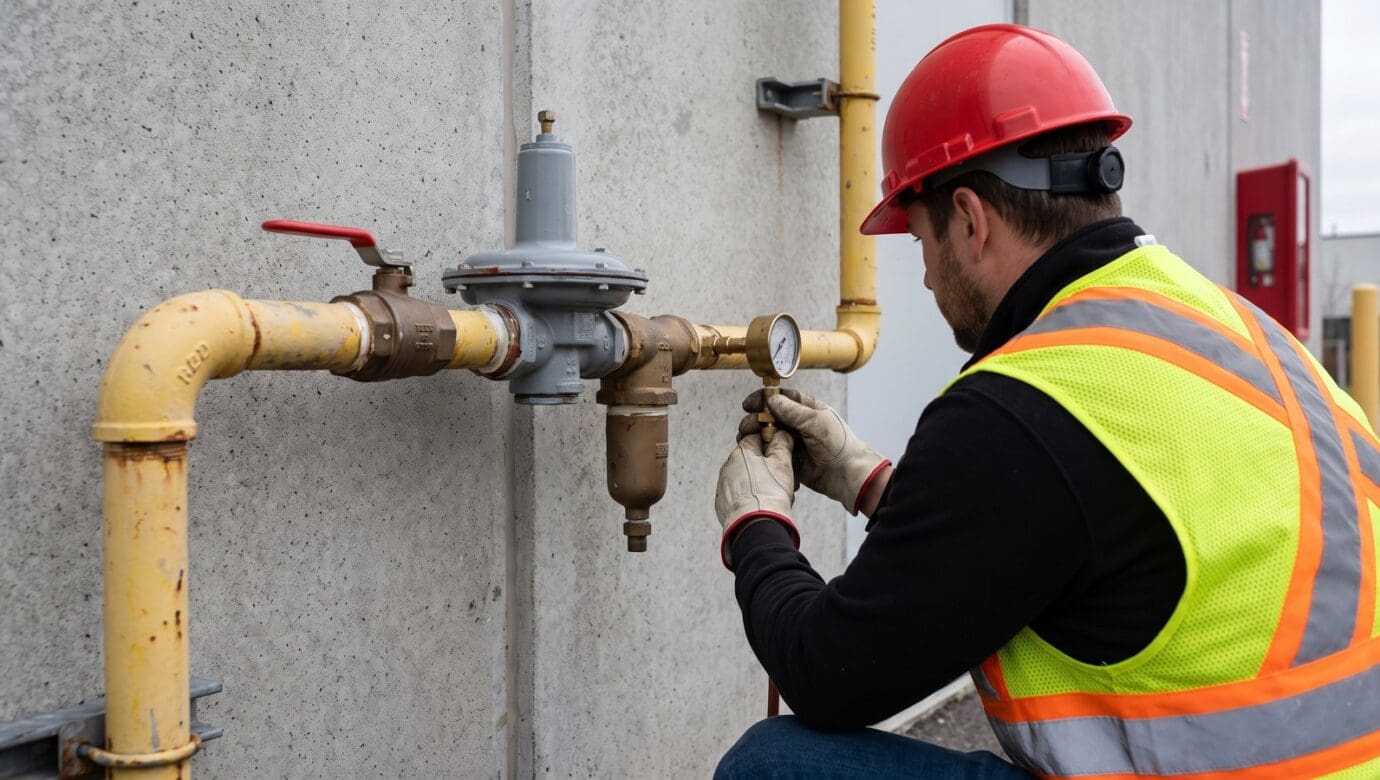
Elevated pressure brings rules of its own. A line pressure regulator is required wherever an appliance is designed for a lower pressure than the supply, and it must be listed to ANSI Z21.80, accessible and protected from damage. Regulators that need a vent are vented directly outdoors unless they carry an approved vent-limiting device, and a listed shutoff valve goes immediately ahead of each medium pressure regulator.
Inside buildings, the code caps operating pressure at 5 psig unless one of its listed conditions applies, such as welded or brazed joints, fittings listed for the purpose, a ventilated chase, or a space used only for industrial processing or heating, research, warehousing, or as a boiler or mechanical room. That is why a plant floor or boiler room can carry pressures that a mixed-use building with threaded joints cannot.
Overpressure protection deserves the same attention as the pipe. In the Merrimack Valley, Massachusetts, disaster on September 13, 2018, high-pressure gas entered a low-pressure utility distribution system, and the fires and explosions damaged 131 structures. The NTSB found that a cast iron main had been abandoned without first relocating its regulator sensing lines, and that the system lacked adequate overpressure protection. It was a utility system, but the lesson carries over: regulators and sensing lines on an elevated pressure system should be documented and rechecked whenever the piping around them changes.
What valves, drips and traps does the code require?
Shutoff valves come first. The code bars shutoff valves from concealed locations, requires access to them, and puts a shutoff valve on the supply side of every meter. A multiple-tenant building on a common system needs a shutoff valve for each tenant that the tenant can reach, and a common system serving more than one building needs a shutoff valve outdoors at each building.
Each appliance gets its own shutoff valve, normally in the same room, within 6 feet of the appliance and upstream of the union or connector it serves. A valve installed at a manifold may instead sit up to 50 feet from the appliance if it is readily accessible and permanently identified. Downstream of that valve, as close to the appliance inlet as practical, the code calls for a sediment trap, usually a tee with a capped nipple in its bottom opening, unless the appliance has one built in.
Where wet gas exists, a drip goes at any point where condensate could collect, with ready access for emptying, and never where the condensate can freeze. In a Lake Erie winter that rules out many exterior and unheated locations, and our winterizing guide covers the rest of the cold weather list.
Piping outdoors has to sit at least 3.5 inches above the ground or roof surface, be securely supported and protected from damage, and be coated or wrapped with an inert material where it passes through an outside wall. On a fit out or renovation, keeping hangers, roof penetrations, gas piping and equipment connections under a single scope removes most of the coordination arguments between trades.
How should buried gas piping be protected?
Corrosion is the long-term threat to buried metallic gas pipe. The code says zinc galvanizing is not adequate protection for underground gas piping, and it requires buried pipe to be a corrosion-resistant material suited to the soil, pipe with a factory-applied insulating coating and coated joints, or pipe under a monitored and maintained cathodic protection system.
Underground piping systems go at least 12 inches below grade, and piping under a building is prohibited unless it is encased in an approved conduit. Plastic pipe is limited to outdoor underground runs and is kept out of and from under buildings and slabs, with narrow exceptions for anodeless risers, wall head adapters, and outdoor patio, walkway and driveway slabs buried to the code’s depth. It also needs a tracer, typically a yellow insulated copper wire of at least 18 AWG, so the line can be found again. On a campus or plant with long underground runs, keep as-built drawings and schedule leak surveys rather than waiting for someone to smell gas.
What has to happen before anyone digs near a buried gas line?
In Ohio, the excavator calls first. The Ohio Revised Code requires the excavator to notify the protection service at least two working days, not counting the day of notice, and no more than sixteen calendar days before excavation starts, and the protection service passes that notice to the utilities with underground facilities at the site.
Customer-owned piping past the meter is the owner’s to find. The federal customer notice says buried gas piping should be located in advance and the excavation done by hand, and OSHA’s excavation standard requires the estimated location of fuel lines and other underground installations to be determined before an excavation is opened.
During the dig, the excavator’s duties under Ohio law include having someone other than the equipment operator watch when powered equipment approaches or works inside the tolerance zone, and excavating carefully and nondestructively within that zone. Any damage that releases gas must be reported immediately to the utility and the protection service, and to 9-1-1 when necessary.
How is a new gas line tested and purged before it goes into service?
No gas piping goes into service, or gets covered up, until it has been tested to prove it is gastight. The test medium is air, nitrogen, carbon dioxide or another inert gas, never oxygen, and the test pressure is at least 1.5 times the proposed maximum working pressure and never less than 3 psig. The test lasts at least half an hour for each 500 cubic feet of pipe volume, and any drop on the gauge is treated as a leak unless it can be readily attributed to another cause.
Purging deserves its own plan. On June 9, 2009, an explosion at the ConAgra Foods facility in Garner, North Carolina fatally injured four workers and injured dozens of others, and the Chemical Safety Board’s bulletin on the case is titled “Dangers of Purging Gas Piping Into Buildings.” The Board recommended that the fuel gas codes require purged gas to be vented outdoors, that combustible gas detectors monitor the release, and that workers be trained against relying on odor alone.
The 2021 International Fuel Gas Code sets the purging rules out in detail. Piping designed to operate above 2 psig, or with sections of at least 2.5-inch pipe over 50 feet, 3-inch over 30 feet, 4-inch over 15 feet, 6-inch over 10 feet or 8-inch of any length, must be purged outdoors. Where the piping meets those size and length criteria, the air is first displaced with an inert gas before fuel gas goes in. The sequence on a new commercial gas line usually runs like this:
- Walk the installation with the joints still exposed and confirm that valves, supports, drips, sediment traps and regulators match the drawings.
- Isolate the pressure source and hold the test pressure for the required duration on a gauge sized for the test.
- Repair any leak the gauge shows, then retest until the system holds.
- For piping that must be purged outdoors, first displace the air with inert gas wherever the pipe meets the code’s size and length criteria, then introduce fuel gas through a valved discharge point at least 10 feet from ignition sources and building openings and 25 feet from mechanical air intakes.
- Keep the discharge attended and monitored with a combustible gas indicator, keep bystanders 10 feet away, and stop introducing fuel gas at 90 percent fuel gas by volume.
- Check for leaks immediately after gas is turned on, then light each appliance and confirm its inlet pressure.
Can existing gas piping handle a new boiler, rooftop unit or process load?
Not without checking. Before an additional appliance is served, the code requires the existing piping to be checked for adequate capacity for every appliance on it, and if it falls short, the system has to be enlarged or separate piping provided. The meter and service need the same check, because a larger main does not help if the meter cannot deliver the volume.
On a boiler and hydronic heating survey we look at gas service and meter capacity along with heating load, venting and combustion air, and on water heater replacements we review venting, gas capacity and recirculation before quoting. A boiler changeout or tankless conversion can be the moment an old gas main turns out to be undersized.
In plants, gas piping travels with the HVAC and process work. On a typical plant job, Wilkes handles gas and refrigerant piping along with duct fabrication, equipment setting and controls interfaces through our industrial HVAC work, including gas-fired make-up air units. Where a gas main runs alongside high-pressure or critical process systems, our industrial process piping crews and in-house fabrication shop handle that side of the plant.
At the United States Gypsum Company plant in Gypsum, Ohio, our scope covered the HVAC system along with both compressed air and natural gas systems, including nearly a quarter mile of 8-inch gas main piping that was critical to the facility’s operations. At Firelands Regional Medical Center in Sandusky, Wilkes completed the full plumbing installation for a two-story medical office building, including sanitary, water and natural gas systems. Under the 2021 International Fuel Gas Code, an 8-inch main of any length falls in the outdoor purge category, which is one reason industrial gas work is planned as a sequence and not just a pipe route.
Frequently asked questions
Who is responsible for gas piping after the meter?
The piping that starts at the outlet of the meter, the point of delivery, belongs to the building owner and is installed under the International Fuel Gas Code. An operator that does not maintain your buried piping has to tell you that it should be inspected for leaks and corrosion and repaired when unsafe.
What pressure is natural gas piping tested at?
At least 1.5 times the proposed maximum working pressure and never less than 3 psig, using air or an inert gas, never oxygen. The hold time is at least half an hour per 500 cubic feet of pipe volume, or 10 minutes for systems under 10 cubic feet, and no test has to run past 24 hours.
How deep does underground gas pipe have to be buried?
Underground gas piping systems go at least 12 inches below grade, with a shallower minimum allowed only for individual lines to outdoor appliances. Buried steel also needs real corrosion protection, because zinc galvanizing alone is not adequate.
Can plastic pipe be used for natural gas inside a building?
Generally no. Plastic gas pipe is for outdoor underground runs and cannot be used within or under a building or slab, apart from narrow exceptions for risers, wall head adapters and outdoor patio, walkway and driveway slabs. For natural gas it also cannot operate above 100 psig.
Is the smell of gas enough to find a leak?
No. Gas in a distribution line must be odorized so it is readily detectable at one-fifth of the lower explosive limit by a person with a normal sense of smell, but the Chemical Safety Board has warned about odor fade and odor fatigue. Leak checks on commercial piping use the pressure test and a combustible gas indicator, not the nose.
Talk to Wilkes about your project
Bring the Btu input of every gas appliance, including planned equipment, the utility meter information, drawings or a sketch of existing pipe routes and sizes, any underground runs, and the shutdown windows the building can live with. We work from our shop in Huron across Erie, Huron, Lorain, Ottawa and Sandusky counties, and we travel for commercial and industrial projects across Ohio.
Wilkes Plumbing & Heating is at 205 Sprowl Rd, Huron, OH 44839, serving Huron, Sandusky, Norwalk, Port Clinton, Vermilion, Lorain, Fremont, and the surrounding counties. Call (419) 433-2325, or request a quote.
Keep reading
Dust Collection System Design for Plants: Ducts, Fumes, NFPA 660
A collector performs only as well as its hoods, its ducts, and the air the building has to give back. A plant-floor guide to capture, transport velocity, explosion protection and Ohio permits for dust and fume systems.
Medical Gas Piping: What Hospitals Need From a Contractor
Medical gas is a life safety system, not a utility. Here is what NFPA 99 verification, ASSE 6010 certification, and occupied-hospital work actually require from a mechanical contractor in Northern Ohio.

Legionella Water Management Plans: ASHRAE 188 in Ohio
ASHRAE 188 sets the framework for a Legionella water management plan in hospitals and large buildings. Here is what Ohio facility teams need to know to build and maintain one.
Need this handled at your facility?
Wilkes engineers, fabricates, and installs process piping, plumbing, and HVAC systems across Ohio.