
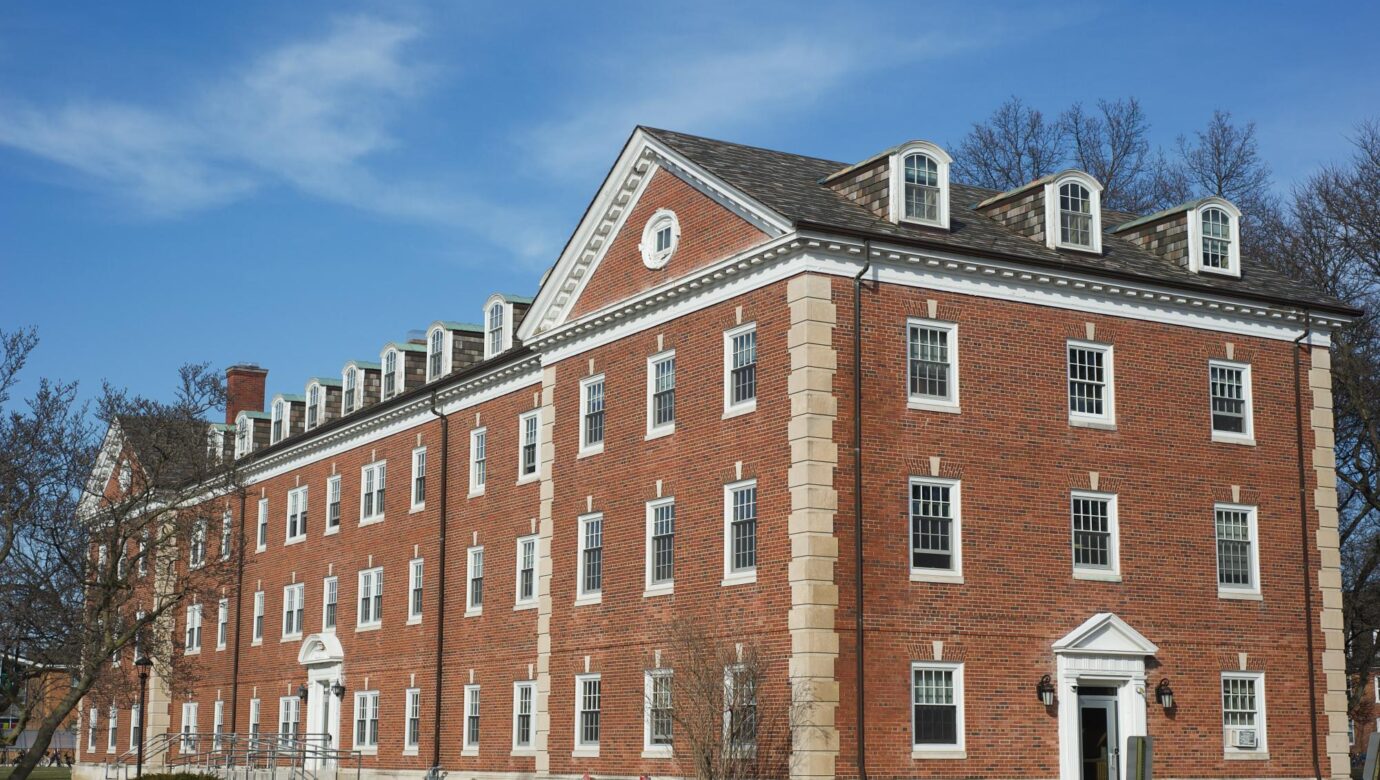
Chilled Water Systems for Schools and Campuses in Ohio
A chilled water system cools a school or campus building by circulating water chilled at a central plant out to air handling units and fan coils through insulated piping, instead of running refrigerant to each room. It costs more to install than packaged rooftop DX units, but it pays that back on large campuses through lower operating costs, longer equipment life, and one plant to maintain instead of a dozen scattered units. This guide is for facility directors, business managers, and engineers at Ohio school districts, colleges, and campuses sizing a new chilled water plant or deciding whether to replace an aging one.
Key takeaways
- Chilled water systems generally pencil out once a campus has roughly 150 to 200 tons of cooling load; below that, packaged DX equipment is usually cheaper to own.
- Variable primary flow pumping and a wide chiller delta T, the temperature difference between supply and return water, cut plant energy use more than any single piece of equipment.
- Cooling towers need a written water treatment and Legionella management plan built to ANSI/ASHRAE Standard 188; this is not optional for an institutional campus.
- Northern Ohio’s freeze risk means outdoor piping, cooling towers, and any water-filled equipment need real freeze protection, not just insulation.
- Most Ohio K-12 retrofits happen in the 10 to 12 week window between the last day of school and the start of fall classes, so procurement has to start the previous fall.
- Ohio Facilities Construction Commission projects add a design review and procurement process on top of the local building department, and that timeline has to be built into the schedule early.
How Does a Chilled Water System Work?
A chilled water system has three parts that all have to work together: a central plant that makes cold water, a distribution network of insulated pipe and pumps that moves it, and terminal units, usually air handler coils or fan coil units, that use it to cool the air in each room. Everything downstream of the plant only ever sees water, never refrigerant, which is one reason chilled water scales so well across a large building or a multi-building campus. Wilkes designs and installs these systems as part of our commercial HVAC work across Northern Ohio campuses and institutional buildings.
The Central Plant: Chillers, Cooling Towers, and Condensers
The chiller does the actual refrigeration cycle, cooling water typically from around 54 F to 42 F on the supply side. Water-cooled chillers reject that heat to a cooling tower on the roof or in a yard; air-cooled chillers reject it straight to outdoor air through a condenser section, which trades some efficiency for a much simpler mechanical room and no tower water treatment. Ohio institutions often land on water-cooled plants for anything above a few hundred tons and air-cooled for smaller campuses that want to avoid tower maintenance altogether.
Primary and Secondary Pumping and Distribution Piping
Most campus plants use a primary and secondary pumping arrangement: primary pumps move a constant flow through each chiller to protect it, while secondary pumps push variable flow out to the buildings based on actual cooling demand. That separation lets the plant run chillers efficiently while throttling flow to match load, which is where much of the energy savings in a chilled water system comes from. Distribution piping is typically welded steel, sized and insulated to hold the delta T across long campus runs, worth getting right the first time under ASME B31.9, since repiping a buried loop later is expensive.
Coils and Controls at the Building Level
At each building, chilled water passes through coils in air handling units or fan coils, where a fan pushes room air across the coil and a control valve modulates flow to hold the setpoint. A direct digital control system ties it all together, resetting supply temperature and pump speed based on outdoor conditions and building load rather than running the plant at full output around the clock.
When Does Chilled Water Beat Packaged DX for a School or Campus?
Chilled water plants cost more up front than packaged rooftop DX units, so the decision usually comes down to campus size and how many buildings share the load. A single building under about 50,000 square feet almost always does better with packaged DX or a small split system; a multi-building campus above roughly 150 to 200 tons of combined cooling load starts to favor a central chilled water plant.
The table below lays out how the two approaches compare across the factors that actually drive a district’s or a facility director’s decision.
| Factor | Chilled Water | Packaged DX |
|---|---|---|
| Best fit | Multi-building campuses, large single buildings | Single buildings, additions, portable classrooms |
| First cost | Higher, central plant and piping | Lower per ton installed |
| Operating cost at scale | Lower once load is high enough | Higher as unit count grows |
| Maintenance | One plant, fewer access points | Many rooftop units to service |
| Redundancy | Multiple chillers can share load if one fails | Each unit is independent, no shared backup |
| Water treatment needed | Yes, cooling tower and closed loop | No, air-cooled refrigerant circuits |
| Typical equipment life | 20 to 25 years for the plant | 15 to 20 years per unit |
Refrigerant handling matters too. Packaged DX equipment carries refrigerant in every unit, so more of it falls under EPA Section 608 leak repair and recordkeeping rules; a chilled water plant concentrates refrigerant in one or two chillers instead of scattering it across a roof full of units. For campuses weighing that against packaged options, our companion piece on repairing versus replacing commercial HVAC equipment covers the same math for existing DX systems. The same central-plant logic drives much of Ohio’s data center cooling and piping work, where uptime pushes the decision toward chilled water even harder than efficiency alone.
What Efficiency Measures Matter Most in a Chilled Water Plant?
Variable Primary Flow and Delta T
The single biggest lever in an existing plant is usually delta T, the temperature difference between supply and return chilled water. A wide delta T, say 16 F to 20 F instead of 10 F, means less water has to move to carry the same amount of heat, which cuts pump energy directly. Low delta T syndrome, where return water comes back only a few degrees warmer than supply, is one of the most common problems we find on older campus systems, usually traced to control valves that will not close fully or coils sized for a different era.
Chiller Plant Optimization and ASHRAE 90.1
Ohio’s commercial energy code adopts efficiency requirements that track ASHRAE Standard 90.1, which sets minimum efficiency levels for chillers, pumps, and economizer operation. On a retrofit, new chillers have to meet current part-load efficiency targets, not just full-load ratings, since a campus chiller spends most of its life at partial load. Plant optimization controls that reset condenser water temperature, sequence multiple chillers, and stagger tower fans can trim another 10 to 20 percent off plant energy use without new equipment. Selecting chillers certified through AHRI gives a district a verified, apples-to-apples efficiency comparison across manufacturers.
How Do You Control Legionella Risk on Cooling Towers?
Any open cooling tower creates warm water droplets in the air, which is exactly the environment Legionella bacteria need to grow. CDC guidance on Legionella identifies cooling towers as one of the highest-risk building water system components, and a school or hospital campus with vulnerable occupants nearby cannot treat that as optional.
The industry standard is a written water management plan built to ANSI/ASHRAE Standard 188, covering biocide dosing, conductivity and pH monitoring, regular Legionella testing, and a documented response plan if results come back elevated. That plan needs an assigned owner on staff, not just a service contract nobody reads, because the standard expects the building owner to know what the numbers mean.
Rule of thumb: If a cooling tower has been idle for more than a few days, whether from a break, a shutdown, or a weather event, disinfect and flush the system before restarting it rather than assuming stagnant water is fine to circulate.
How Do Northern Ohio Winters Affect a Chilled Water System?
Lake Erie winters bring hard freezes, lake-effect snow, and stretches of single-digit nights across Erie, Huron, Lorain, Ottawa, and Sandusky counties, and a chilled water system has a lot of exposed water-filled equipment that has to survive them. The National Weather Service Cleveland office tracks the freeze and lake-effect patterns that make this a design consideration, not a theoretical one. Outdoor piping, cooling towers, and any condenser water loop that stays outside year-round need glycol protection, heat trace, or a drain-down strategy, not insulation alone; insulation slows heat loss, it does not stop a pipe from freezing solid if the water inside stops moving.
Cooling towers are usually the most exposed equipment on a campus. A tower basin heater keeps the sump above freezing during shoulder seasons when the plant might still run on mild days, and the makeup water line needs its own freeze protection since it often sits with no flow for long stretches. Many Ohio campuses winterize the tower entirely, draining and bypassing it once cooling season ends, simpler than heat-tracing a component that sits idle for five or six months.
Why Does Chilled Water Work Fit the School Construction Calendar?
School HVAC work runs on a calendar the rest of the construction industry does not have to think about. A district cannot shut down classrooms and hallways during the school year, so major chilled water plant work, piping replacement, or coil changeouts have to happen in the roughly 10 to 12 week window between the last day of classes and the first day back in the fall.
That compresses a project that might normally run six to nine months into a summer sprint, so design, permitting, and equipment ordering have to start the previous fall or winter. Chiller lead times alone can run 20 to 40 weeks depending on tonnage and type, so a district deciding in April to replace a chiller for that summer is usually already too late. For an Ohio Facilities Construction Commission funded project, that summer window sits on top of the commission’s own review and bidding calendar. Our piece on hydronic heating retrofits in schools covers the same scheduling pressure on the heating side of a campus conversion.
How Does the Ohio Facilities Construction Commission Affect a School HVAC Project?
Public school and higher education projects in Ohio that use state co-funding go through the Ohio Facilities Construction Commission, which reviews design documents and administers bidding and construction alongside the district’s own procurement rules. That adds a review cycle on top of the local building department’s plan review under Ohio’s adopted building code, which the Ohio Board of Building Standards oversees statewide.
For a district weighing a chilled water conversion, that means building OFCC review time into the schedule from the first conversation, not after design is finished. Even non-OFCC-funded projects benefit from designing to the same documentation standard, since it makes future state-assisted phases easier to fold in. Wilkes has worked through this process on campus mechanical conversions, including our work with Northern Ohio schools and colleges on new construction and phased retrofits.
What Does a Chilled Water Retrofit Look Like, Step by Step?
A campus chilled water retrofit moves through a fairly consistent sequence regardless of size. Skipping ahead on any of these steps is usually where a summer schedule falls apart.
- Assess existing load, piping condition, and equipment age across every building on the loop, not just the plant itself.
- Set efficiency and redundancy targets for the new plant, including how many chillers and what staging strategy the campus needs.
- Choose water-cooled or air-cooled chillers based on available space, water treatment capacity, and long-term maintenance staffing.
- Complete design documents and, for state co-funded work, submit through Ohio Facilities Construction Commission review.
- Order long-lead equipment, especially chillers and cooling towers, as soon as design is far enough along to lock capacity.
- Sequence demolition and installation to fit the summer break, phasing multi-building campuses across more than one summer if needed.
- Commission the plant and controls, verify delta T and flow at design conditions, and put a written water management plan in place before the tower runs.
- Train facility staff on the new controls, water treatment routine, and winter shutdown or freeze protection procedure.
Wilkes supported Oberlin College through this kind of conversion, replacing legacy steam and condensate systems with modern hydronic heating and chilled water cooling as part of the campus’s push toward carbon neutrality, eliminating natural gas-fired equipment in the process. That project is a useful reference point for any Ohio campus weighing a similar move away from steam toward a chilled water and hydronic plant.
Talk to Wilkes about your project
Bring your most recent utility bills, any existing mechanical drawings or a facility condition assessment, and a sense of your funding timeline, especially if the project needs to go through Ohio Facilities Construction Commission review. That lets us scope load, plant type, and a realistic summer schedule in the first conversation instead of guessing.
Call Wilkes at (419) 433-2325 to start the conversation, or request a quote online.
Frequently asked questions
How much does a chilled water system cost compared to packaged DX?
A central chilled water plant costs more to install than packaged rooftop DX units, mainly because of the chillers, cooling towers or condensers, pumps, and distribution piping. On a multi-building campus, that higher first cost is usually offset within the plant’s service life by lower energy use, fewer pieces of equipment to maintain, and longer equipment life than scattered rooftop units, but a detailed load and cost comparison is the only way to know for a specific campus.
How often does a cooling tower need water testing for Legionella?
Most water management plans built to ANSI/ASHRAE Standard 188 call for regular Legionella testing on a set schedule, along with more frequent checks on conductivity, pH, and biocide levels between lab tests. The exact interval depends on the tower, the water source, and the building’s occupants, so an institutional campus with a hospital or elder care facility nearby should treat that testing schedule as a floor, not a ceiling.
Can a chilled water plant work with air-cooled chillers instead of a cooling tower?
Yes. Air-cooled chillers reject heat directly to outdoor air instead of through a cooling tower, which removes the tower and its water treatment and Legionella management burden entirely. The tradeoff is somewhat lower efficiency and a larger footprint for the condenser section, which makes air-cooled chillers a common choice for campuses that want to avoid tower maintenance or that lack room or water capacity for one.
How long does a typical chilled water plant last?
A well-maintained central chiller plant typically runs 20 to 25 years before major components need replacement, longer than most packaged rooftop DX units, which usually run 15 to 20 years. Distribution piping, if welded steel and properly protected, can outlast several generations of chillers, part of why campuses that invest in a chilled water loop often replace only the plant equipment on later retrofits.
What size campus actually needs a central chilled water plant instead of individual units?
There is no single cutoff, but a rough rule of thumb is that a campus with combined cooling loads above about 150 to 200 tons across several buildings starts to favor a central chilled water plant over packaged DX. Below that, the piping and plant cost is hard to justify, and packaged or split systems usually make more sense.
Keep reading
Commercial Boiler Maintenance: Checklist, Tune-Up and Ohio Rules
A frequency-by-frequency maintenance plan for commercial steam and hot water boilers, from the daily log to the annual combustion report, built around Ohio's inspection cycle.
Warehouse Heating in Ohio: Unit Heaters, Infrared and Make-Up Air
A plant engineer's guide to choosing between unit heaters, radiant tube heaters, destratification fans and make-up air, and to balancing exhaust so the building stops fighting its own heat.
Ohio Data Center Cooling: What It Means for Facility Owners
Liquid cooling turned data center heat rejection into a welded piping job, and that competes for the same welders, shop slots, and long-lead equipment your plant, hospital, or school project needs.
Need this handled at your facility?
Wilkes engineers, fabricates, and installs process piping, plumbing, and HVAC systems across Ohio.