Orbital Welding for High-Purity Process Lines: A Plant Guide
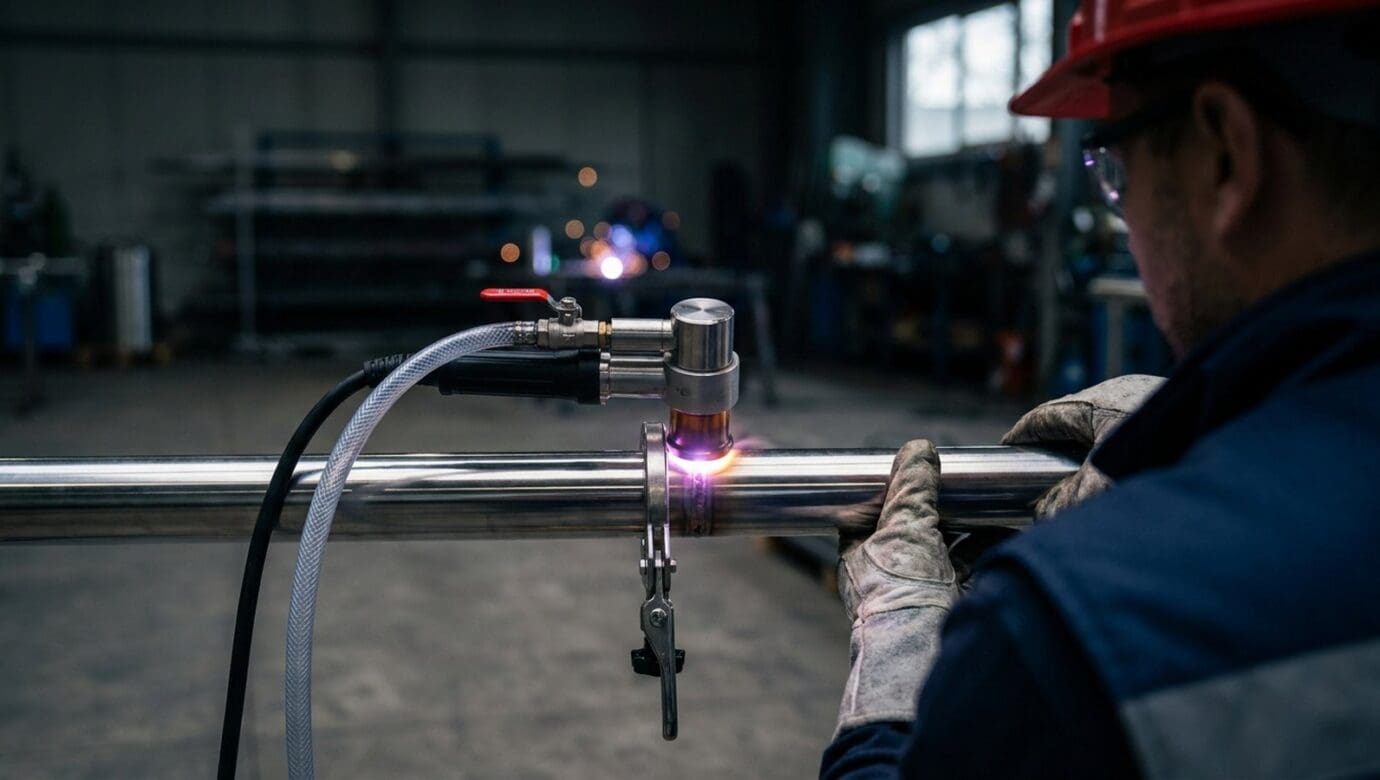
Orbital welding is mechanized gas tungsten arc welding: a welding head clamps around a stationary tube and rotates the arc through a stored weld schedule that controls current, travel speed, pulsing, and timing at each sector of the joint. Paint, plastics, and chemical plants specify it on high-purity and product-contact lines because it produces full-penetration welds with a smooth, low-oxide internal surface, and because every joint runs to the same recorded parameters instead of the same welder’s best day.
It is not a premium finish applied to ordinary piping. It is a different method with different preparation requirements, and it earns its place on a narrow set of systems rather than across a whole plant.
This is written for plant engineers, maintenance managers, and capital project managers in Northern Ohio who have to decide which lines get orbital welds, what the specification has to say, and how to tell whether the welds you paid for are the welds you got.
Key takeaways
- Orbital welding is automated GTAW. The value is repeatability and a clean internal surface, not speed.
- Specify it on product-contact, high-purity, and corrosive-service lines. Leave plant air, cooling water, and drains to manual welding.
- Fit-up and inside purge decide the outcome. The machine cannot compensate for a bad joint prep the way a hand welder can.
- Name the governing documents in the specification: ASME B31.3, ASME BPE, AWS D18.1, and ASME BPVC Section IX for procedure and performance qualification.
- Move as much of the system as possible into shop fabrication. Field joints are where purge control and cleanliness get expensive.
What is orbital welding, and how does it actually work?
A conventional pipe weld is made by a welder moving a torch around the joint by hand, adjusting as heat builds and position changes. An orbital weld is made by a machine that does not adjust unless you tell it to.
The tube ends are squared and faced, the joint is fit with no filler in most high-purity applications, the head is clamped in place, the inside of the tube is purged with inert gas, and a qualified weld schedule drives current, rotation speed, pulse ratio, and dwell through each sector. The arc travels a full circle around a tube that never moves.
Three consequences follow. Weld schedules can be qualified, saved, and re-run, so the joint you approve during qualification is the joint you get in production. Parameters can be logged for every weld, which gives you documentation instead of assurance. And the operator’s job shifts toward fit-up, purge control, and inspection, which is where high-purity welds succeed or fail.
Where the qualification rules come from
The welding procedure and the operator both get qualified under ASME Boiler and Pressure Vessel Code Section IX, which is the qualification basis referenced by the piping codes. For sanitary and hygienic stainless tube, AWS D18.1 is written specifically for welding austenitic stainless steel tube in those systems, including acceptance criteria for internal weld discoloration. Machine welding does not exempt anyone from qualification. It changes what gets qualified: the schedule, the equipment, and the operator.
Why do paint, plastics, and chemical plants specify orbital welding?
Because contamination and corrosion both start at the weld, on the side of the pipe nobody can see.
Product quality
A rough or oxidized internal weld gives product somewhere to hang up. In coatings and resin service that shows up as color carryover between batches, gel formation, and cleaning cycles that get longer every year. In food and pharmaceutical service it becomes a cleaning validation problem, which is why the FDA current good manufacturing practice regulations and the 3-A Sanitary Standards drive owners toward crevice-free, cleanable joints.
Corrosion life
The heat-affected zone of a poorly purged stainless weld is where corrosion begins. Heavy heat tint means chromium-depleted oxide on the inside surface, and a line that fails at a weld fails years earlier than the pipe around it. An orbital weld run under a proper inside purge leaves a smooth, minimally oxidized surface whose corrosion resistance is close to that of the parent material.
Consistency across hundreds of joints
A plant installing several hundred product-contact welds does not want a quality distribution, it wants a quality level. Automation narrows that distribution, which is why high-purity specifications call the process out by name.
There is a safety argument as well. Automation moves the welder back from the plume, which matters given what NIOSH documents about welding fume exposure, particularly on stainless.
Our industrial piping fabrication shop was built around this work: high-purity process piping, orbital welding, and in-house skid assembly. That capability is not common in this region, which is why the calls come from paints and plastics, chemicals, food and beverage, and hospital facilities teams.
Which systems in your plant should be orbitally welded?
Not every line needs it. Use the process, not the pipe size, to decide.
| System | Typical material | Orbital welding | Primary reference |
|---|---|---|---|
| Product-contact batching and transfer lines, coatings and resins | 304L or 316L tube, 1 in. to 3 in. | Specify it | ASME B31.3 |
| Purified water and clean steam distribution | 316L tube, polished internal surface | Specify it | ASME BPE |
| Food, dairy, and beverage transfer | Sanitary tube with clamp fittings | Specify it | 3-A Sanitary Standards, AWS D18.1 |
| High-purity and specialty process gas | Small-bore stainless tube | Specify it | Compressed Gas Association practice |
| Corrosive chemical transfer in alloy | Duplex or high-nickel alloy | Case by case | ASME B31.3 |
| Plant air, cooling water, drains, utility steam | Carbon steel or copper | Not warranted | ASME B31.9 |
The systems that justify the cost share one trait: the internal surface is part of the process. That includes any line that cannot be disassembled or borescoped after startup. On carbon steel utility piping, non-critical air and water, and large-diameter drainage, specifying it adds cost without buying anything back.
What has to be in the specification?
Most industrial process piping in a paint, plastics, or chemical plant falls under ASME B31.3 Process Piping, which sets design, materials, fabrication, examination, and testing requirements by fluid service category. B31.3 governs pressure integrity. It does not tell you what the inside of the weld has to look like.
That is what ASME BPE adds for hygienic and bioprocess systems: surface finish, drainability, traceability, and weld acceptance criteria for product-contact service. For high-purity water and clean steam, the ISPE Baseline Guide on water and steam systems is the reference most owners’ engineers work from.
The six lines a good specification contains
- Governing code and fluid service category under ASME B31.3, stated per system.
- Material and internal surface finish, including whether mill-finish tube is acceptable.
- Purge gas, purity, and maximum residual oxygen at the joint before the arc is struck.
- Weld acceptance criteria for internal discoloration, referencing AWS D18.1 or an ASME BPE class.
- Documentation: weld map, weld log, schedule number, operator identification, purge readings.
- Examination extent: what gets borescoped, what gets pressure tested, and who witnesses it.
Without those six you are buying the contractor’s habits. With them you are buying a defined product, and two bidders can be compared on the same basis. Our guide to materials and contamination control in chemical and paint plant piping covers the material selection side of the same conversation.
How does a high-purity orbital weld actually get made?
The machine is the easy part. Everything before and after it is where jobs are won or lost.
- Qualify the weld schedule on coupons cut from the same heat and wall thickness as the production material.
- Cut and face the tube ends square. Saw-cut ends that were never faced are the most common reason a good schedule produces a bad weld.
- Clean and degrease the joint area, then handle the tube with clean gloves from that point forward.
- Fit the joint tight with no gap and minimal internal mismatch. An automated head cannot bridge what a hand welder would bridge instinctively.
- Establish the inside purge and verify it with an oxygen monitor down to the level the specification names.
- Clamp the head, confirm the correct schedule is loaded, and check the tungsten. A worn electrode changes the arc before it changes the weld log.
- Run the weld, then hold the post-purge until the joint cools below the temperature at which the inside surface will oxidize.
- Log the weld number, schedule, operator, and purge reading, and borescope per the inspection plan.
Steps 4, 5, and 7 account for most rejected high-purity welds we see on rework calls. None involve the welding machine.
What this means in Ohio: Purge gas behaves differently in a cold building. Argon bottles staged outdoors through a Lake Erie winter feed regulators that frost and creep, and a shop door open to a January wind pulls a purge off a long tube run faster than anyone expects. Bring gas indoors to temperature first, and verify oxygen at the joint, not at the manifold.
How do you verify the welds you paid for?
Automation reduces variability. It does not remove the need to look.
Three checks that are worth the money
Parameter records for every joint. The weld log ties a weld number on the isometric to a schedule, an operator, a date, and a purge reading. If a joint later fails, that record tells you whether it was a process problem or a one-off.
Borescope inspection on a defined sample. Internal discoloration is the fastest read on purge quality. Specify the acceptance level in writing, because “looks fine” is not a criterion anyone can enforce at turnover.
Coupon welds at shift start and after any parameter change. A coupon takes minutes and catches a drifting gas flow or a schedule loaded from the wrong file before it is welded into 40 joints.
A contractor who recommends orbital welding for your entire plant is selling machine time. A contractor who tells you which lines need it and which do not is giving you an engineering opinion.
Does orbital welding cost more than manual welding?
Per joint in isolation, the preparation is more demanding and the setup is longer. Across a project, the comparison is rarely that narrow.
Count what the alternative carries: rework on rejected welds, extra examination, cleaning cycles that stay long for the life of the system, and the risk of a joint failure inside a running plant. On several hundred product-contact welds, consistency is a schedule benefit before it is a quality benefit, because rework is what pushes a shutdown past its window.
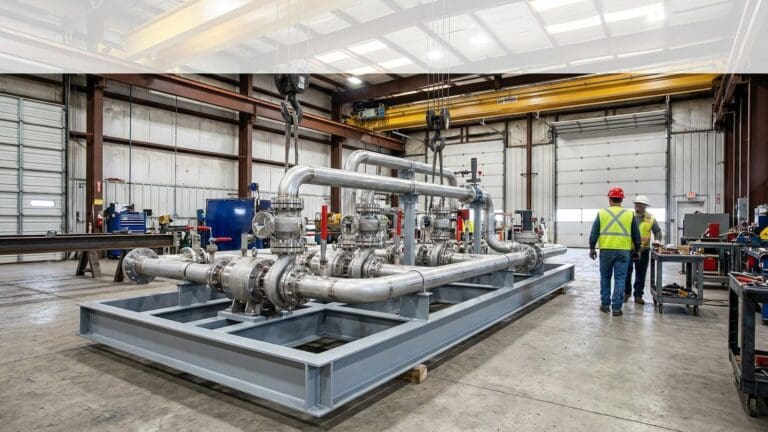
The cost lever most owners underuse is location. A joint welded on a bench, with a stable purge and a clean floor, costs less and inspects better than the same joint welded on a ladder in an operating plant. That is the argument for prefabricated piping skids and shop-built spools.
Field welding also drags in the site safety program. Hot work in an operating plant means a permit and fire watch under NFPA 51B, energy isolation under OSHA 29 CFR 1910.147, and, at plants holding threshold quantities of highly hazardous chemicals, the mechanical integrity and management of change elements of OSHA process safety management. Every field joint you delete removes a share of that cost.
What does this mean for a Northern Ohio plant?
The industrial base along the Lake Erie shore is heavy on exactly the processes that need clean welds: coatings and resins, plastics compounding, specialty chemicals, and food processing. Those plants share two constraints that shape a piping scope.
The first is the shutdown calendar. Turnarounds cluster around holiday weeks and summer slowdowns, and an emissions-controlled process cannot simply be restarted early to make up lost time, since the permit conditions administered by Ohio EPA’s Division of Air Pollution Control follow the equipment, not the schedule.
The second is winter. Between December and March, freeze protection, cold material, and heated enclosures all take time out of a field day, and hydrostatic testing on outdoor runs needs a plan that does not end with a split line. Shop fabrication moves that work into a heated building.
Our project for AkzoNobel in Huron illustrates the constraints. The scope centered on a turnkey installation of a new reactor, a core component of their chemical manufacturing process, with stainless steel welded process piping installed across seven separate buildings on the site. Predictable weld quality and shop fabrication are what make that kind of scope schedulable.
If you are still sorting out which systems are process piping and which are plumbing, start with our guide to what process piping is and how it differs from plumbing, then look at the broader industrial process piping capability.
Frequently asked questions
What is the difference between orbital welding and TIG welding?
Orbital welding is a mechanized form of gas tungsten arc welding, the process commonly called TIG. The arc, the shielding gas, and the metallurgy are the same. The difference is that the torch is carried by a head that rotates around a stationary tube under machine control rather than by hand. That automation produces the repeatability, and it is why fit-up and purge preparation carry far more weight than in manual welding.
Do orbital welds still need to be inspected?
Yes, and the inspection plan belongs in the specification rather than in a conversation at turnover. Common practice is to record weld parameters for every joint, borescope the internal surface on a defined sample or on all joints depending on service, and run coupon welds at the start of a shift or after any parameter change. Automation narrows variability, it does not remove the need to verify what was built.
Can orbital welding be done in the field?
It can, and tie-ins usually require it. The practical limits are clearance for the head to rotate around the joint, the ability to hold a clean purge in a plant environment, and power and gas at the location. This is the reason to push as much of a high-purity system as possible into shop fabrication and then design the field work around a small number of well-planned, accessible field joints.
Which codes and standards apply to high-purity piping?
Most industrial process piping falls under ASME B31.3 Process Piping. Hygienic and bioprocess systems add ASME BPE, which covers surface finish, drainability, and material requirements for product-contact service, while AWS D18.1 addresses welding of austenitic stainless steel tube in sanitary applications. Welding procedures and operators are qualified under ASME Boiler and Pressure Vessel Code Section IX. Settle which of these governs in the specification, not during construction.
How clean does the purge have to be?
It depends on the acceptance criteria you write. Sanitary and high-purity specifications commonly require residual oxygen well under 100 parts per million at the joint before the arc is struck, with tighter limits on polished product-contact tube. Verify with an oxygen monitor at the joint, not at the manifold, and hold the post-purge until the weld has cooled enough that the internal surface will not oxidize.
Talk to Wilkes about your project
Bring what you have to the first conversation: the line list, the drawings or isometrics, the materials and finish you have in mind, the outage window you are working toward, and any existing weld specification. If that specification does not yet say what the inside of the weld has to look like, it is a good first thing to settle together. We will tell you which lines justify orbital welding, what belongs in the shop, and what has to happen in the field.
Wilkes Plumbing & Heating has been a mechanical contractor in Huron, Ohio since 1912, and we take piping and fabrication work across Ohio. Call (419) 433-2325, or request a quote.
Keep reading
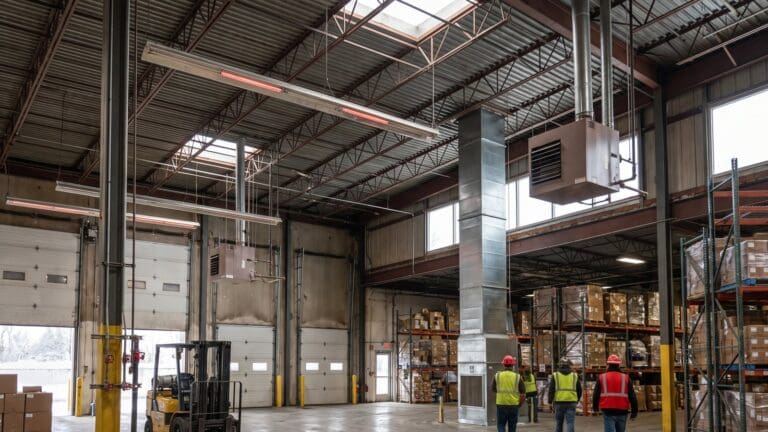
Warehouse Heating in Ohio: Unit Heaters, Infrared and Make-Up Air
A plant engineer's guide to choosing between unit heaters, radiant tube heaters, destratification fans and make-up air, and to balancing exhaust so the building stops fighting its own heat.
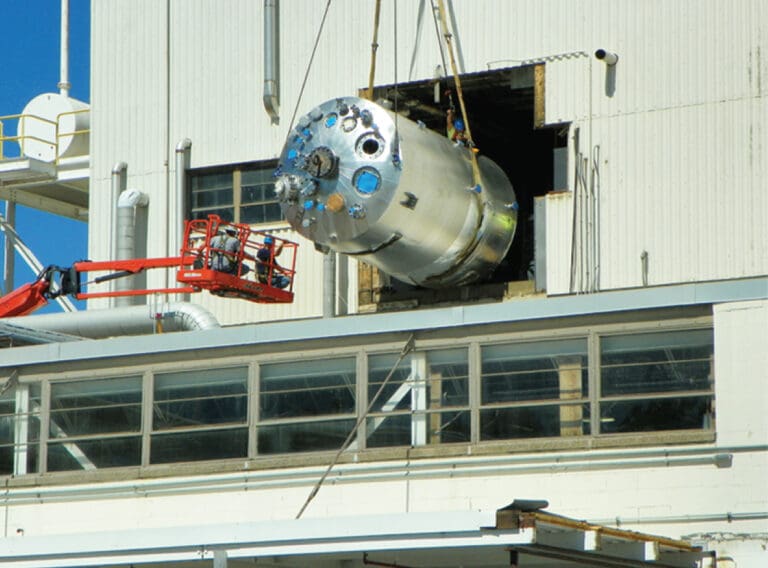
Turnkey Process Piping and a Reactor Install at AkzoNobel
A look inside a turnkey reactor installation and stainless steel process piping scope spread across seven buildings at a Huron, Ohio chemical plant, sequenced so production never stopped.
Prefabricated Piping Skids: Faster Installs, Cleaner Welds
Prefabricated piping skids move the slow, inspection-heavy work off your production floor and into a controlled shop. Here is how Northern Ohio plants scope, test, rig, and tie in a modular process assembly without losing production time.
Need this handled at your facility?
Wilkes engineers, fabricates, and installs process piping, plumbing, and HVAC systems across Ohio.