Industrial Pipe Insulation: Savings and Freeze Protection in Ohio
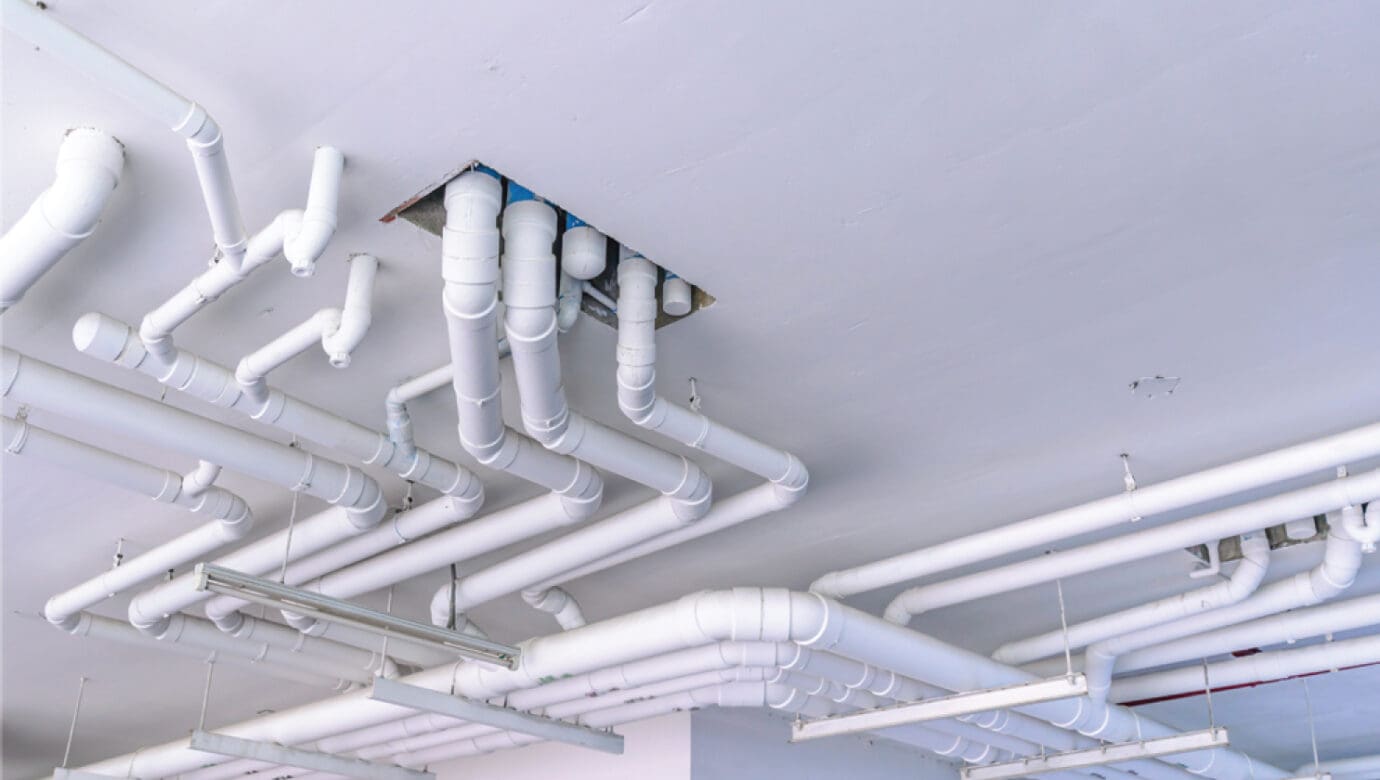
Industrial pipe insulation pays for itself by cutting the heat a steam, condensate, hot water, or chilled water line loses to the surrounding air, and by keeping those same lines from freezing, sweating, or corroding from the outside in. In most Ohio plants, insulation upgrades on bare or damaged piping return the installed cost within one to three years, largely through lower fuel and electric bills. This article is written for plant managers, facility directors, maintenance engineers, and school or hospital facilities teams in Northern Ohio who are deciding where to spend an insulation budget this year, and how to justify it. Most of what follows applies directly to the industrial manufacturers, healthcare facilities, and institutional campuses that run the steam, hot water, and chilled water systems this article covers.
The goal here is practical: what insulation material fits which line, how jacketing and personnel protection work together, how to stop condensation and corrosion under insulation, how to protect exposed piping through a Lake Erie winter, and how to survey a plant and build a payback case a controller will approve.
Key takeaways
- Bare or damaged insulation on steam, condensate, and hot water piping is one of the fastest paybacks available in most plants, often under two years.
- Material selection depends on service temperature, moisture exposure, and mechanical wear, not on cost per linear foot alone.
- Jacketing and surface temperature affect both energy loss and worker safety around hot piping.
- Corrosion under insulation is a hidden failure mode on cold, intermittently wet, and cyclic-temperature lines.
- Freeze protection in Northern Ohio is an insulation and heat trace decision made together, not either one alone.
- A short walk-through survey with a contact thermometer or thermal camera is enough to build a priority list and a rough payback estimate.
How Much Does Bare or Damaged Pipe Insulation Actually Cost You?
Bare pipe carrying steam, hot water, or process heat radiates energy continuously, whether or not anyone is standing near it. The U.S. Department of Energy’s steam systems program has long identified damaged or missing insulation as one of the most common and fastest-payback findings in industrial energy assessments, because the loss runs around the clock, seven days a week, in every season.
Damaged insulation is often worse than no insulation at all in one specific way: a torn or wet section traps moisture against the pipe wall, so you lose the thermal benefit and start a corrosion problem at the same time. Piping systems built to ASME B31.1 for power piping or ASME B31.3 for process piping do not specify insulation thickness directly, but both codes assume a system that is maintained as designed, and a bare or soaked section is not that system anymore.
Natural gas and electricity are not getting cheaper in Ohio. The U.S. Energy Information Administration’s Ohio state profile tracks industrial and commercial energy costs that make wasted steam and hot water heat a recurring line item, not a one-time capital problem you can defer indefinitely.
Which Insulation Material Fits Which Line?
There is no single best insulation material. The right choice depends on the service temperature of the pipe, whether the line runs above or below ambient, how much moisture and physical abuse the area sees, and whether the pipe is indoors, outdoors, or in a washdown area.
| Material | Typical service range | Best fit |
|---|---|---|
| Mineral wool (rock or slag wool) | Roughly minus 20 F to 1,200 F, higher for select blends | Steam, hot water, and process lines; good fire resistance |
| Calcium silicate | Roughly ambient to 1,200 F or higher | High-temperature steam and process piping needing rigidity and compressive strength |
| Cellular glass (foam glass) | Roughly minus 450 F to 900 F | Cold, dual-temperature, and corrosion-prone lines where moisture control matters most |
| Elastomeric foam | Roughly minus 40 F to 220 F, higher for specialty grades | Chilled water, refrigerant, and condensate lines where condensation control is the priority |
| Polyisocyanurate (polyiso) | Roughly minus 297 F to 300 F | Below-ambient and dual-temperature piping in mechanical rooms and plenums |
Mineral wool and calcium silicate dominate the hot side: steam mains, condensate return, hot water, and process heat. Cellular glass, elastomeric foam, and polyiso dominate the cold and dual-temperature side, where the job is as much about stopping condensation and vapor drive into the insulation as it is about saving energy.
Jacketing for Outdoor, Washdown, and Corrosive Areas
The insulation material only performs as designed if the jacket protects it. Aluminum jacketing is standard on outdoor and mechanical room piping. Stainless steel jacketing earns its cost in food, chemical, and paint plants with washdown or corrosive atmospheres, and in coastal or lakefront air that carries more moisture than an inland plant sees. A vapor retarder facing matters just as much as the jacket on any line running colder than the surrounding air.
What Surface Temperature Actually Protects Your Crew?
Personnel protection is a real design factor, not an afterthought. A bare steam or hot water line can exceed 300 F at the pipe wall, hot enough to burn skin on contact in a fraction of a second. Insulation thickness and jacketing choice bring that outer surface down to a level a worker can brush against without injury.
Many mechanical engineers use 140 F as the practical ceiling for an accessible insulated surface, a rule of thumb that lines up with OSHA’s personal protective equipment standards, which require employers to protect workers from contact hazards on hot equipment and piping. Where a line runs hotter and full insulation thickness is not practical, a perforated metal guard or standoff barrier does the same job.
Rule of thumb: If a worker can reach it during a normal shift, target an outer surface temperature at or below 140 F. Anything hotter needs either more insulation thickness or a physical guard, not a warning sign.
How Do You Stop Condensation and Corrosion Under Insulation on Cold Lines?
Chilled water, refrigerant, and cold process lines have the opposite problem from steam mains: the pipe surface runs colder than the air around it, so moisture in the air condenses on or inside the insulation system if the vapor barrier fails anywhere along the run. Wet insulation loses most of its insulating value and keeps the pipe wet, which is exactly the condition that starts corrosion under insulation, often called CUI.
CUI is dangerous because it hides. The jacket can look fine from the outside while the carbon steel pipe wall underneath is actively pitting. Cellular glass insulation is a common fix on lines with a known moisture history because it is closed-cell and does not wick water the way fibrous materials can. A continuous, correctly lapped vapor retarder, sealed at every joint, fitting, and support, matters as much as the insulation material itself.
Facilities in the chemical and paint plant markets Wilkes serves tend to see CUI first at pipe supports and penetrations, where insulation is hardest to install cleanly and easiest to damage during maintenance. A periodic visual check at those points, pulling back a section of jacket where staining or bulging suggests trapped moisture, catches most CUI problems before they become a pipe replacement.
How Do You Protect Piping From Freezing in a Lake Erie Winter?
Insulation alone does not stop a pipe from freezing. Insulation slows heat loss, but a line with no flow and no heat source will eventually reach the temperature of the air around it, insulated or not. Freeze protection on an exposed or low-flow line means adding a heat source, almost always electric heat tracing cable, underneath the insulation.
The National Weather Service’s Cleveland forecast office, which covers the Erie, Huron, Lorain, and Ottawa county area Wilkes serves, regularly records lake-effect cold snaps that hold wind chills well below zero for days at a stretch. An exposed 2 in. process line with no flow overnight in that kind of stretch can freeze solid long before morning, regardless of how much insulation wraps it.
Self-Regulating vs. Constant-Wattage Heat Trace
Self-regulating heat trace cable adjusts its own output as the pipe temperature changes, drawing more power in a cold snap and less as the pipe warms, which makes it the common choice for freeze protection on piping with variable exposure. Constant-wattage cable delivers a fixed output regardless of pipe temperature and fits applications needing steady heat input, such as maintaining a process temperature rather than just preventing freeze. Either type is electrical equipment installed under NFPA 70, the National Electrical Code, which governs the circuit protection, grounding, and control wiring the installation depends on.
How Do You Survey a Plant and Estimate Payback?
A useful insulation survey does not require expensive equipment. A contact thermometer or an infrared camera, a tape measure, and a walking tour of the mechanical rooms, pipe racks, and rooftop units will find the worst offenders in an afternoon.
- Walk every steam, condensate, hot water, and chilled water run in the plant, including rooftop and outdoor pipe racks that get skipped in indoor-only inspections.
- Flag every bare section, missing valve or flange cover, crushed jacket, and any insulation that looks wet, stained, or sagging.
- Record pipe size, surface temperature, and running hours for each flagged section, since payback depends on all three, not just temperature alone.
- Photograph each location so the priority list survives past the walk-through and can be shared with whoever approves the budget.
- Rank findings by combined pipe diameter, temperature differential, and hours of operation, since a small high-temperature line running continuously often beats a larger line that only runs seasonally.
- Price insulation, jacketing, and labor for the top-ranked items, and compare that cost against the estimated annual energy savings to get a simple payback period.
- Schedule the work in phases tied to planned shutdowns where possible, since insulation work rarely needs its own dedicated outage.
New and altered piping insulation in commercial and institutional buildings falls under the Ohio Mechanical Code, enforced by the Ohio Board of Building Standards. That code sets a floor for new work, but most of the payback opportunity in an existing plant sits in older piping installed before current minimums, which is where a survey earns its keep.
What Does an Insulation and Piping Project Look Like on the Ground?
Piping and insulation decisions get made together, not in separate phases, on any project with a long exposed run. On the United States Gypsum Company project, Wilkes installed nearly a quarter mile of 8 in. gas main piping along with the site’s ductwork and compressed air and natural gas systems. A run that long, much of it exposed to Ohio weather, is exactly the kind of installation where insulation, jacketing, and freeze protection choices need to happen during design and construction rather than as a retrofit after startup, when access is harder and the plant is already running.
That same logic applies to any facility adding or replacing industrial process piping: the insulation and heat trace plan belongs in the same set of drawings as the pipe routing, not bolted on after the fact.
Talk to Wilkes about your project
Bring your building or process drawings if you have them, a rough list of the lines you already suspect are bare, wet, or under-insulated, and the utility bills or energy data you want to see move. That is enough for a first conversation about scope and a realistic payback estimate.
Call Wilkes at (419) 433-2325, or request a quote to schedule a plant walk-through with our team.
Frequently asked questions
How long does industrial pipe insulation take to pay for itself?
Most Ohio plants see payback on bare or damaged pipe insulation within one to three years, depending on pipe size, service temperature, and how many hours the line runs. Continuously operating steam and hot water lines with the largest temperature difference from the surrounding air typically show the fastest payback, while seasonal or intermittent lines take longer to recover the installed cost.
What is the difference between insulation and heat tracing?
Insulation slows the rate at which a pipe loses heat to the air around it, but it cannot add heat. Heat tracing, almost always electric cable installed under the insulation, actively adds heat to replace what the line loses, which is what actually prevents a low-flow or stagnant line from freezing during an Ohio cold snap.
Which insulation material handles moisture and washdown areas best?
Cellular glass and closed-cell elastomeric foam handle moisture exposure better than fibrous materials like mineral wool because they do not wick water into the insulation. In washdown areas common to food and chemical plants, pairing either material with stainless steel jacketing and a fully sealed vapor retarder gives the best protection against both condensation and physical wear.
How do I know if my plant has corrosion under insulation?
Visible clues include staining, bulging, or dark streaks on the jacket, and rust bleeding through seams or fitting covers. Since corrosion under insulation hides beneath an intact-looking jacket, the reliable way to check is a periodic spot inspection at pipe supports, low points, and penetrations, where trapped moisture and CUI most often start.
Does Ohio require a minimum insulation thickness on commercial piping?
New and altered commercial and institutional piping in Ohio generally falls under the Ohio Mechanical Code, enforced by the Ohio Board of Building Standards, which sets minimum insulation requirements for new construction and major renovation work. Existing piping installed before current code minimums is not automatically required to be upgraded, which is why a voluntary energy survey is usually how older plants find their biggest opportunities.
Keep reading
Warehouse Heating in Ohio: Unit Heaters, Infrared and Make-Up Air
A plant engineer's guide to choosing between unit heaters, radiant tube heaters, destratification fans and make-up air, and to balancing exhaust so the building stops fighting its own heat.
Turnkey Process Piping and a Reactor Install at AkzoNobel
A look inside a turnkey reactor installation and stainless steel process piping scope spread across seven buildings at a Huron, Ohio chemical plant, sequenced so production never stopped.
Prefabricated Piping Skids: Faster Installs, Cleaner Welds
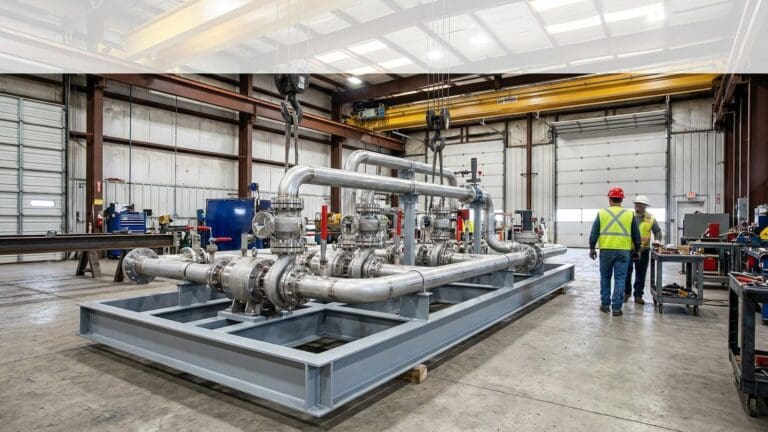
Prefabricated piping skids move the slow, inspection-heavy work off your production floor and into a controlled shop. Here is how Northern Ohio plants scope, test, rig, and tie in a modular process assembly without losing production time.
Need this handled at your facility?
Wilkes engineers, fabricates, and installs process piping, plumbing, and HVAC systems across Ohio.