Prefabricated Piping Skids: Faster Installs, Cleaner Welds
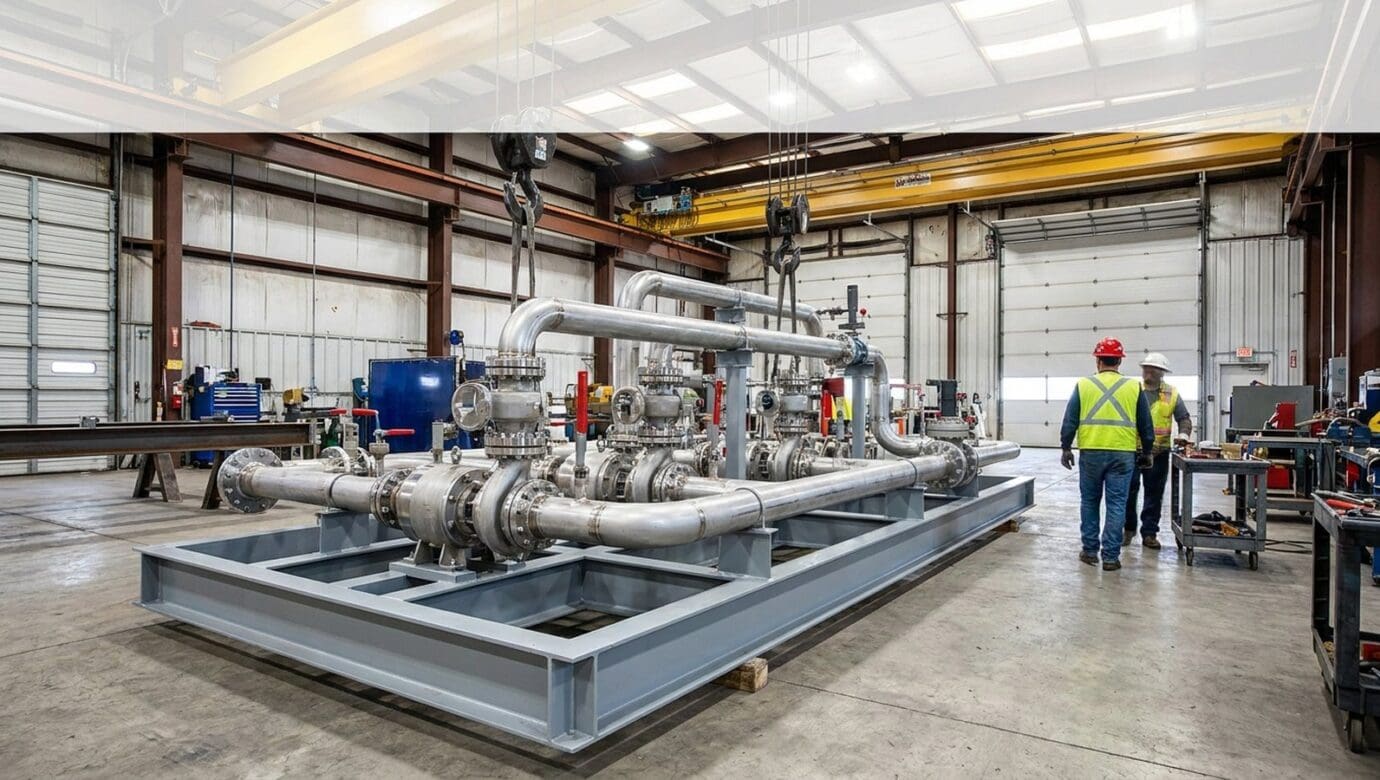
Prefabricated piping skids are complete process assemblies, meaning pipe, valves, pumps, instruments, and supports, built and tested on a structural steel frame in a fabrication shop and then shipped to the plant ready to set and tie in. They shorten the on-site portion of a project because the slow, inspection-heavy work happens at bench height in a controlled shop instead of on a ladder in your production area. This guide is for plant managers, maintenance supervisors, and facility engineers in Northern Ohio who must install process equipment without giving up production time.
The trade is easy to state and harder to execute: you buy shop hours to avoid field hours. Field hours are the expensive ones, the disruptive ones, and in an Ohio January the least predictable ones.
Key takeaways
- A skid is a defined product with a defined boundary. The field scope shrinks to setting it, connecting utilities, and commissioning.
- Shop conditions, not shop welders, are what improve weld quality. Position, purge control, lighting, and access all get better at a bench.
- Skid fabrication runs in parallel with demolition and foundation work, so the schedule compresses even when total labor hours do not drop much.
- The usual failure mode is dimensional, not metallurgical. Field verification and adjustable tie-ins are what keep a module from arriving wrong.
- Off-site fabrication does not change the code. ASME B31.3, AWS qualification, and Ohio permitting still apply to the finished system.
What is actually on a prefabricated piping skid?
The name comes from the base. A skid is a rigid structural frame, usually welded carbon steel, carrying equipment and piping as one transportable unit. Everything mounted to it gets positioned, welded, supported, insulated, and usually pressure tested before it leaves the shop.
The scope varies widely: a pump and filter set, a chemical dosing package, a heat transfer loop, a clean-in-place unit, or a multi-pump system with its own control panel. What they share is a drawn boundary. Every line crossing the frame edge is a numbered tie-in, and everything inside is the fabricator’s responsibility.
The boundary is the contract
Write the tie-in list before anything gets cut. A good boundary definition names each connection point, its size, material, rating, and elevation, and who supplies the mating flange. Most disputes on modular work trace back to a connection that two parties each assumed the other owned.
Wilkes builds these assemblies through its industrial piping fabrication group, which handles custom process piping, modular skid packages, and high-purity lines out of the same shop in Huron. Because the same organization performs the installation, the boundary list is written by people who will have to make those connections fit.
Why do shop welds come out better than field welds?
This is not a comment on anyone’s craftsmanship. It is a comment on conditions.
In the shop, a welder works at a comfortable height with unrestricted access to the joint, on a positioner that rotates the pipe instead of forcing out-of-position work. Purge setups for stainless steel and other alloys are repeatable because the same fixtures get used every time. Lighting, ventilation, temperature, and cleanliness are controlled, which matters because NIOSH guidance on welding fume exposure treats local exhaust and enclosure as the primary controls.
In the field, the same joint might sit 12 ft up, 8 in. from a wall, next to a live line, with operators working underneath. Access drives technique, and technique drives quality. The welder does not get worse; the job gets harder.
Where it matters most
Orbital welding is the clearest case. It produces repeatable, consistent-penetration welds for high-purity and sanitary systems, and it depends on tight fit-up, clean end preparation, and stable purge. Those are shop conditions by nature. Our article on orbital welding for high-purity process lines covers the surface finish and documentation side in more detail, and ASME BPE is the standard most often invoked when internal surface quality is part of the specification.
Qualification does not change because the work moved indoors. Procedures still have to be qualified to the governing code, and the American Welding Society codes and standards catalog is where most of that language lives. What changes is the reject rate, the ease of examination, and the ability to fix a problem without a hot work permit in a running plant.
How much site time does prefabrication actually save?
It depends on the assembly, and any contractor who quotes a fixed percentage before seeing your scope is guessing. What can be described up front is where the savings come from, so you can size the prize on your own project.
Parallel work. Shop fabrication runs at the same time as your demolition, foundation work, and electrical rough-in. Stick-built work makes those steps sequential.
Fewer field welds. After a skid is set, the remaining scope is usually anchor bolts, alignment, a handful of tie-ins, and commissioning. Field welds are the slow part because each one carries fit-up time, inspection, and often a hot work permit under NFPA 51B.
Less energy isolation. Every tie-in to a live system requires a lockout and tagout sequence under OSHA 29 CFR 1910.147. Fewer connection points means fewer isolations, fewer permits, and fewer chances for a line to be opened under pressure.
Rework caught early. A fit-up problem found in the shop costs shop hours. The same problem found during a turnaround costs production.
| Factor | Stick-built in place | Prefabricated skid |
|---|---|---|
| Schedule shape | Sequential: site prep, then fabrication, then test | Parallel: shop build runs during site prep |
| Typical field weld count | Every joint in the system | Tie-ins only, often under a dozen |
| Weld position | Mixed, including overhead and restricted access | Mostly rolled or flat on a positioner |
| Pressure test | After installation, in the plant | In the shop, before shipment |
| Weather exposure | High for outdoor or dock-adjacent work | Limited to the delivery and setting day |
| Main cost adder | Field labor, scaffolding, permits | Structural frame, freight, rigging |
| Main risk | Schedule slip inside a production area | Dimensional mismatch at the tie-ins |
If your driver is a shutdown window rather than lowest installed cost, prefabrication is usually the largest lever available.
What this means in Ohio: Lake Erie winters do not just make field work unpleasant, they make it slower and less predictable. Preheat, hydrostatic testing above freezing, coating cure temperatures, and lift decisions all depend on conditions the National Weather Service Cleveland forecast office tracks daily. A January tie-in in Huron or Sandusky can lose a half day to wind on a crane pick alone.
Moving fabrication indoors removes most of that variance. What stays weather-dependent is the delivery, the pick, and the tie-ins, a far smaller and more schedulable exposure.
Which codes and standards still apply to an off-site build?
Moving fabrication into a shop changes where the work happens, not which rules govern it. The finished system is judged the same way a stick-built one is.
For most chemical, paint, plastics, and food process systems, the design and fabrication rules come from ASME B31.3, which covers material selection, allowable stress, examination, and testing for process piping. Steam and power services more often fall under ASME B31.1. If the skid carries a pressure vessel, a receiver, or a heat exchanger, the ASME Boiler and Pressure Vessel Code governs that component and the Ohio boiler rules follow it.
On the regulatory side, permitting and inspection for the building-connected portions of the work run through local jurisdictions operating under the Ohio Board of Building Standards. Food and beverage plants add their own layer: sanitary design expectations tied to FSMA and, for contact surfaces, the 3-A Sanitary Standards that drive drainability, joint finish, and crevice-free construction.
Documentation is part of the deliverable
Decide early what the handover package contains. Material test reports, weld maps, qualification records, examination results, pressure test records, and as-built isometrics are easier to produce in a shop than to reconstruct later. If an audit or an insurer will ask for them, put them in the scope before fabrication starts.
How does a skid project run from kickoff to tie-in?
The sequence matters more than it does on stick-built work, because decisions get locked in earlier and cost more to reverse. A workable order looks like this.
- Define the process and the boundary. Agree on the P and ID, the flow rates, the design pressure and temperature, and the exact list of tie-ins with sizes and ratings.
- Field verify against reality. Measure existing connections, elevations, and clearances in the plant. In older facilities as-built drawings are frequently wrong, and a drawing is not a measurement.
- Walk the rigging path. Door widths, ceiling heights, floor loading, turning radius, and crane access set the maximum module size before the frame is designed.
- Detail the module. Produce fabrication isometrics, the frame design, support locations, and the lift point plan. Confirm insulation and coating thicknesses now, because they eat clearance.
- Qualify and fabricate. Confirm procedure and welder qualification for the material and service, then build, examining the work as it progresses rather than at the end.
- Test and inspect in the shop. Pressure test, verify instrument locations, check alignment, and reconcile the assembly against the isometrics.
- Plan the outage in writing. Sequence the isolation, drain, purge, lift, set, tie-in, and restart hour by hour, with the energy control plan attached.
- Deliver, set, and connect. Rig the module in, shim and grout the frame, make the tie-ins, then commission with the engineers who will operate it.
Steps 2 and 3 get skipped most often. Both are cheap to do and expensive to discover.
Where do prefabricated piping skids pay off, and where do they not?
Repeatable systems benefit most, because the second and third units reuse the first one’s detailing, fixturing, and lift plan. Plants with restricted access benefit, because a module can be rigged through one opening instead of carried in piece by piece. Facilities that cannot take a long outage benefit, because the field scope compresses into a window you can schedule.
Any system where internal cleanliness is specified benefits, which is why paint, coatings, food, and pharmaceutical work moves off site so often. The material and contamination side of that decision is covered in our guide to piping for chemical and paint plants.
When stick-built is the better answer
Modular is not automatically right. A short run of large-diameter pipe between two fixed points gains nothing from a frame, and a system that snakes around existing structure in three planes is often faster to build in place. If the rigging path forces you to cut the module into four pieces, you have paid for a frame and kept most of the field welds.
A useful test: count the joints that move into the shop against the joints that stay in the field. If the ratio does not strongly favor the shop, the frame and freight may not earn their keep.
What does this look like on a real project?
Wilkes has performed process piping upgrades for Pepperidge Farms on multiple occasions, supporting the expansion of their Goldfish and cookie production lines. That work included seasoning piping, steam and condensate piping, and jacketed piping for food preparation lines.
A food plant is the clearest illustration of why off-site work matters. Production lines run on a schedule that does not bend, sanitary requirements make construction cleanliness a real concern, and jacketed piping is fabrication-intensive work nobody wants to perform next to an operating line. Every joint made in the shop is a joint not made inside a food production environment.
Steam and condensate service adds another reason. Return systems are unforgiving of poor slope and bad trap placement, and the Department of Energy steam system resources point at trap and return failures as a leading source of avoidable loss. A shop build is how you control slope and support spacing precisely instead of approximately.
How do you keep a skid from arriving wrong?
The failure mode with modular work is dimensional. A module that will not fit through the door, will not sit on the pad, or will not line up with the existing connections is a very expensive object sitting on a trailer.
Three controls do most of the work. Field verify before detailing, against the plant rather than against as-built drawings. Design adjustment into the tie-in points, so the last connection absorbs accumulated tolerance instead of the whole module. Keep fabrication and installation inside one organization, so no one can hand a dimensional assumption to somebody else and call it settled, which is the same argument made in our piece on design-build mechanical contracting.
The safety plan travels with the module
Setting day compresses several hazards into a few hours. Crane and rigging work falls under OSHA crane, derrick, and hoist requirements, tie-in work on a vessel or pit may trigger confined space entry procedures, and hot work in a production area needs a permit and a fire watch. Write those plans while the skid is still being built, not while a crane is idling in your parking lot.
Wilkes performs this work as part of its industrial process piping practice, serving plants in Huron, Sandusky, Norwalk, Vermilion, Lorain, Port Clinton, Fremont, and across Ohio.
Frequently asked questions
How big can a prefabricated piping skid be?
Transport and rigging set the limits, not fabrication. Over-the-road width, height, and weight rules set one boundary, and the path from your receiving door to the final location sets the other. Larger systems get broken into modules sized to travel and to fit your access, then joined in the field at a few planned connections.
Can a skid be pressure tested before it ships?
Yes, and it should be. A shop build makes it practical to pressure test, check alignment, verify instrument placement, and confirm the piping matches the isometrics while everything is still accessible. Test method and pressure depend on the service and the governing code. Agree on test scope and documentation before fabrication starts.
Do prefabricated piping skids cost more than building on site?
Shop hours are usually more productive than field hours, but a skid also carries a structural frame, freight, and rigging that stick-built work does not. Whether the total lands higher or lower depends on the scope. The consistent gain is schedule and reduced disruption, which is why tight shutdown windows push plants toward modular.
Can you fabricate a skid that somebody else designed?
Yes. Fabrication to a customer’s engineered drawing set is routine, and design-build is available when you would rather hand over the process requirements. If you bring a complete drawing set, expect a constructability review before anything gets cut, including comments on routing, supports, and tie-in details.
What information do you need to quote a skid?
A process flow diagram or P and ID, the design pressure and temperature, the fluid service and materials, a rough equipment list, and photographs or a marked-up plan of where the module has to live. Provide shutdown dates if you have them, and any documentation requirements from an audit or insurer.
Talk to Wilkes about your project
Send what you have. A P and ID, a flow schematic, an equipment list, a marked-up plant drawing, or a plain description of the process and the space it has to occupy is enough to start. If a shutdown window is already on the calendar, share the dates first, because that constraint shapes the whole approach.
Call (419) 433-2325, or use the contact page to request a quote. Wilkes Plumbing and Heating has worked out of Huron, Ohio since 1912, fabricating and installing process piping for manufacturers, healthcare facilities, schools, and commercial buildings across Northern Ohio.
Keep reading
Warehouse Heating in Ohio: Unit Heaters, Infrared and Make-Up Air
A plant engineer's guide to choosing between unit heaters, radiant tube heaters, destratification fans and make-up air, and to balancing exhaust so the building stops fighting its own heat.
Turnkey Process Piping and a Reactor Install at AkzoNobel
A look inside a turnkey reactor installation and stainless steel process piping scope spread across seven buildings at a Huron, Ohio chemical plant, sequenced so production never stopped.
Chemical Plant Piping: Materials, ASME B31.3, and Cleanliness
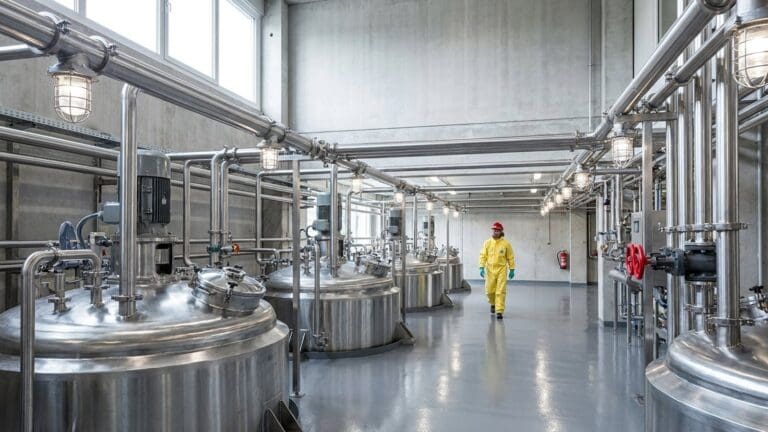
How ASME B31.3 fluid service categories, material selection, and contamination control decisions shape process piping in chemical and paint plants, plus what Northern Ohio winters and Ohio EPA air permits add to the job.
Need this handled at your facility?
Wilkes engineers, fabricates, and installs process piping, plumbing, and HVAC systems across Ohio.