Dust Collection System Design for Plants: Ducts, Fumes, NFPA 660
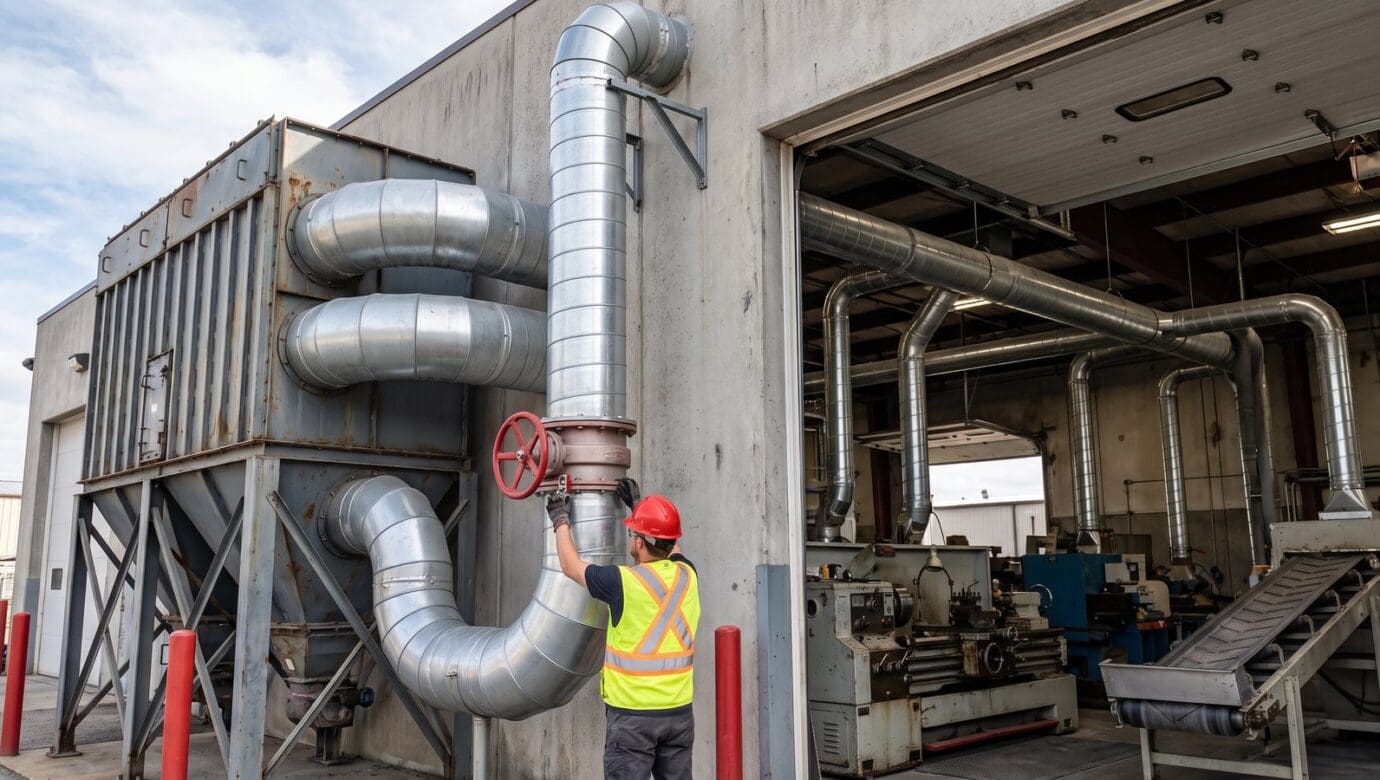
A dust collection system is the whole chain that pulls dust or fume away from the source and out of the workroom: hoods at the machines, ductwork sized to keep particles moving, a collector, a fan, a discharge, and the make-up air that replaces what leaves. On industrial HVAC projects, a hood that stops capturing usually points to reduced airflow, which OSHA traces to causes such as plugged ducts, blast gates in the wrong position, a clogged air cleaner, and branches added after the original installation. If the dust can burn, NFPA 660 and OSHA add explosion protection to the list.
This guide is for plant engineers, EHS managers, and maintenance leads at manufacturers in Huron, Sandusky, Norwalk, Fremont, Port Clinton, and Lorain County who are adding a collector or extending an older system to new machines. It covers how the system is laid out, protected, and permitted, not which brand to buy.
Key takeaways
- A dust collection system performs only as well as its hoods, duct velocities, fan, and make-up air.
- Capture falls off fast with distance: OSHA’s ventilation guidance shows capture velocity dropping by a factor of 10 between one and two duct diameters from a simple hood.
- If your dust can burn, NFPA 660 now holds the combustible dust requirements that used to sit in six separate NFPA standards.
- Stainless steel welding fume carries hexavalent chromium, which argues against returning filtered air to the room.
- In Ohio, a new or modified emissions unit needs an Ohio EPA permit before installation unless an exemption applies.
- Measured airflow at startup and records of every change keep a system performing for years.
What is a dust collection system, and which parts decide whether it works?
OSHA’s Technical Manual describes a typical local exhaust ventilation system as five parts: fans, hoods, ducts, air cleaners, and stacks, designed to capture a contaminant at or near its source before it disperses into the workplace air. The dust collector is the air cleaner in that list. It is one part of five, and it can only clean the air the hoods and ducts deliver to it.
The hood decides whether the dust gets into the system at all, and the ductwork decides whether it arrives at the collector or settles out along the way. The fan has to be sized for the real resistance of the system, and the building has to supply replacement air, or the system runs short of its design flow.
That is why we treat dust and fume collection as part of the plant’s air system rather than as a piece of equipment. On our industrial work, our own crews fabricate and install the ductwork and collector connections, and we size the make-up air that replaces what the collector removes.
Is your dust combustible, and what does NFPA 660 ask of you?
OSHA warns that any combustible material can burn rapidly in a finely divided form, and that even materials that do not burn in larger pieces, such as aluminum or iron, can be explosible as dust. Its examples include sugar, starch, flour, plastics, wood, paper, rubber, coal, and metals.
OSHA notes that the U.S. Chemical Safety and Hazard Investigation Board identified 281 combustible dust incidents between 1980 and 2005, with 119 deaths and 718 injuries. In its final report on the Didion Milling explosion, the CSB found that a fire spread through the process equipment via interconnected dust collection systems, causing explosions in some of the collection equipment and then secondary explosions throughout the facility.
According to NFPA, NFPA 660, Standard for Combustible Dusts and Particulate Solids, is a combination of NFPA 61, NFPA 484, NFPA 652, NFPA 654, NFPA 655, and NFPA 664. Requirements that used to sit in separate documents, such as NFPA 652 and NFPA 654, are now found in a single standard.
A dust hazard analysis is the natural starting point, because it identifies where fire, flash fire, and explosion hazards exist and what safeguards they call for. After Didion, the CSB recommended that NFPA strengthen its requirements for dust hazard analyses, incident investigations, and management of change.
OSHA has no overarching combustible dust standard, as the CSB has noted, but OSHA’s combustible dust standards page lists general industry rules that each reach part of the hazard, including ventilation (1910.94) and hazardous (classified) locations (1910.307). It also points to the General Duty Clause where no standard addresses a hazard.
How should hoods and dust collection ductwork be designed?
Put the hood where the dust is
A hood has to sit closer to the source than most people expect. OSHA’s ventilation chapter gives a simple example: with a plain hood and a duct velocity of 3,000 feet per minute, a source one duct diameter in front of the hood sees a capture velocity of about 300 feet per minute, and at two duct diameters that falls by a factor of 10, to 30 feet per minute. Air approaching a hood comes from every direction, so pulling a hood back a few inches costs far more capture than it looks like it should.
So enclose the operation as much as the work allows, and put the hood where the dust is thrown rather than where it is convenient to mount. As the same chapter puts it, an exhaust hood does little good if the welder does not know it must be positioned close to the work.
When a hood “doesn’t pull,” measure before resizing anything. OSHA lists the situations that reduce flow: plugged or dented ducts, slipping belts, open access doors, blast gates in the wrong position, a fan turning backward because its motor leads were reversed, branches added after the original installation, and a clogged air cleaner.
Keep the dust moving in the duct
Ductwork has to keep particles airborne until they reach the collector. OSHA notes that ducts plug when transport velocity is inadequate, or when condensing vapor wets the particles and builds up material. OSHA’s combustible dust emphasis program adds that the minimum required velocities can vary significantly based on dust characteristics.
For a sense of scale, OSHA’s ventilation standard for grinding, polishing, and buffing gives a recommended minimum duct velocity of 4,500 feet per minute in the branch and 3,500 feet per minute in the main for grinding wheels. That figure belongs to that operation, and the design should rest on the material your plant actually handles.
Layout matters as much as size, because every elbow and transition adds resistance. The Department of Energy’s fan sourcebook notes that placing an elbow close to the fan outlet can decrease the delivered flow by up to 30 percent.
Access is part of the design too. OSHA’s emphasis program has inspectors check for inspection and cleanout ports, and OSHA’s spray finishing rule requires clean-out doors every 9 to 12 feet of running length for ducts up to 12 inches in diameter.
How is welding fume extraction different from dust collection?
Welding fume is a health problem before it is a housekeeping problem. OSHA’s fact sheet on controlling hazardous fume and gases during welding notes that prolonged exposure to manganese fume can cause Parkinson’s-like symptoms, and that chromium in stainless steel and some consumables is converted to hexavalent chromium during welding. The same fact sheet gives OSHA’s permissible exposure limit for hexavalent chromium as 5 micrograms per cubic meter as an 8-hour time-weighted average.
Welding fume needs a collector selected for it, because the particles are so small. A peer-reviewed review of welding fume and lung disease describes welding fume as fine and ultrafine particles, with aerodynamic diameters of about 0.01 to 1 micrometer. EPA notes that some particles under 10 micrometers can get deep into the lungs, and that those under 2.5 micrometers pose the greatest risk to health. A collector that handles wood chips well can still pass welding fume if its filter media and airflow were never selected for it.
Capture at the arc is the priority. OSHA’s fact sheet recommends keeping fume hoods, extractor guns, and vacuum nozzles close to the plume source, and positioning flexible exhaust so fume is drawn away from the welder.
Then decide where the filtered air goes. OSHA’s ventilation chapter says recirculation is not generally recommended, should not be used if a carcinogen is present, and should include monitoring and a design that will not recirculate air during a malfunction. Because OSHA’s fact sheet lists cancer among the effects of hexavalent chromium fume, stainless steel welding is a strong case for exhausting outdoors and tempering the replacement air.
Where do explosion venting, isolation, and spark control belong?
Once the hazard analysis shows a deflagration hazard inside the collector, the protection has to be designed into the equipment and the ductwork together. NFPA 68 is the standard on explosion protection by deflagration venting, which releases deflagration pressure so damage is minimized. NFPA 69 covers explosion prevention systems for enclosures that hold flammable concentrations of dust.
OSHA’s emphasis program shows what an inspector expects to see on a dry collector inside a building: explosion protection, such as suppression or explosion vents ducted to a safe location outside, and deflagration isolation that keeps a flame front from traveling back through the ducts. Active isolation includes high-speed isolation valves and chemical flame-front quenching, and passive isolation includes flap valves, diverters, and rotary valves. At Didion, the fire moved through interconnected collection systems.
Several items on that inspection list belong to the ductwork. The program asks whether ductwork is conductive, bonded, and grounded to dissipate static, whether transport velocity keeps dust from accumulating, and whether systems returning clean air to buildings have spark detection, abort gates, or isolation. Those are fabrication decisions, and they are easier to build in than to add later.
Placement is the other lever. A collector outside the building wall, with vents aimed away from walkways and occupied areas, takes much of the explosion consequence out of the plant.
Why does make-up air decide whether the collector performs?
Every cubic foot a collector exhausts has to come back into the building. OSHA’s ventilation chapter states that if make-up air is not provided, a slight negative pressure will be created in the room and air flow through the exhaust system will be reduced, and that exhaust systems are generally interlocked with a dedicated make-up air system. Air that leaks in through cracks, under doors, and through roof vents is, in OSHA’s word, unacceptable.
In Northern Ohio that replacement air arrives cold for months at a time. An exhaust-heavy building without tempered make-up air goes negative in winter, and closing off openings to fight the draft starves the collector further. We size industrial exhaust and make-up air together and prove the balance with measured airflow at startup rather than relying on a submittal sheet.
Supply placement matters as well. OSHA notes that supply registers should be positioned so they do not disrupt emission and exposure controls. A make-up air unit that blows across the face of a hood will undo capture you paid for at the collector.
What permits and codes apply to a new dust collection system in Ohio?
Three sets of rules usually meet on a collector project. Ohio EPA regulates what leaves the stack, Ohio’s building codes and the local building department cover the exhaust work, and OSHA and NFPA 660 cover worker exposure and the dust hazard inside the plant.
What this means in Ohio: Ohio EPA states that before installing any new air contaminant emissions unit or modifying an existing one, a facility must apply for and be issued a permit-to-install or permit-to-install and operate, and installation may begin only after it is issued. Ohio EPA also lists more than 60 exemptions, and one commonly used exemption covers grinding, machining, abrasive blasting, woodworking, and pneumatic conveying controlled by an internally vented dust collector under 4,000 CFM. That exemption is written for collectors that vent inside the building, so a collector that exhausts outdoors, as we suggest above for stainless steel fume, needs its own look. Check the criteria before the purchase order goes out.
On the building side, Ohio adopts the exhaust systems chapter of the 2021 International Mechanical Code, with state modifications, through Ohio Administrative Code rule 4101:2-5-01. The Ohio Building Code’s administration rule also exempts process equipment from approval, while still requiring that work to comply with the code. Whether a collector and its ductwork count as process equipment or as part of a regulated exhaust system is a question to settle with the building department early, before drawings are final.
| Question | Where the answer comes from | What it means for the project |
|---|---|---|
| Can the dust burn or explode? | NFPA 660 and a dust hazard analysis | Where venting, isolation, and housekeeping are needed |
| Is the air safe to breathe? | OSHA exposure limits, such as the hexavalent chromium standard | Hood design, capture, and recirculation |
| What will an OSHA inspector check? | OSHA’s combustible dust emphasis program | Collectors, duct bonding, velocity, cleanouts |
| Does the stack need a permit? | Ohio EPA, OAC 3745-31 | Permit before installation unless exempt |
| How is the duct built and discharged? | Ohio Mechanical Code, exhaust chapter | Confirm building department review early |
How do you install a collector without shutting down the line?
A collector added to an existing plant ties into a running operation. We build as much of the duct as practical in our shop and keep the tie-in short, planned around your shutdown or weekend window. Tie-ins are hot work, and OSHA’s emphasis program points to 29 CFR 1910.252(a)(2)(vi)(C), which bars cutting and welding where explosive atmospheres, including mixtures of dust with air, may develop.
At CertainTeed Products Corp. in Avery, Ohio, our team installed a carbon steel welded fume collection system tailored to the plant’s asphalt storage operations. The same project included steam and condensate piping and gas and water flow meters, and the new systems had to be integrated without disrupting ongoing production.
For the rock crusher duct installation at United States Gypsum Company in Gypsum, Ohio, we installed fabricated ductwork for the entire HVAC system, along with the rooftop units, exhaust fans, and supply air fans. That pairing of exhaust and supply is the thread of this whole article, and it is how we approach dust and fume work across our industrial market.
If the project also touches process lines, see our guide to chemical plant piping. If the system still needs to be designed, our article on design-build mechanical contracting explains how one team carrying design and installation cuts change orders.
How do you keep a dust collection system performing after startup?
Start with numbers. At turnover, record measured airflow at each hood, static pressure at key points, and filter pressure drop against the design. OSHA’s abrasive blasting rule, for example, requires that the static pressure drop at the exhaust ducts be checked when the installation is completed and periodically after that, and that a partial blockage be cleaned out whenever the readings show one. OSHA’s ventilation chapter lays out an inspection rhythm that most plants can adapt:
- Daily: look at hoods, ductwork, access and cleanout doors, blast gate positions, hood static pressure, and pressure drop across the collector, and ask operators how the system is performing.
- Weekly: check collector capacity, the fan housing, and the belts.
- Monthly: inspect the collector components.
- As needed: tap the underside of horizontal ducts; a clean sheet metal sound means the duct is clear, and a heavy thud means settled dust or liquid.
- Always: keep drawings, fan curves, and test data on file, and record every modification and problem along with its resolution.
Filters deserve their own attention. The Department of Energy notes that in many systems poor performance is a direct result of inadequate attention to filter cleanliness, and it warns that oversized fans bring high energy costs, high maintenance, and reduced reliability.
Changes are where good systems drift. Adding a drop for a new machine or closing a gate to “boost” another hood rebalances the whole system, and on a combustible dust system that change belongs in your management of change process.
Frequently asked questions
What velocity should dust collection ductwork run at?
There is no single number, because the minimum transport velocity depends on the material and how heavily the air is loaded. For grinding wheels, OSHA’s ventilation standard recommends at least 4,500 feet per minute in the branch and 3,500 in the main, which shows the order of magnitude, but the design should rest on data for your own dust.
Can a dust collector be installed inside the building?
It can, but it brings more requirements when the dust is combustible. OSHA’s emphasis program directs inspectors to check that dry collectors inside buildings have explosion protection, such as suppression or vents ducted safely outside, plus isolation that stops a flame front from moving through the ducts.
Do I need an Ohio EPA permit for a new dust collector?
It depends on the operation and its emissions. Ohio EPA requires a permit before a new or modified air contaminant emissions unit is installed, but it also lists more than 60 exemptions, including one for several operations controlled by an internally vented collector under 4,000 CFM. A collector that exhausts outdoors does not fit that description, so check the criteria before ordering equipment.
Can filtered air from a dust collector be returned to the plant?
Sometimes, with care. OSHA’s ventilation guidance says recirculation is not generally recommended, should not be used if a carcinogen is present, and needs monitoring plus a design that stops recirculating during a malfunction. For combustible dust, OSHA’s emphasis program also looks for spark detection, abort gates, or isolation.
How often should a dust collection system be inspected?
OSHA’s ventilation chapter suggests daily visual checks of hoods, ducts, blast gates, and pressure readings, weekly checks of the fan and belts, and monthly inspection of collector components. Comparing pressure readings against startup values is a practical way to spot a plugging duct or a loading filter.
Talk to Wilkes about your project
Bring what you have: the materials you handle, safety data sheets, any dust test results or dust hazard analysis, drawings or photos of the area, the machines or weld stations to connect, and your shutdown windows. For an existing collector, its nameplate data and airflow readings help us start from facts. We fabricate and install the ductwork, blast gates, transitions, and collector connections, and we size the make-up air with it.
Wilkes Plumbing & Heating is at 205 Sprowl Rd, Huron, OH 44839, serving Huron, Sandusky, Norwalk, Port Clinton, Vermilion, Lorain, Fremont, and the surrounding counties. Call (419) 433-2325, or request a quote.
Keep reading
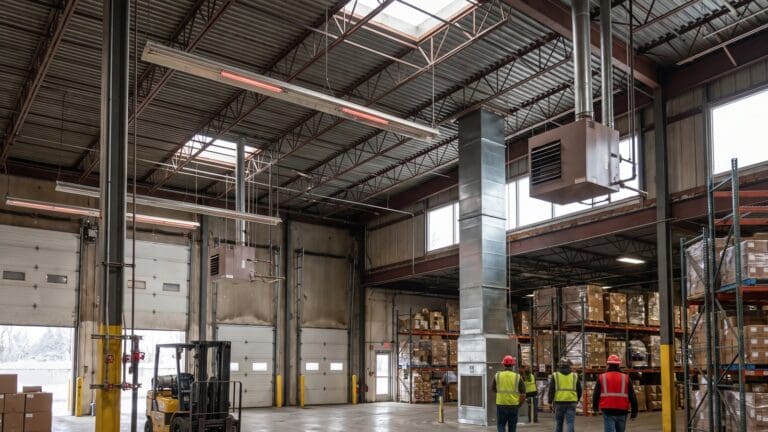
Warehouse Heating in Ohio: Unit Heaters, Infrared and Make-Up Air
A plant engineer's guide to choosing between unit heaters, radiant tube heaters, destratification fans and make-up air, and to balancing exhaust so the building stops fighting its own heat.
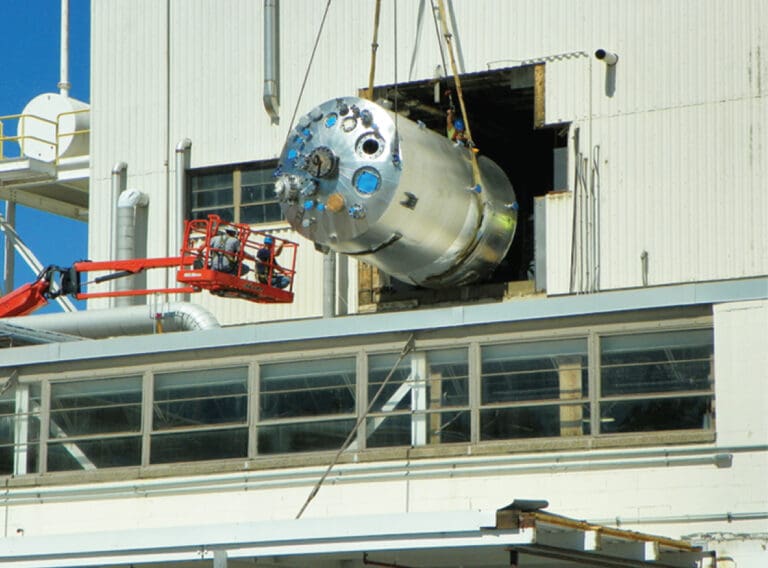
Turnkey Process Piping and a Reactor Install at AkzoNobel
A look inside a turnkey reactor installation and stainless steel process piping scope spread across seven buildings at a Huron, Ohio chemical plant, sequenced so production never stopped.
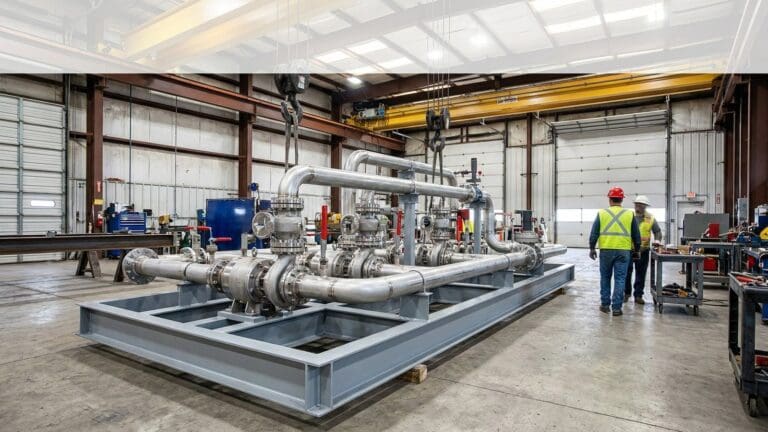
Prefabricated Piping Skids: Faster Installs, Cleaner Welds
Prefabricated piping skids move the slow, inspection-heavy work off your production floor and into a controlled shop. Here is how Northern Ohio plants scope, test, rig, and tie in a modular process assembly without losing production time.
Need this handled at your facility?
Wilkes engineers, fabricates, and installs process piping, plumbing, and HVAC systems across Ohio.