Commercial Plumbing Contractor Sandusky Ohio and Erie County
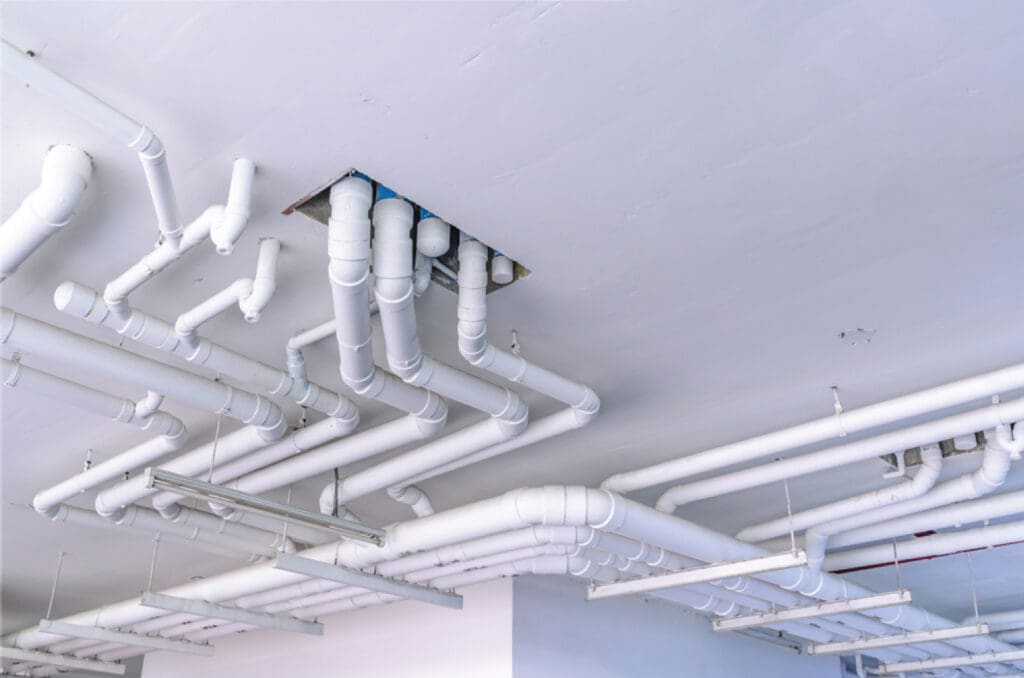
Our crews handle commercial plumbing installation on new construction and tenant fit outs, commercial plumbing repair in occupied buildings, commercial water heater replacement, grease waste and vent work, natural gas piping, and annual backflow testing. The same company carries the HVAC scope, so one contractor owns the mechanical work instead of two trades pointing at each other.
Manufacturers, hospitals, schools and commercial property owners near Lake Erie deal with hard water, freeze exposure and aging cast iron. We size, install and service systems with those conditions in front of us.
Commercial plumbing built to code
- Domestic water and drainage
- Grease waste and vents
- Commercial water heater replacement
- Backflow assembly testing
- Natural gas piping
- Repairs in occupied buildings
What we install, repair and maintain
Installation and construction
- Domestic water mains and risers
- Sanitary, storm and vent piping
- Grease interceptors and waste lines
- Fixtures, carriers and trim
- Sump and sewage ejector pumps
Repair, testing and service
- Leak location and pipe replacement
- Commercial water heater replacement
- Backflow assembly testing and repair
- Drain cleaning and camera inspection
- Freeze damage repair and heat trace
What does a commercial plumbing contractor Sandusky Ohio buildings rely on actually do?
Commercial work is a different animal from residential. You are sizing domestic water mains and risers for peak fixture demand, running sanitary, storm and vent piping through occupied floors, handling grease waste, natural gas, compressed air and process drains, and keeping the potable system isolated from every hazard connected to it. Materials, joint methods, support spacing and testing follow the Ohio Plumbing Code, adopted in Ohio Administrative Code 4101:3, with building services piping practice drawn from ASME B31.9.
It also means working around production. A shutdown on a paint line or a hospital wing is measured in hours, so the sequence, the isolation points and the temporary services get planned before anyone opens a wall. If you are deciding what level of contractor a job needs, our comparison of plumbing contractors and plumbers lays out the difference in scope, coordination and documentation.
What commercial plumbing installation work does Wilkes handle?
New buildings, additions, tenant fit outs, riser replacements and equipment tie ins. A typical scope covers underground sanitary and water service, above ground waste and vent, domestic hot and cold distribution, fixtures and carriers, water heaters, booster pumps, sump and sewage ejector pumps, gas piping to rooftop units and process equipment, and the trenching, sleeving and firestop work that goes with it.
At NASA’s facility in Sandusky, Ohio, we installed domestic water and sanitary piping, plumbing fixtures and sump pumps, and performed steam and condensate work during bathroom remodels. The NASA project page lists that scope. We have also performed mechanical work at Oberlin College in Lorain County. Because plumbing and commercial plumbing and HVAC are carried by the same company, hangers, penetrations and equipment connections stay coordinated instead of being fought out in the field.
How is commercial plumbing repair handled in an occupied building?
Repair starts with finding the real failure rather than the symptom. A wet ceiling tile can be a pinholed copper branch, a failed shower pan, a condensate line or a roof drain joint. We isolate the zone, prove the source, and give you the options with what each one costs in downtime.
Winter drives a large share of these calls in northern Ohio. Lake Erie snow and long stretches below freezing find every uninsulated line in an unheated warehouse, every dead leg over a loading dock door, and every backflow assembly sitting in an unheated vestibule. Freeze protection, heat trace and proper draining belong in the fall walkthrough, not in a January emergency.
Older buildings in Sandusky, Norwalk and Vermilion still run cast iron and galvanized steel that has lost most of its inside diameter. Where lead solder or lead bearing fittings may be present on a potable line, replacement decisions are guided by the EPA Lead and Copper Rule.
When does commercial water heater replacement make sense?
Rust in the hot water, a tank that will not hold setpoint, a failed flue or a unit past its design life all point the same direction. Repair is worth it when the failure is a control, a gas valve, an anode or a circulator. Replacement wins when the tank is leaking, the burner is obsolete, or capacity no longer matches how the building is used.
Size on real demand, not on whatever was there in 1985. We look at fixture counts, kitchen and laundry loads, recirculation, and whether a condensing unit, a semi instantaneous heater or storage fed from the boiler fits the mechanical room. Ratings published for Energy Star commercial water heaters make units comparable, and storage and distribution temperatures should be set with ASHRAE Standard 188 in mind wherever the owner keeps a water management program. Hospital and clinic owners can see how we approach healthcare mechanical work.
What does Ohio require for backflow prevention and maintenance?
Public water systems in Ohio run cross connection control programs under Ohio Administrative Code 3745-95, and the assemblies protecting the supply are tested on a set schedule by a certified tester. The Ohio EPA backflow prevention pages explain the state requirements, and our backflow testing service covers annual testing, repair and rebuild.
Everything else is a schedule you can hold someone to. Our commercial plumbing maintenance checklist walks through drain and interceptor service, water heater inspection, valve exercise and freeze prep. Plants that also run product lines get the same crews through our industrial process piping group, and buildings inside our Sandusky service area are a short drive from the Huron shop.
Talk to Wilkes about your building
Call (419) 433-2325 Monday to Friday, 8:00 AM to 4:00 PM, or request a quote and send drawings, a fixture count or a photo of the failed equipment. Tell us the building, the system and the date it has to be back in service, and we will tell you what the work involves.
Frequently asked questions
What areas does Wilkes cover for commercial plumbing?
We work from Huron, Ohio across Erie, Huron, Lorain, Ottawa and Sandusky counties, including Sandusky, Norwalk, Port Clinton, Vermilion, Lorain and Fremont, and we take projects across Ohio. Larger plant and institutional jobs regularly take our crews outside the immediate lakeshore area, so ask about your site even if it is farther out.
Do you handle both the plumbing and the HVAC on a job?
Yes. Wilkes is a mechanical contractor, so plumbing, HVAC, hydronic heating, process piping, and welding and fabrication all come from one company. On a fit out or a renovation that keeps hangers, roof penetrations, gas piping and equipment connections under a single scope, which removes most of the coordination arguments between trades.
How often does a backflow assembly have to be tested in Ohio?
Ohio public water systems run cross connection control programs under Ohio Administrative Code 3745-95, and assemblies are tested on the schedule the water supplier sets, commonly once a year, by a certified tester. Your local supplier issues the notice and receives the report, so keep the test records with the building file.
Can you repair a leak without shutting the whole building down?
Usually. We map the isolation valves first and shut the smallest branch that lets us work, then set temporary service if a critical fixture group or process line has to stay live. On buildings with missing or frozen valves, adding proper isolation during the repair is often the cheapest part of the job.
Should I repair or replace a failing commercial water heater?
Repair a control, gas valve, anode or circulator. Replace when the tank leaks, the burner is obsolete, the flue is failing, or demand has outgrown the unit. We size the replacement on current fixture and process loads rather than matching the old nameplate, and we review venting, gas capacity and recirculation before quoting.
Request a commercial plumbing quote
Commercial Plumbing
Wilkes Family of Companies